Home
Class 11
PHYSICS
An ideal monoatomic gas is confined in a...

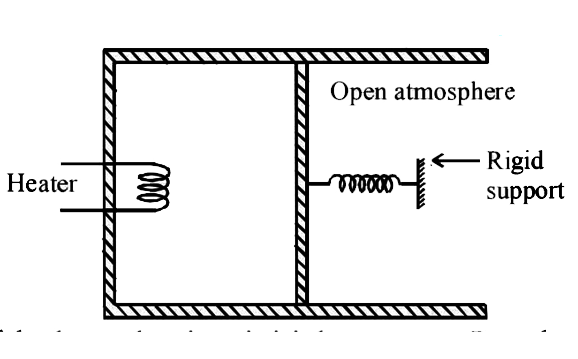
An ideal monoatomic gas is confined in a cylinder by a spring-loaded piston of cross-section `8.0xx10^-3m^2`. Initially the gas is at 300K and occupies a volume of `2.4xx10^-3m^3` and the spring is in its relaxed (unstretched, unompressed) state, fig. The gas is heated by a small electric heater until the piston moves out slowly by 0.1m. Calculate the final temperature of the gas and the heat supplied (in joules) by the heater. The force constant of the spring is `8000 N//m`, atmospheric pressure is `1.0xx10^5 Nm^-2`. The cylinder and the piston are thermally insulated. The piston is massless and there is no friction between the piston and the cylinder. Neglect heat loss through lead wires of the heater. The heat capacity of the heater coil is negligible. Assume the spring to be massless.

Text Solution

Verified by Experts

Initially, the pressure of the gas in the cylinder is atmosphere pressure as spring is in relaxed state. Therefore,
`P_(1)` atmospheric pressure `= 1.0 xx 10^(5) N//m^(2)`
`V_(1)`= initial volume `= 2.4 xx 10^(3) m^(3)`
`T_(1)` - initial temperature = 300 K
When the heat is supplied by the heater, the piston is compressed by 0.1 m. The reaction force of compression of spring is equal to kx which acts on the piston or on the gas as
`F = kx = 8000 xx 0.1 xx 800 N`
Pressure exerted on the piston by the spring is
`Delta P = (F)/(A) = (800)/(8 xx 10^(-3)) = 1 xx 10^(5) N//m^(2)`
The total pressure `P_(2)` of the gas inside cylinder is
`P_(2) = P_(atm) + Delta P =1 xx 10^(5) + 1 xx 10^(5) = 2 xx 10^(6) N//m^(2)`
Since the piston has moved outwards, there has been an increase of `Delta V` in the volume of the gas, i.e.,
`Delta V = A xx x = (8 xx 10^(-3)) xx (0.1)`
`= 8 xx 10^(-4) m^(3)`
The final volume of the gas
`V_(2) = V_(1) + Delta V = 2.4 xx 10^(-3) + 8 xx 10^(-4) = 3.2 xx 10^(-3) m^(3)`
Let `T_(2)` be the final temperature of gas. Then
`(P_(1) V_(1)//T_(1)) = (P_(2) V_(2)//T_(2)) implies T_(2) (P_(2) V_(2)//P_(1) V_(1)) T_(1)`
`= 300 xx (2 xx 10^(5) xx 3.2 xx 10^(-3))//(10^(5) xx 2.4 xx 10^(-3))`
`= 800 K`
Let the heat supplied by the heater be Q. This is used in two parts, i.e., a part is used in doing external work W due to expansion of the gas and the other part is used in increasing h internal energy of the gas. Hence,
`Q = W + Delta U`
Now `W = int_(V_(1))^(V_(2)) PdV = int_(0)^(x) (P_(atm) + (kx)/(A)) Adx`
[as pressure is `(P_(atm + kx//A` and `dV = Adx)]`
or `W = P_(atm) Ax + ((kx^(2))/(2))`
`= [10^(5) xx (8 xx 10^(-3)) (0.1) + (8000 xx (0.1)^(2))/(2)] = 120 J`
Further, `Delta = nC_(v) Delta T`
Number of moles of gas can be obtained from initial conditions and gas law is
`n = ((PV)/(RT)) = ((1 xx 10^(5) xx 2.4 xx 10)/(8.314 xx 300)) = 0.096 mol`
Thus, change in internal energy of gas is given as
`Delta U = n ((3)/(2) R) Delta T` (as for monatomic gas `C_(V) = (3)/(4) R`)
or `U = 0.906 xx (3)/(2) xx 8.314 xx 598.6 J`
Heat supplied by the heater = (120 + 598.6) = 718.6 J.
Promotional Banner

Topper's Solved these Questions

  • KINETIC THEORY OF GASES AND FIRST LAW OF THERMODYNAMICS

    CENGAGE PHYSICS|Exercise Exercise 2.1|20 Videos
  • KINETIC THEORY OF GASES AND FIRST LAW OF THERMODYNAMICS

    CENGAGE PHYSICS|Exercise Exercise 2.2|28 Videos
  • KINETIC THEORY OF GASES AND FIRST LAW OF THERMODYNAMICS

    CENGAGE PHYSICS|Exercise Interger|11 Videos
  • KINETIC THEORY OF GASES

    CENGAGE PHYSICS|Exercise Compression|2 Videos
  • LINEAR AND ANGULAR SIMPLE HARMONIC MOTION

    CENGAGE PHYSICS|Exercise Multiple Correct Answer Type|9 Videos

Similar Questions

Explore conceptually related problems

An ideal monatonic gas is confined in a cylinder by a spring-loaded piston of cross section 8.0xx10^(-3) m^(2). initially the gas is at 300K and occupies a volume of 2.4xx10^(-3)m^(-3) and the sprinng is in its relaxed state. The gas is heated by a small heater until the piston moves out slowly by 0.1m. Calculate the final tenoerature of the gas. The force constant if the spring is 8000Nm^(-1) ,and the atmospheric pressure is 1.0xx10^(5)Nm^(-2).Hte cylinder and the piston are thermally insylated. The piston and the spring are massless and there is no friction between the piston and the cylinder. Neglect any heat-loss through the lead wires of the heater. The heat capacity of the heater coil is negligible.

An ideal monoatomic gas is confined in a horizontal cylinder by a spring loaded piston (as shown in the figure). Initially the gas is at temperature T_1 , pressure P_1 and volume V_1 and the spring is in its relaxed state. The gas is tehn heated very slowly to temperature T_2 ,pressure P_2 and volume V_2 . During this process the piston moves out by a distance x. Ignoring the friction between the piston and the cylinder, the correct statement (s) is (are)

Two mole of an ideal monatomic gas are confined within a cylinder by a mass less spring loaded with a frictionless piston of negligible mass and crossectional area 4xx10^(-3)m^(2) . The gas is heated by a heater for some time. During this time the gas expands and does 50J of work in moving the piston through a distance of 0.01 m. The temperature of gas increases by 50 k. Heat supplied by heater during this process is

Two mole of an ideal monatomic gas are confined within a cylinder by a mass less spring loaded with a frictionless piston of negligible mass and crossectional area 4xx10^(-3)m^(2) . The gas is heated by a heater for some time. During this time the gas expands and does 50J of work in moving the piston through a distance of 0.01 m. The temperature of gas increases by 50 k. The force constant of spring is

Two moles of an ideal monoatomic gas are confined within a cylinder by a massless and frictionless spring loaded piston of cross-sectional area 4 xx 10^(-3)m^(2) . The spring is, initially in its relaxed state. Now the gas is heated by an electric heater, placed inside the cylinder, for some time. During this time, the gas expands and does 50J of work in moving the piston through a distance 0.10m . The temperature of the gas increases by 50K . Calculate the spring constant and the heat supplied by the heater. P_(atm) = 1 xx 10^(5)N//m^(2)R = 8.314 J//mol-K

Two mole of an ideal monatomic gas are confined within a cylinder by a mass less spring loaded with a frictionless piston of negligible mass and crossectional area 4xx10^(-3)m^(2) . The gas is heated by a heater for some time. During this time the gas expands and does 50J of work in moving the piston through a distance of 0.01 m. The temperature of gas increases by 50 k. Change in internal energy of the gas is

In the arrangement shown in Fig. gas is thermally insulated. An ideal gas is filled in the cylinder having pressure P_(0) (gt atmospheric pressure P_(0) ). The spring of force constant K is initially unstretched. The piston of mass m and area S is frictionless. In equilibrium, the piston rises up by distance x_(0) , then

A diatomic gas is enclosed in a vessel fitted with massless movable piston. Area of cross section of vessel is 1m^2 . Initial height of the piston is 1m (see the figure). The initial temperature of the gas is 300K. The temperature of the gas is increased to 400K, keeping pressure constant, calculate the new height of the piston. The piston is brought to its initial position with no heat exchange. Calculate the final temperature of the gas. You can leave answer in fraction.
