Home
Class 11
PHYSICS
A sample of an ideal gas is taken throug...

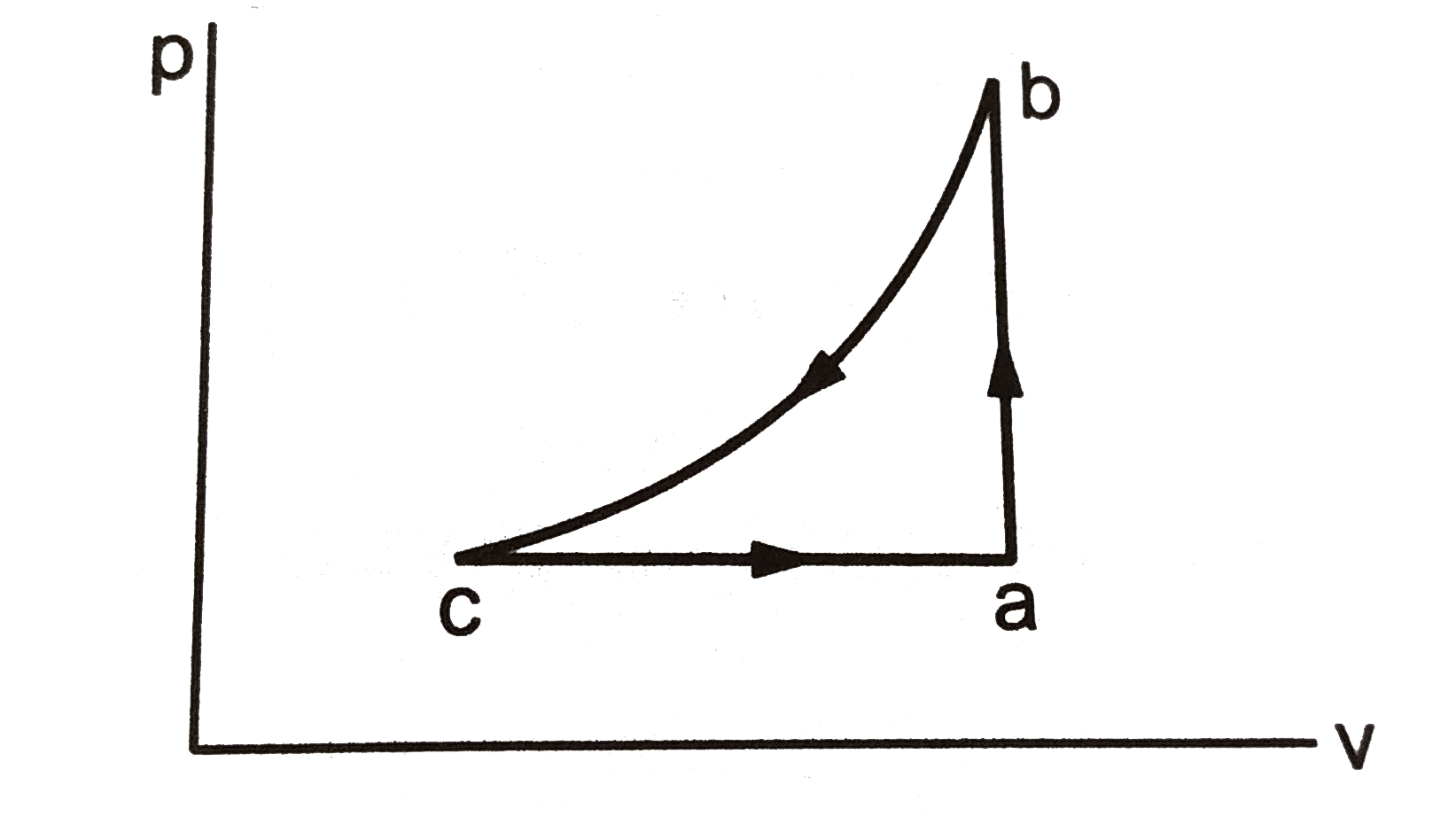
A sample of an ideal gas is taken through the cyclic process `abca` . It absorbs `50 J` of heat during the part `ab`, no heat during `bc` and rejects `70 J` of heat during `ca`. `40 J` of work is done on the gas during the part `bc`.
(a) Find the internal energy of the gas at `b` and `c` if it is `1500 J` at `a`.
(b) Calculate the work done by the gas during the part `ca`.

Text Solution

Verified by Experts

a. In the part `ab` the volume remains constant. Thus, the work done by the gas is zero. The heat absorbed by the gas is `50 J` The increase in internal energy from a to b is
`Delta U = Delta Q = 50 J`
As the internal energy is `1500 J` at `a`, it will be `1500 J` at `b`. In the part `bc`, the work done by the gas is `Delta W = - 40 J` and no heat is given to the system. The increase in internal energy from b to c is `Delta U - Delta W = 40 J`
As the internal energy is `1550 J` at `b`, it will be `1590 J` at c.
b. The change in internal energy from c to a is
`Delta U = 1500 J - 1590 J = - 90 J`
The heat given to the system is `Delta Q = - 70 J`.
Using `Delta Q = Delta U + Delta W`,
`Delta W ca = Delta Q - Delta U = - 70 J + 90 J = 20 J`
Promotional Banner

Topper's Solved these Questions

  • KINETIC THEORY OF GASES AND FIRST LAW OF THERMODYNAMICS

    CENGAGE PHYSICS|Exercise Subjective|22 Videos
  • KINETIC THEORY OF GASES AND FIRST LAW OF THERMODYNAMICS

    CENGAGE PHYSICS|Exercise Single Correct|140 Videos
  • KINETIC THEORY OF GASES AND FIRST LAW OF THERMODYNAMICS

    CENGAGE PHYSICS|Exercise Exercise 2.1|20 Videos
  • KINETIC THEORY OF GASES

    CENGAGE PHYSICS|Exercise Compression|2 Videos
  • LINEAR AND ANGULAR SIMPLE HARMONIC MOTION

    CENGAGE PHYSICS|Exercise Multiple Correct Answer Type|9 Videos

Similar Questions

Explore conceptually related problems

A sample of an ideal gas in taken through the cyclic process abca in the given figure. It absorbs 50 J of heat during the parth ab, no heat during bc and rejects 70J of heat during ca, 40 J of work is done on the gas during the part bc. (a) Find the internal energy of the gas at b adn c if it is 1500 J at a. ltbr. (b) Calculate the work done by the gas during the part ca.

In figure, a sample of an ideal gas is taken through the cyclic process abca. 800J of work is done by the gas during process ab. If gas absorb no heat in process ab, rejects 100J of heat during bc and absord 500J of heat during process ca . Then (a) find the internal energy of the gas at b and c if its is 1000J at a (b). Also calculate the work by the gas during the part bc ,

A sample of an ideal gas is taken through the cyclic-process ABCA shown in Fig. It rejects 50 J of heat during the part AB , doens not absorb or reject the heat during BC , and accepts 70 J of heat during CA . Forty joules of works is done on the gas during the part BC . The internla energies at B and C , respectively, will be

A sample of an ideal gas is taken through the cyclic process abca and shown in the figure. The chagne in the internal energy of the gas along the path ca is -180J . The gas aborbs 250J of heat along the path ab and 60 J along the path bc. the work done by the along the path abc is:

In a process, 701 J of heat is absorbed by a system and 394 J of work is done by the system. What is the change in internal energy for the process?

A gas is taken through a cyclic process ABCA as shown in, if 2.4 cal of heat is given in the process, what is the value of J ?

A system works in a cyclic process. It absorbs 20 calories of heat and rejects 60 J of heat during the process. The magnitude of work done (J) is [ 1 "calorie"=4.2 J] :

CENGAGE PHYSICS-KINETIC THEORY OF GASES AND FIRST LAW OF THERMODYNAMICS-Exercise 2.2
  1. Explain why the temperature of a gas drops in an adiabatic expansion,...

    Text Solution

    |

  2. In what process is the heat added entirely converted into internal ene...

    Text Solution

    |

  3. When a gas is compressed adiabaticlly, it becomes more elasitc. Is thi...

    Text Solution

    |

  4. A cylinder contains 3 moles of oxygen at a temperature of 27^(@)C. The...

    Text Solution

    |

  5. What amount of heat is to be transferred to nitrogen in an isobaric he...

    Text Solution

    |

  6. As a result of the isobaric heating by DeltaT=72K, one mole of a certa...

    Text Solution

    |

  7. A certain mass of a gas is compressed first adiabatically, and then is...

    Text Solution

    |

  8. A cylindrical vessel of 28 cm diameter contains 20 g of nitrogen compr...

    Text Solution

    |

  9. One mole of oxygen is heated at constant pressure starting at 0^(@)C. ...

    Text Solution

    |

  10. An ideal gas expands from an initial temperature T(1) to a final tempe...

    Text Solution

    |

  11. An ideal gas whose adiabatic exponent equals gamma expands so that the...

    Text Solution

    |

  12. On mole of argon expands polytropically, the polytropic constant being...

    Text Solution

    |

  13. Find out the work done in the given graph. Also draw the corresponding...

    Text Solution

    |

  14. Two moles of a diatomic gas at 300 K are kept in a nonconducting conta...

    Text Solution

    |

  15. A sample of an ideal gas is taken through the cyclic process abca . It...

    Text Solution

    |

  16. The internal energy of a monatomic ideal gas is 1.5 nRT.One mole of he...

    Text Solution

    |

  17. A sample of ideal gas (gamma = 1.4) is heated at constant pressure. If...

    Text Solution

    |

  18. P-V curve of a diatomic gas is shown in the Fig. Find the total heat g...

    Text Solution

    |

  19. A monoatomic gas is enclosed in a nonconducting cylinder having a pist...

    Text Solution

    |

  20. A nonconducting cylinder having volume 2 V(0) is partitioned by a fixe...

    Text Solution

    |
