Home
Class 11
PHYSICS
Figure shows an isochore, an isotherm, a...

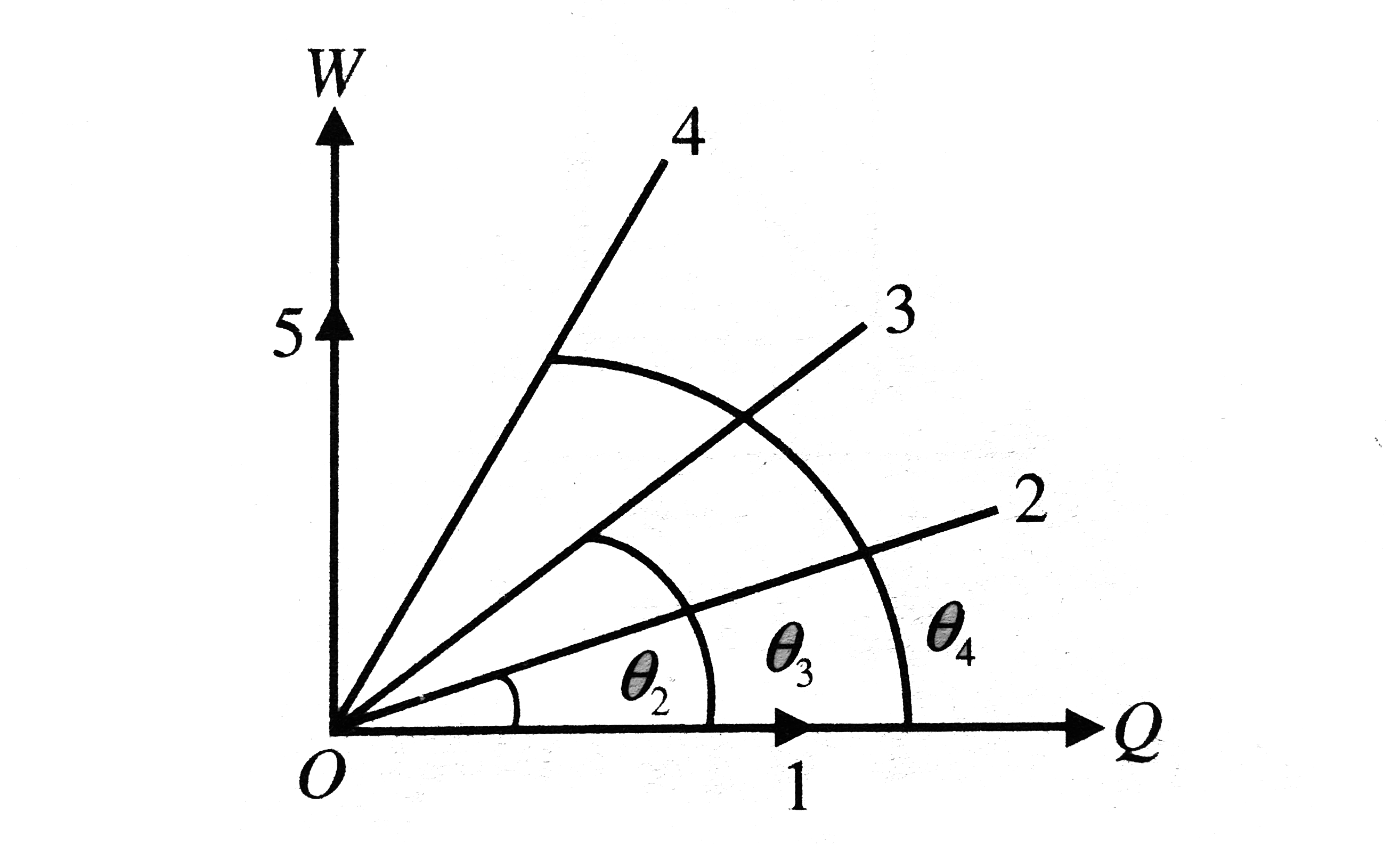
Figure shows an isochore, an isotherm, an adiabatic and two isobars of two gases on a work done versus heat supplied curve. The initial states of both gases are the same and the scales for the two axes are same.

A

Straight line 1 corresponds to an isochoric process.

B

Straight line 2 corresponds to an isobaric process for diatomic gas.

C

Straight line 4 corresponds to an isothermal process.

D

Straight line 5 corresponds to an isothermal process.

Text Solution

Verified by Experts

The correct Answer is:

D

d. From the first law of thermodynamics
`Q = W + Delta U`
For an isobaric process
`W = R Delta T, Q = C_(P) Delta T = ((f + 2)/(2)) R Delta T`
`(W)/(Q) = (2)/(f + 2)`
where f is the number of degrees of freedom For an isochoric process.
`W = 0, (W)/(Q) = 0`
The straight line 1 corresponds toan isochoric process.
For monatoic gas `f = 3` and for diatomic gas `f = 5`.
`(W)/(Q) = (2)/(5)` (for monatomic gas)
`= (2)/(7)` (for diatomic gas)
Straight line 2 corresponds to isobaric process for diatomic gas straight line 3 corresponds to isobaric process for monatomic gas.
For isotherm `W = Q, tan theta_(4) = 1` straight line 4 only if `Delta T = 0` i.e., `Delta U = 0`, For an adiabatic process `Q = 0`, the straight line 5 corresponds to it.
Promotional Banner

Topper's Solved these Questions

  • KINETIC THEORY OF GASES AND FIRST LAW OF THERMODYNAMICS

    CENGAGE PHYSICS|Exercise Multiple Corrects|29 Videos
  • KINETIC THEORY OF GASES AND FIRST LAW OF THERMODYNAMICS

    CENGAGE PHYSICS|Exercise Assertion-Reasoning|6 Videos
  • KINETIC THEORY OF GASES AND FIRST LAW OF THERMODYNAMICS

    CENGAGE PHYSICS|Exercise Subjective|22 Videos
  • KINETIC THEORY OF GASES

    CENGAGE PHYSICS|Exercise Compression|2 Videos
  • LINEAR AND ANGULAR SIMPLE HARMONIC MOTION

    CENGAGE PHYSICS|Exercise Multiple Correct Answer Type|9 Videos

Similar Questions

Explore conceptually related problems

The amount of heat supplied to an ideal gas is laid off on the horizontal axis and the amount of work performed by the g-as is laid off on the vertical axis. One of the straight lines in the ligure is an isotherm and the other two are isobars of two gases. The initial states of hoth gases (pressure, temperature, volume) are the same, and the scales on the two axes coincide. Which straight line corresponds to which process? How many degrees of freedom does each gas have? (Vibrational degrees of freedom are not to be taken into account.) The graphs of what processes coincide with the coordinate axes?

Figure shows the variation in temperature (DT) with the amount of heat supplied (Q) in an isobaric process corresponding to a monoatomic (M), diatomic (D) and a polyatomic (P) gas. The initial state of all the gases are the same and the scales for the two axes coincide. Ignoring vibrational degrees of freedom, the lines a, b and c respectively correspond to

A gas is first compressed adiabatically and then isothermally. In both cases, the initial state of the gas is the same. Find in which case more work is done on the gas.

Under the same conditions, two gases have the same number of molecules. They must:

Under the same conditions, two gases have the same number of molecules. They must

A certain mass of nitrogen was compressed eta = 5.0 times (in terms of volume), first adiabatically, and then isothermally. In both cases the initial state of the gas was the same. Find the ratio of the respective works expended in each compression.

Two samples A and B are initaially kept in the same state. The sample A is expanded through an adiabatic process and the sample B through an isothermal process. The final volumes of the samples are the same . The final pressures in A and B are p_A and P_B respectively.

A certain mass of a gas is compressed first adiabatically, and then isothermally. In both cases, the initial state of the gas is the same. Is the work done W_(1) in the first case greater than the work done W_(2) in the second case ? Explain.

CENGAGE PHYSICS-KINETIC THEORY OF GASES AND FIRST LAW OF THERMODYNAMICS-Single Correct
  1. A cylindrical chamber A of uniform cross section is divided into two p...

    Text Solution

    |

  2. An ideal gas (1 mol, monatomic) is in the intial state P (see Fig.) on...

    Text Solution

    |

  3. Figure shows an isochore, an isotherm, an adiabatic and two isobars of...

    Text Solution

    |

  4. A stationary cylinder of oxygent used in a hospital has the following ...

    Text Solution

    |

  5. A sample of ideal gas is expanded to twice its original volume of 1.00...

    Text Solution

    |

  6. One mole of air (C(V) = 5R//2) is confined at atmospheric pressure in ...

    Text Solution

    |

  7. A thermodynamic process is shown in Fig. The pressures and volumes cor...

    Text Solution

    |

  8. Carbon monoxide is carried around a closed cyclic processes abc, in wh...

    Text Solution

    |

  9. An ideal gas is taken through a cyclic thermodynamic process through f...

    Text Solution

    |

  10. Pressure versus temperature graph of an ideal gas as shown in Fig. C...

    Text Solution

    |

  11. An ideal gas is taken through the cycle AtoBtoCtoA, as shown in the fi...

    Text Solution

    |

  12. Two identical containers A and B with frictionless pistons contain the...

    Text Solution

    |

  13. Argon gas is adiabatically compressed to half its volume. If P, V and ...

    Text Solution

    |

  14. A fixed mass of helium gas is made to undergo a process in which its p...

    Text Solution

    |

  15. Oxygen gas is made to undergo a process in which its molar heat capaci...

    Text Solution

    |

  16. If the ratio of specific heat of a gas of constant pressure to that at...

    Text Solution

    |

  17. A gas is at 1 atm pressure with a volume 800 cm^(3). When 100 J of hea...

    Text Solution

    |

  18. A fixed mass of a gas is first heated isobarically to double the volum...

    Text Solution

    |

  19. An ideal heat engine has an efficiency eta. The cofficient of performa...

    Text Solution

    |

  20. Two moles of helium gas are taken along the path ABCD (as shown in Fig...

    Text Solution

    |
