Home
Class 11
PHYSICS
An ideal gas expands isothermally from v...

An ideal gas expands isothermally from volume `V_(1)` to `V_(2)` and is then compressed to original volume `V_(1)` adiabatically. Initialy pressure is `P_(1)` and final pressure is `P_(3)`. The total work done is `W`. Then

A

`P_(3) gt P_(1), W gt 0`

B

`P_(3) lt P_(1), W lt 0`

C

`P_(3) gt P_(1), W lt 0`

D

`P_(3) = P_(1), W = 0`

Text Solution

Verified by Experts

The correct Answer is:
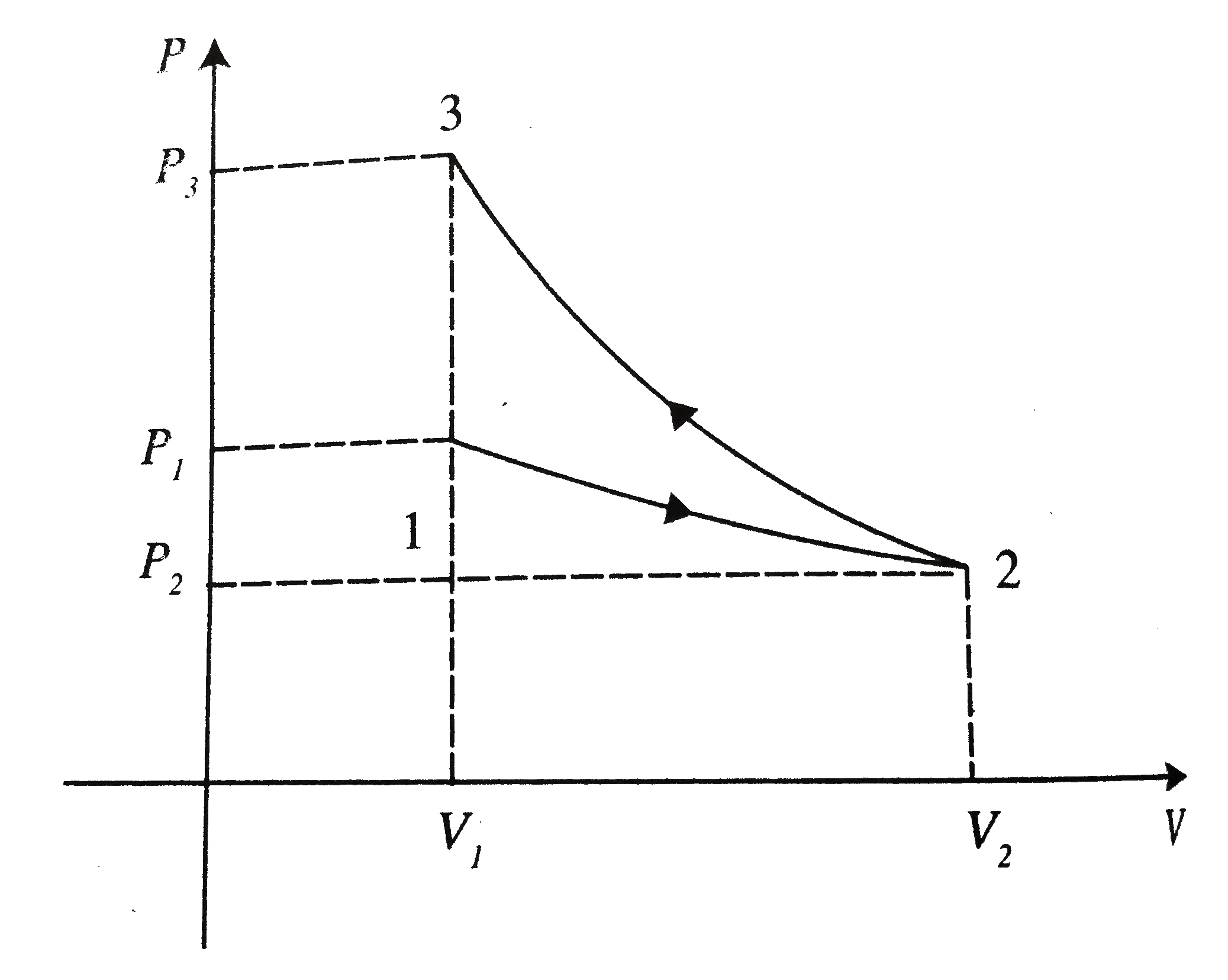
C

For isothermal process :
`P_(1) V_(1) = P_(2) V_(2)`
i.e., `P_(1) = ((V_(2))/(V_(1))) P_(2)`
For adiabatic process :
`P_(3) V_(1)^(gamma) = P_(2) V_(2)^(gamma)`
i.e., `P_(3) = ((V_(2))/(V_(1)))^(gamma) P_(2)`
As `gamma gt 1`, hence `P_(3) gt P_(1)`,
Further, as slope of adiabatic curve is greater than that of isothermal process curve, adiabatic curve will lie above the isothermal curve. That is, area under adiabatic curve gt area under isothermal curve
i.e., Negative work gt Positive work
i.e., `W lt 0`
Promotional Banner

Topper's Solved these Questions

  • KINETIC THEORY OF GASES AND FIRST LAW OF THERMODYNAMICS

    CENGAGE PHYSICS|Exercise Multiple Corrects|29 Videos
  • KINETIC THEORY OF GASES AND FIRST LAW OF THERMODYNAMICS

    CENGAGE PHYSICS|Exercise Assertion-Reasoning|6 Videos
  • KINETIC THEORY OF GASES AND FIRST LAW OF THERMODYNAMICS

    CENGAGE PHYSICS|Exercise Subjective|22 Videos
  • KINETIC THEORY OF GASES

    CENGAGE PHYSICS|Exercise Compression|2 Videos
  • LINEAR AND ANGULAR SIMPLE HARMONIC MOTION

    CENGAGE PHYSICS|Exercise Multiple Correct Answer Type|9 Videos

Similar Questions

Explore conceptually related problems

An ideal gas of volume V and pressure P expands isothermally to volume 16 V and then compressed adiabatically to volume V . The final pressure of gas is [ gamma = 1.5]

A gas expands under constant pressure P from volume V_(1) to V_(2) The work done by the gas is

A sample of ideal gas undergoes isothermal expansion in a reversible manner from volume V_(1) to volume V_(2) . The initial pressure is P_(1) and the final pressure is P_(2) . The same sample is then allowed to undergoes reversible expansion under adiabatic conditions from volume V_(1) to V_(2) . The initial pressure being same but final pressure is P_(2) . The work of expansion in adiabatic process (w_(adi)) is related to work of expansion in isothermal process (w_(iso)) is

A sample of ideal gas undergoes isothermal expansion in a reversible manner from volume V_(1) to volume V_(2) . The initial pressure is P_(1) and the final pressure is P_(2) . The same sample is then allowed to undergoes reversible expansion under adiabatic conditions from volume V_(1) to V_(2) . The initial pressure being same but final pressure is P_(2) . If P_(3) and P_(2) are equal, then

A sample of ideal gas undergoes isothermal expansion in a reversible manner from volume V_(1) to volume V_(2) . The initial pressure is P_(1) and the final pressure is P_(2) . The same sample is then allowed to undergoes reversible expansion under adiabatic conditions from volume V_(1) to V_(2) . The initial pressure being same but final pressure is P_(2) . Which relation is correct (gamma = (C_(P))/(C_(V))) ?

A sample of ideal gas undergoes isothermal expansion in a reversible manner from volume V_(1) to volume V_(2) . The initial pressure is P_(1) and the final pressure is P_(2) . The same sample is then allowed to undergoes reversible expansion under adiabatic conditions from volume V_(1) to V_(2) . The initial pressure being same but final pressure is P_(2) . Which of the following is correct?

A sample of ideal gas undergoes isothermal expansion in a reversible manner from volume V_(1) to volume V_(2) . The initial pressure is P_(1) and the final pressure is P_(2) . The same sample is then allowed to undergoes reversible expansion under adiabatic conditions from volume V_(1) to V_(2) . The initial pressure being same but final pressure is P_(2) . Which graphic representation is correct a.

CENGAGE PHYSICS-KINETIC THEORY OF GASES AND FIRST LAW OF THERMODYNAMICS-Single Correct
  1. One mole of gas having gamma = 7//5 is mixed with 1 mole of a gas havi...

    Text Solution

    |

  2. The specific heats of argon at constant pressure and constant volume a...

    Text Solution

    |

  3. An ideal gas expands isothermally from volume V(1) to V(2) and is then...

    Text Solution

    |

  4. Internal energy of n(1) mol of hydrogen of temperature T is equal to t...

    Text Solution

    |

  5. An ideal gas (gamma = 1.5) is expanded adiabatically. How many times h...

    Text Solution

    |

  6. If 2 mol of an ideal monatomic gas at temperature T(0) are mixed with ...

    Text Solution

    |

  7. Three samples A, B and C of the same gas (gamma = 1.5) have equal volu...

    Text Solution

    |

  8. P - V diagram of an ideal gas is as shown in figure. Work done by the ...

    Text Solution

    |

  9. n' moles of an ideal gas undergoes a process AtoB as shown in the figu...

    Text Solution

    |

  10. The relation between internal energy U, pressure P and volume V of a g...

    Text Solution

    |

  11. One mole of an ideal gas at temperature T expands slowly according to ...

    Text Solution

    |

  12. Two moles of an ideal gas at temperature T(0) = 300 K was cooled isoch...

    Text Solution

    |

  13. An ideal gas is taken around the cycle ABCA shown in P - V diagram. Th...

    Text Solution

    |

  14. Heat energy absorbed by a system in going through a cyclic process sho...

    Text Solution

    |

  15. A diatomic ideal gas is heated at constant at constant volume until th...

    Text Solution

    |

  16. One mole of an ideal gas is taken from state A to state B by three dif...

    Text Solution

    |

  17. One mole of an ideal gas at pressure P(0) and temperature T(0) is expa...

    Text Solution

    |

  18. P - T diagram is shown in Fig. Choose the corresponding V - T diagram.

    Text Solution

    |

  19. P-V curve of a diatomic gas is shown in the Fig. Find the total heat g...

    Text Solution

    |

  20. A gas expands with temperature according to the relation V = kT^(2//3)...

    Text Solution

    |

