Home
Class 11
PHYSICS
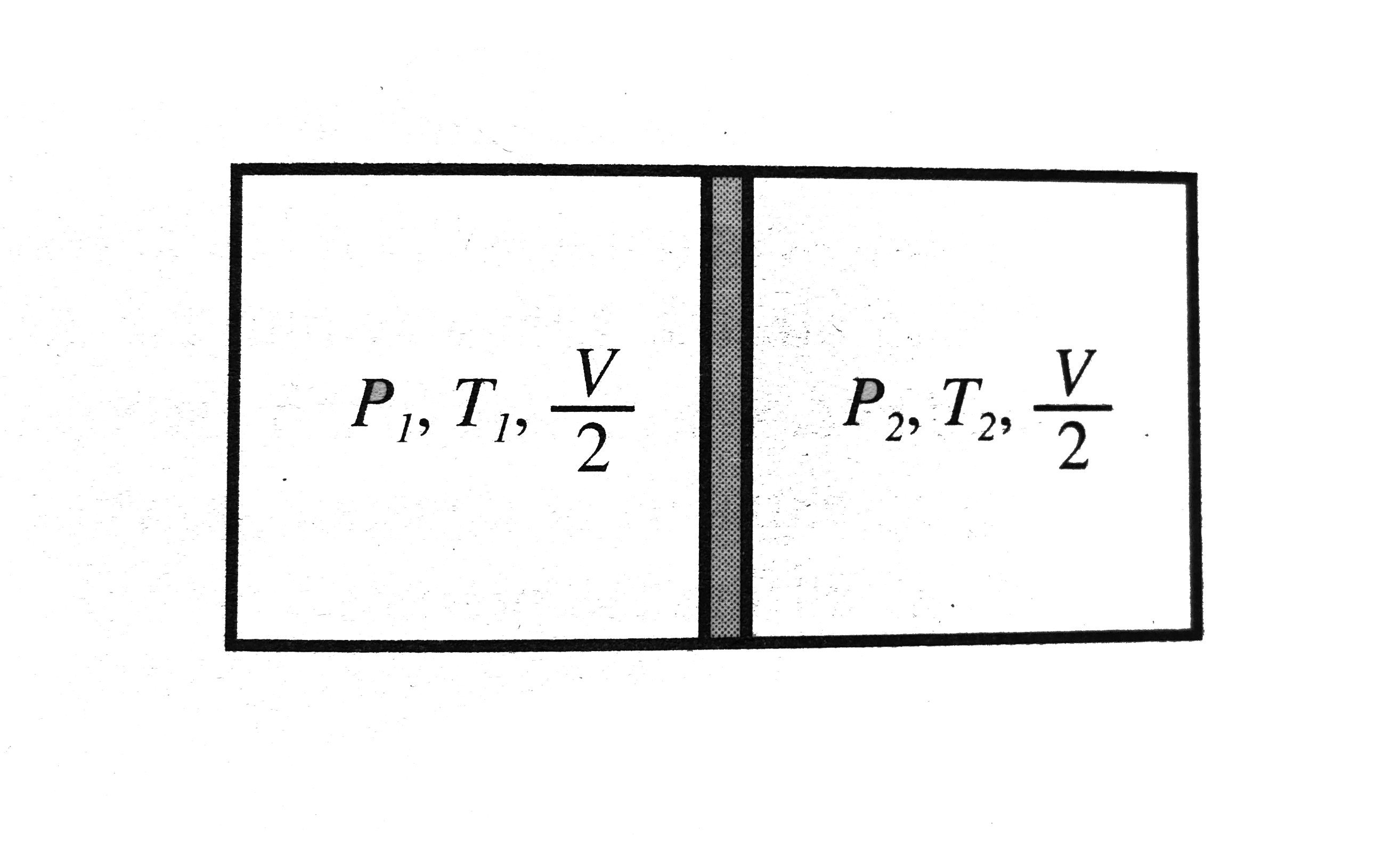
Figure shows an insulated cylinder of v...

Figure shows an insulated cylinder of volume `V` containing monatomic gas in both the compartments. The piston is diathermic. Initially the piston is kept fixed and the system is allowed to acquire a state of thermal equilibrium. The initial pressures and temperatures are as shown in the figure. Calculate

Final volume of the left compartment.

A

`(V)/(2)((P_(1)T_(2))/(P_(2)T_(1)+P_(1)T_(2)))`

B

`V((P_(1)T_(2))/(P_(2)T_(1)-P_(1)T_(2)))`

C

`V((P_(1)T_(2))/(P_(2)T_(1)+P_(1)T_(2)))`

D

`V((2P_(1)T_(2))/(P_(2)T_(1)+P_(1)T_(2)))`

Text Solution

Verified by Experts

The correct Answer is:

C

`P'_(1)=(P_(1)T_(2)(P_(1)+P_(2)))/((P_(1)T_(2)+P_(2)T_(1)))` and `P'_(2)=(P_(2)T_(1)(P_(1)+P_(2)))/((P_(1)T_(2)+P_(2)T_(1)))`
As `P_(2)T_(1) gt P_(1) T_(2)` (given)
Hence, `P'_(2)gt P'_(1)`
Let `Delta V` be the change in volume of any compartments.
`(P((V//2)-DeltaV))/(T)=(P_(1)V)/(2T_(1))`
`(P(V//2)+DeltaV)/(T)=(P_(2)V)/(2T_(2))`
Dividing, we get
`(((V//2)+DeltaV))/(((V//2)-DeltaV))=(P_(2)T_(1))/(P_(1)T_(2))`
`DeltaV=(V)/( 2)((P_(2)T_(1)-P_(1)T_(2))/(P_(2)T_(1)+P_(1)T_(2)))`
Volume of left compartment
`V'_(1)=(V)/(2)-DeltaV=V((P_(1)T_(2))/(P_(2)T_(1)+P_(1)T_(2)))`
Volume of right compartment
`V'_(2)=(V)/(2)+DeltaV=V((P_(2)T_(1))/(P_(2)T_(1)+P_(1)T_(2)))`
Promotional Banner

Topper's Solved these Questions

  • KINETIC THEORY OF GASES AND FIRST LAW OF THERMODYNAMICS

    CENGAGE PHYSICS|Exercise Interger|11 Videos
  • KINETIC THEORY OF GASES AND FIRST LAW OF THERMODYNAMICS

    CENGAGE PHYSICS|Exercise Assertion-Reasoning|6 Videos
  • KINETIC THEORY OF GASES

    CENGAGE PHYSICS|Exercise Compression|2 Videos
  • LINEAR AND ANGULAR SIMPLE HARMONIC MOTION

    CENGAGE PHYSICS|Exercise Multiple Correct Answer Type|9 Videos

Similar Questions

Explore conceptually related problems

Figure shows an insulated cylinder of volume V containing monatomic gas in both the compartments. The pistone is diathermic. Initially the piston is kept fixed and the system is allowed to acquire a state of thermal equilibrium. The initial pressures and temperatures are as shown in the figure. Calculate Final volume of right compartment.

Figure shows an insulated cylinder of volume V containing monatomic gas in both the compartments. The pistone is diathermic. Initially the piston is kept fixed and the system is allowed to acquire a state of thermal equilibrium. The initial pressures and temperatures are as shown in the figure. Calculate The final temperature

Figure shows an insulated cylinder of volume V containing monatomic gas in both the compartments. The pistone is diathermic. Initially the piston is kept fixed and the system is allowed to acquire a state of thermal equilibrium. The initial pressures and temperatures are as shown in the figure. Calculate The final presssures of left and right compartment respectively are

Figure shows an insulated cylinder of volume V containing monatomic gas in both the compartments. The pistone is diathermic. Initially the piston is kept fixed and the system is allowed to acquire a state of thermal equilibrium. The initial pressures and temperatures are as shown in the figure. Calculate The heat that flows from RHS to LHS , Given T_(2)gt T_(1) . Now, the pin which was keeping the piston fixed is removed. and the piston is set free to move. The piston is allowed to slide slowly, such that of mechanical equilibrium is also achieved and T_(1)P_(2)gt P_(1)T_(2) . Find.

A diathermic piston divides adiabatic cylinder of volume V0 into two equal parts as shown in the figure. Both parts contain ideal monoatomic gases. The initial pressure and temperature of gas in left compartment are P0 and T0 while that in right compartment are 2P0 and 2T0. Initially the piston is kept fixed and the system is allowed to acquire a state of thermal equilibrium. The heat that flown from right compartment to left compartment before thermal equilibrium is achieved is

A diathermic piston divides adiabatic cylinder of volume V0 into two equal parts as shown in the figure. Both parts contain ideal monoatomic gases. The initial pressure and temperature of gas in left compartment are P0 and T0 while that in right compartment are 2P0 and 2T0. Initially the piston is kept fixed and the system is allowed to acquire a state of thermal equilibrium. If the pin which was keeping the piston fixed is removed and the piston is allowed to slide slowly such that a state of mechanical equilibrium is achieved. The volume of left compartment when piston is in equilibrium is

A diathermic piston divides adiabatic cylinder of volume V0 into two equal parts as shown in the figure. Both parts contain ideal monoatomic gases. The initial pressure and temperature of gas in left compartment are P0 and T0 while that in right compartment are 2P0 and 2T0. Initially the piston is kept fixed and the system is allowed to acquire a state of thermal equilibrium. The pressure in left compartment after thermal equilibrium is achieved is

A cylinder fitted with a piston contains 0.2 moles of air at temperature 27^(@) . The piston is pushed so slowly that the air within the cylinder remains in thermal equilibrium with the surroundings. Find the approximate work done by the system if the final volume is twice the initial volume

A vertical thermally insulated cylinder of volume V contain n moles of an ideal monoatomic gas under a weightless piston. A load of weight W is placed on the piston as a result of which the piston is displaced. If the initial temp of the gas is 300K , area of piston is A and atmospheric pressure P_(0) . (take W=P_(0)A ). Determine the value of final temperature of the gas

A gas fills the right portion of a horizontal cylinder whose radius is 5.00 cm . The initial pressure of the gas is 101 kPa . A frictionless movable piston separates the gas from the left portion of the cylinder, which is evacuated and contains an ideal spring, as the drawing shows. The piston is initially unstrained, and the length of the gas-filled portion is 20.0 cm . Wheen the pin is removed and the gas is allowed to expand, the length of the gas-filled chamber doubles when it finally reaches equilibrium. The initial and final temperatures are equal. Determine the spring constant of the spring.

CENGAGE PHYSICS-KINETIC THEORY OF GASES AND FIRST LAW OF THERMODYNAMICS-Comprehension
  1. A monatomic gas undergoes a cycle consisting of two isothermals and tw...

    Text Solution

    |

  2. A monatomic gas undergoes a cycle consisting of two isothermals and tw...

    Text Solution

    |

  3. A monatomic gas undergoes a cycle consisting of two isothermals and tw...

    Text Solution

    |

  4. A monatomic gas undergoes a cycle consisting of two isothermals and tw...

    Text Solution

    |

  5. Figure shows an insulated cylinder of volume V containing monatomic g...

    Text Solution

    |

  6. Figure shows an insulated cylinder of volume V containing monatomic g...

    Text Solution

    |

  7. Figure shows an insulated cylinder of volume V containing monatomic g...

    Text Solution

    |

  8. Figure shows an insulated cylinder of volume V containing monatomic g...

    Text Solution

    |

  9. Figure shows an insulated cylinder of volume V containing monatomic g...

    Text Solution

    |

  10. The rectangular box shown in Fig has partition which can slide without...

    Text Solution

    |

  11. The rectangular box shown in Fig has partition which can slide without...

    Text Solution

    |

  12. A container of volume 4V(0) made of a perfectly non- conducting materi...

    Text Solution

    |

  13. A container of volume 4V(0) made of a perfectly non- conducting materi...

    Text Solution

    |

  14. A container of volume 4V(0) made of a perfectly non- conducting materi...

    Text Solution

    |

  15. An ideal gas at NTP is enclosed in an adiabatic vertical cylinder havi...

    Text Solution

    |

  16. An ideal gas at NTP is enclosed in an adiabatic vertical cylinder havi...

    Text Solution

    |

  17. An ideal gas at NTP is enclosed in an adiabatic vertical cylinder havi...

    Text Solution

    |

  18. Piston cylinder device initially contains 0.5m^(3) of nitrogen gas at ...

    Text Solution

    |

  19. Piston cylinder device initially contains 0.5m^(3) of nitrogen gas at ...

    Text Solution

    |

  20. Piston cylinder device initially contains 0.5m^(3) of nitrogen gas at ...

    Text Solution

    |
