Home
Class 11
PHYSICS
A partical excutes SHM with same frequen...

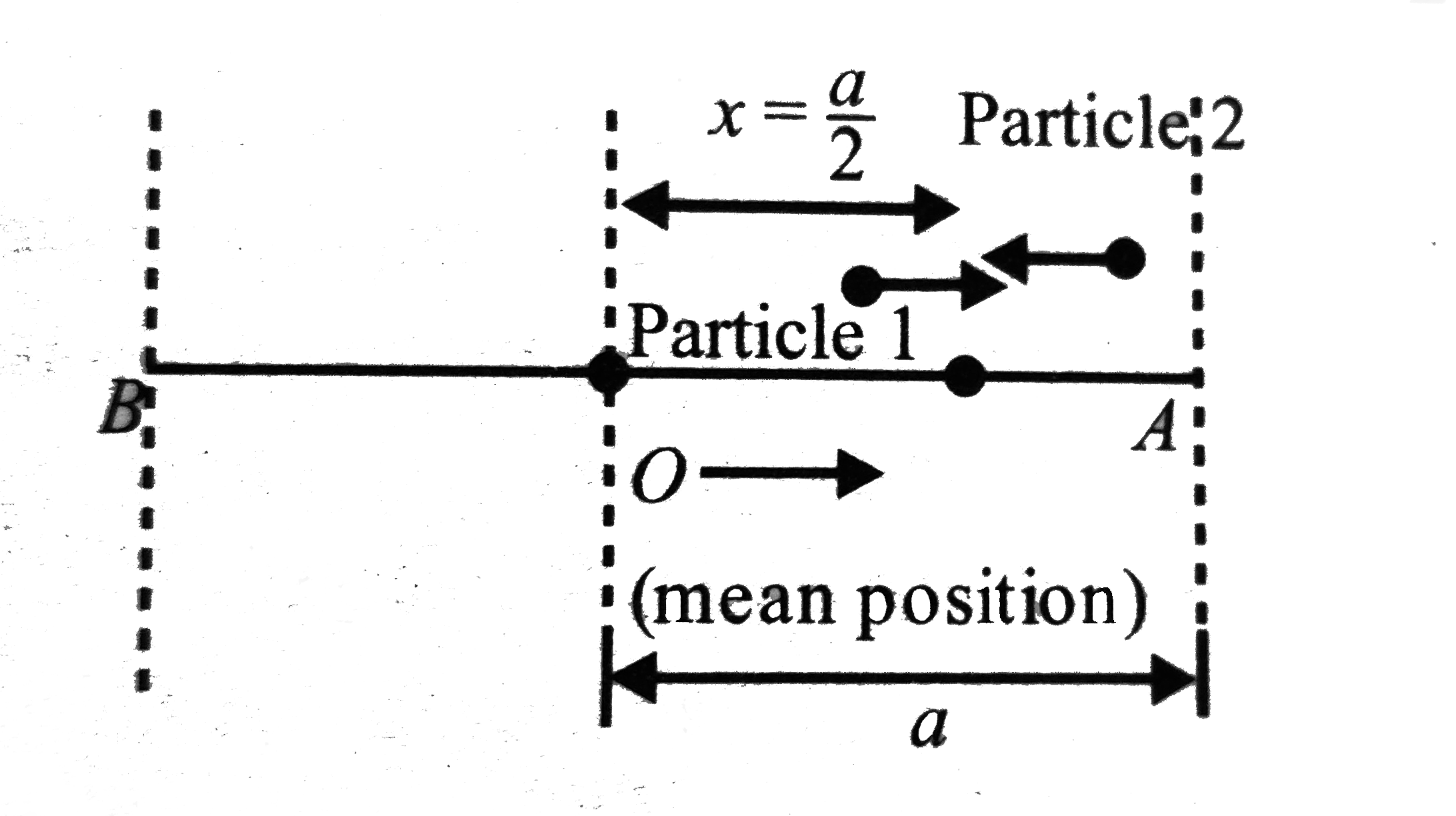
A partical excutes SHM with same frequency and amplitude along the same straight line. They cross each other , at a point midway between the mean and the exterme position. Find the Phase difference between them.

Text Solution

Verified by Experts
Method 1
Let a be the amplitude and `phi` and `phi` there respective phases at any instant ,when they cross each other .
Then their displacement equation can be written as
`x = a sin (phase)`
For the two particals we have `(a)/(2) = a sin phi_(1) and (a)/(2) = a sin phi_(2)`

Taking the least value, `phi_(1) = (pi)/(6)`
and taking the next possible value `phi_(1) = (5 pi)/(6)`
Moreover, from `bar v = a omega cos (phase)`
If `bar v_(1) and bar v_(2)` are the respective velocities of the two particals . The particals cross each other their velocities should be in opposite direction . If we take velocity of the partical `1` positive then velocity of particals should be negative. The velocity of the partical `2` will be negative when it has phase `phi_(1) = 5 pi//6`
Therefore the required phase difference `= phi_(2) - phi_(1) implies (2 pi)/(3) rad`
Method 2
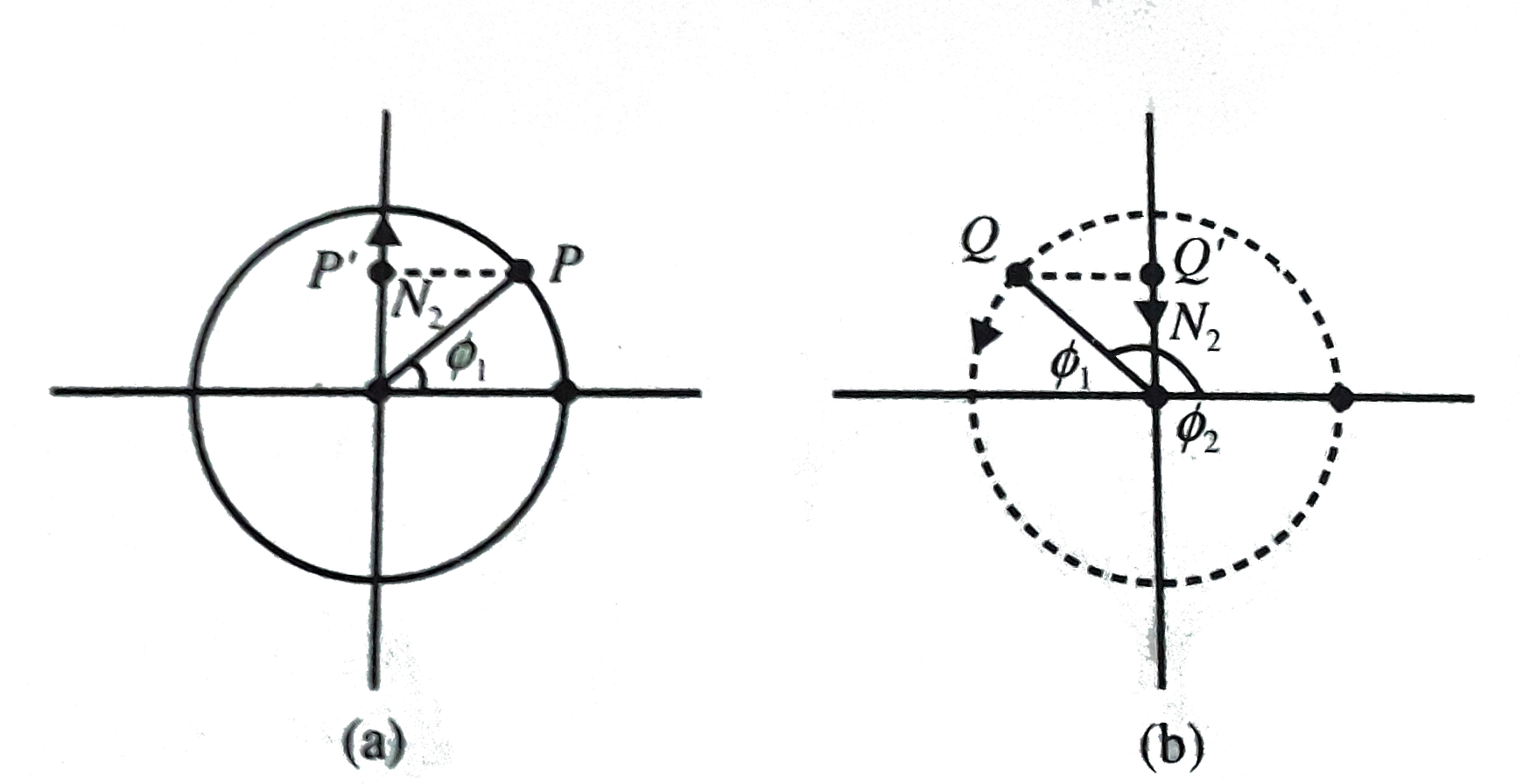
figur show that two particals `P and Q` in SHM along with their corresponding particals in circular motion. Let `P` move in upward direction when crossing `Q at A//2` shown in figure

At htis instant phase of `P` is
`phi_(1) = sin ^(-1) ((1)/(2)) = (pi)/(6)` (i)
Similarly as shown in figure partical `Q` moves in down wards direction (oppositeP) at `A//2`, this implies its circular motion partical is in second quadrant thus its phase angle is
`phi_(2) = pi`
`phi_(1) = pi - sin ^(-1) ((1)/(2)) = pi - (pi)/(6) = (5 pi)/(6)` (ii)
As both are oscillating at same angular frequency their phase difference remain constant which can be given from Eqs (i) and (ii), as `Delta phi = phi_(2) - phi_(1) = (5 pi)/(6) - (pi)/(6) = (2 pi)/(3)`
Promotional Banner

Topper's Solved these Questions

  • LINEAR AND ANGULAR SIMPLE HARMONIC MOTION

    CENGAGE PHYSICS|Exercise Solved Example|15 Videos
  • LINEAR AND ANGULAR SIMPLE HARMONIC MOTION

    CENGAGE PHYSICS|Exercise Exercise 4.1|23 Videos
  • KINETIC THEORY OF GASES AND FIRST LAW OF THERMODYNAMICS

    CENGAGE PHYSICS|Exercise Interger|11 Videos
  • MISCELLANEOUS KINEMATICS

    CENGAGE PHYSICS|Exercise Interger type|3 Videos

Similar Questions

Explore conceptually related problems

two partical excuting SHM with same frequency and amplitudes A and 2A on same straight line with same mean position cross each other in opposite direction at a distance A//3 from mean possion. Find the phase difference in the two SHM s.

Two particles execute SHM of the same time period along the same straight lines. They cross each other at the mean position while going in opposite directions. Their phase difference is

Two particles execute SHMs of the same amplitude and frequency along the same straight ling. They cross one another when going in opposite direction. What is th ephase difference between them when their displacements are half of their amplitudes ?

A particle executing S.H.M. starts from midway between mean and extreme position, the phase is

Two particles are in SHM with the same amplitude and frequency along the same line and about the same point. If the maximum separation between them is sqrt(3) times their amplitude, the phase difference between them is (2pi)/n . Find value of n

The maximum seperation between two particles executing simple harmonic motion of the equal amplitude and same frequency along the same straight line and about the same mean position, is sqrt(3) times the amplitude of oscillation. IF the phase difference between them is phi , determine 2pi//phi .

Two particles executes S.H.M. of the same amplitude and frequency along the same straight line. They pass one another when going in opposite directions, each time their displacement is root three by two times amplitude. The phase difference between them is

Two particles are in SHM with same angular frequency and amplitudes A and 2A respectively along same straight line with same mean position. They cross each other at postion A//2 distance from mean position in opposite direction. The phase between them is-

Two particles P and Q describe S.H.M. of same amplitude a, same frequency f along the same straight line from the same mean position. The maximum distance between the two particles is a sqrt(2) , If the initial phase difference between the particles is (pi)/(N) then find N :