Home
Class 11
PHYSICS
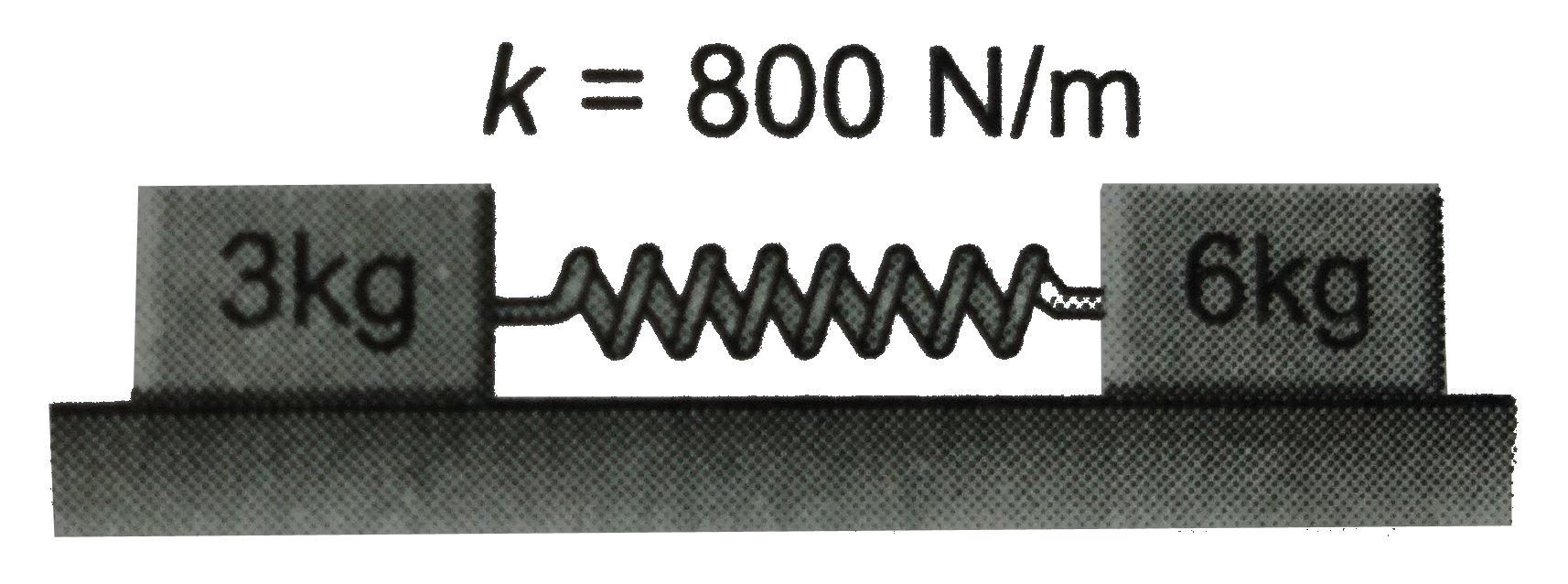
The system shown in the figure can move ...

The system shown in the figure can move on a smooth surface. They are initially compressed by `6cm` and then released, then choose the correct options.

(a) The system performs, SHM with time period `(pi)/(10)s`
(b) The block of mass `3kg` perform SHM with amplitude `4 cm`
( c) The block of mass `6kg` will have maximum momentum of `2.40kg - m//s`
(d) The time periods of two blocks are in the ratio of `1:sqrt(2)`

Text Solution

Verified by Experts

a. `T = 2 pisqrt((mu)/(k))`
Here, `mu = (m_(1) m_(2))/(mm_(1) + m_(2)) = (3 xx 3)/(9) = 2 kg`
`T = 2 pi sqrt((2)/(800)) = 2 pi xx (1)/(20)`
`T = (pi)/(10) sec`
b. Here compression of spring `x_(0) = 6 cm`
Let displacement of block (1) and (2) w.r.t. center of mass be `x_(1) and x_(2)`
But `x_(1) + x_(2) = x_(0) and m_(1) = m_(2)x_(2)`
or `3 x_(1) = 6 x_(2)` or `x_(1) + 2 x_(2)`
` x_(1) + x_(2) = x_(0) or x_(1) + (x_(1))/(2) = x_(0)`
or `(3)/(2) x_(1) = x_(0) implies x_(1) = (2)/(3) x_(0) = (2)/(3) xx 6 = 4 cm`
c. Appling conservation principal of momentum
`3 xx v_(1) - 6 v_(2) = 0`
`3 v_(1)=- 6 v_(2)`
`v_(1) = 2 v_(2)`
Appling mechaincal energy conservation , we get
`(1)/(2) xx 3 xx v_(1)^(2) + (1)/(2) xx 6 xx v_(2)^(2) = (1)/(2) kx_(0)^(2)`
or `(3)/(2) v_(1)^(2) + 3v_(2)^(2) = (1)/(2) xx 800 xx (0.06)^(2)`
or `(3)/(2) (2 v_(2))^(2) + 3v_(2)^(2) = 400 xx 36 xx 10^(-4)`
or `v_(2) = (1.2)/(3) = 0.4 m//s`
`:. P_(2 max) = 6 xx 0.4 = 2.4 kg m//s`
Promotional Banner

Topper's Solved these Questions

  • LINEAR AND ANGULAR SIMPLE HARMONIC MOTION

    CENGAGE PHYSICS|Exercise Solved Example|15 Videos
  • LINEAR AND ANGULAR SIMPLE HARMONIC MOTION

    CENGAGE PHYSICS|Exercise Exercise 4.1|23 Videos
  • KINETIC THEORY OF GASES AND FIRST LAW OF THERMODYNAMICS

    CENGAGE PHYSICS|Exercise Interger|11 Videos
  • MISCELLANEOUS KINEMATICS

    CENGAGE PHYSICS|Exercise Interger type|3 Videos

Similar Questions

Explore conceptually related problems

The system shown in the figure can move on a smooth surface. The spring is initially compressed by 6 cm and then released.

The system shown in the figure can move on a smooth surface. The spring is initially compressed by 6 cm and then released.Find (a) time perod (b) amplitude of 3 kg block (c ) maximum momentum of 6 kg block

A body of mass 8 kg performs S.H.M. of amplitude 60 cm. The restoring force is 120 N, when the displacement is 60 cm. The time period is

Two forces are applied on a system of blocks as shown. The block remains in equilibrium on the smooth surface. Then choose the correct option(s).

A horizontal platform with a small block of mass 1 kg kept on it performs vertical SHM of amplitude 1 cm. The block does not lose contact with the platform anywhere. The minimum possible time period of the platform

A body of mass 8 kg performs SHM of amplitude 60 cm. The restoring force is 120N when the displacement is 60 cm. Its acceleration , PE and KE when displacement is 6 cm are

Block A of mass m is performing SHM of amplitude a. Another block B of mas m is gently placed on A when it passes through mean position and B sticks to A . Find the time period and amplitude of new SHM .

A horizontal spring-block system of mass 1kg executes SHM of amplitude 10 cm. When the block is passing through its equilibrium position another mass of 1kg is put on it and the two move together.

A particle of mass 2kg executing SHM has amplitude 20cm and time period 1s. Its maximum speed is

In the arrangement shown in fig. the block of mass m=2kg lies on the wedge of mass M=8kg . The initial acceleration of the wedge, if the surfaces are smooth, is
