Home
Class 11
PHYSICS
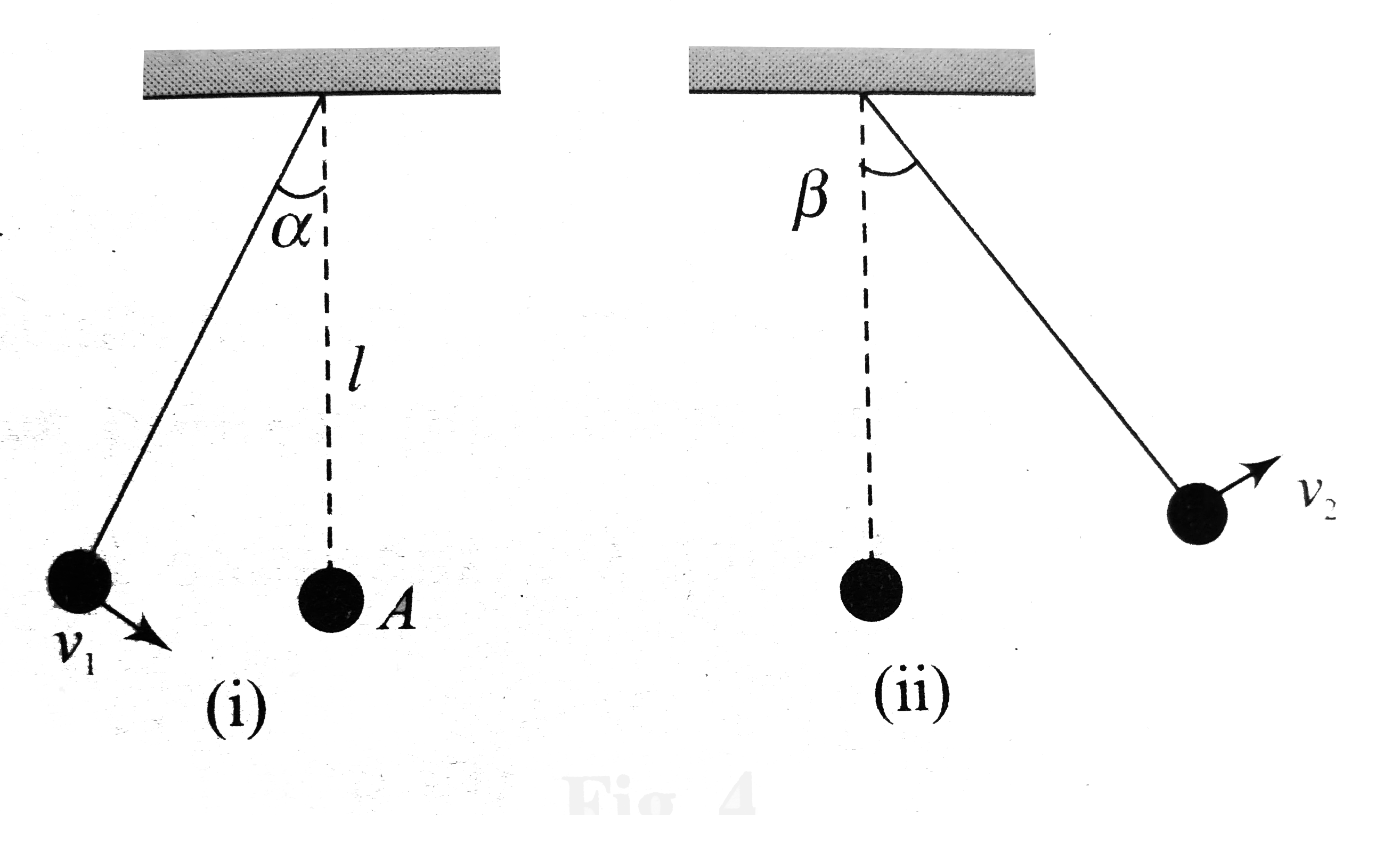
figure show the identical simple pendulu...

figure show the identical simple pendulums of length. One is tilled at an angle `alpha` and imparted an initial velocity `v_(1)` towards mean position and at a velocity `v_(2)` at an initial angular displacement `beta`. Find the phase difference in oscillations of these two pendulums

Text Solution

Verified by Experts
It is given that first pendulum bob is given a velocity `v_(1)` at a dislpacement `l alpha` from mean position , using the formula for velocity we can find the amplitude of its oscillation as
`V_(1) = omega sqrt(A_(1)^(2) - (l alpha)^(2))` [If `A_(1)`, is the amplitude of SHM of this As for simple pendulum `omega = sqrt((g)/(l))` we have
`V_(1)^(2) = (g)/(l) [(A_(1)^(2)) - (l alpha)^(2))]`
`A_(1) = sqrt(l^(2) alpha^(2) + v_(1)^(2)l)/(g)` (i)
Similarly if `A_(2)` is the amplitude of SHM of second pendlum bob we have
`V_(2) = omega sqrt(A_(1)^(2) - (l beta)^(2))`
or `A_(2) = sqrt((l^(2) beta^(2) + (v_(2)^(2)l)/(g))` (ii)
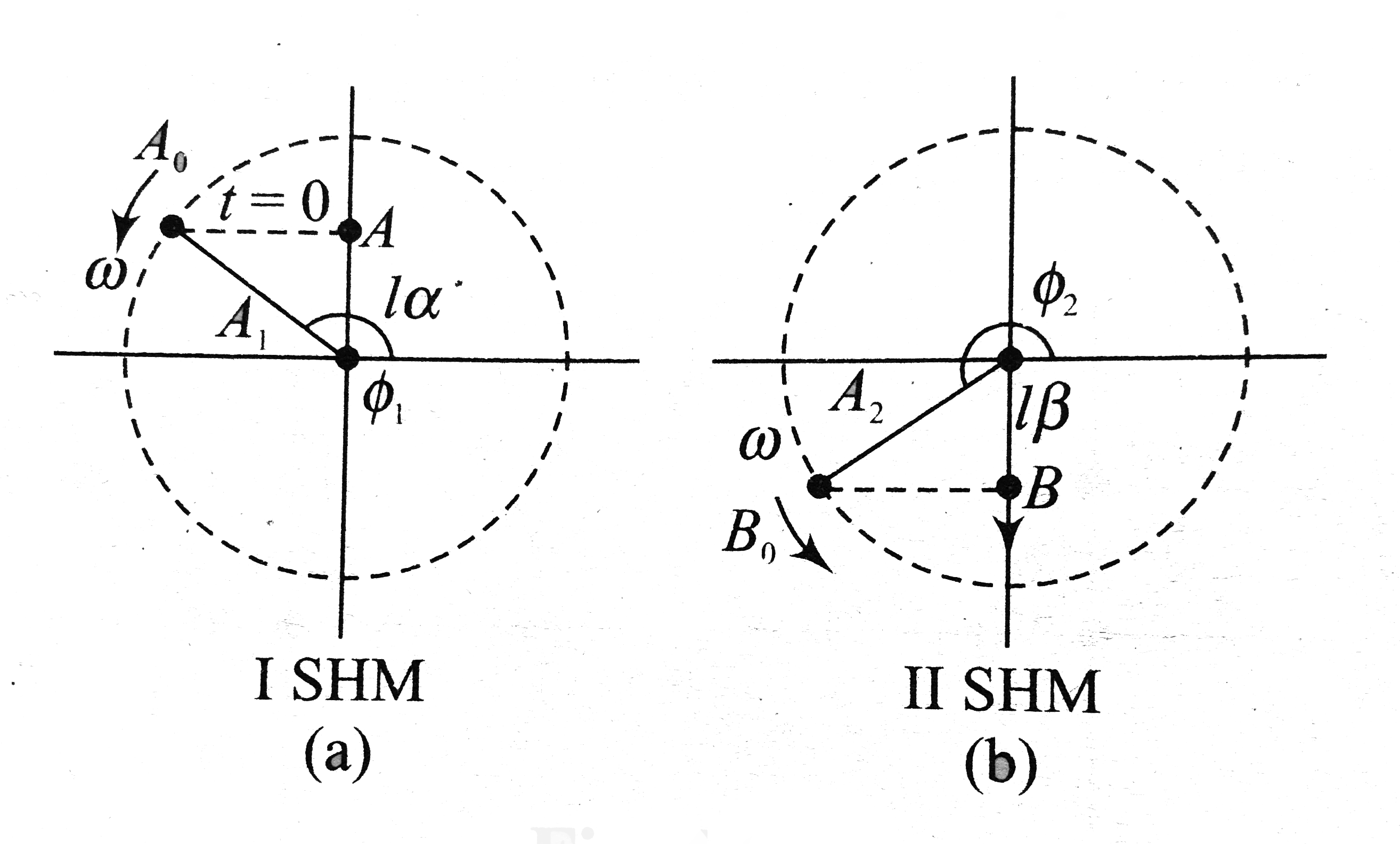
Now we repersent the two SHMs by circular motion representation as shown in figure

In first pendulum at `t = 0` the bob is thrown from a displacement `l alpha` from mean position with a velocity `v_(1)` towards mean position . As it is moving towards mean position in figure (a) , we consider the corresponding circular motion particle `A_(0)` of the bob A is second quarant, as the referance direction of `omega` we consider anticlockwise. As shown in figure initial phase of bob A is given as
`phi_(1) = pi - sin^(-1) ((l alpha)/(A_(1)))` (iii)
Similarly for second pendulum bob B, its corresponding circular motion partical `B_(0) at t = 0` is consider as shown in figure (b) its initial base is given as
`phi_(2) = sin^(-1) ((l beta)/(A_(2)))` (iv)
As both the pandulum are identical, their angular frequency for SHM must be same , so their phase difference can be given as
`Delta phi = phi_(2) - phi_(1) sin^(-1) ((l beta)/(A_(2))) + sin^(-1) ((l alpha)/(A_(1))) - pi`
Promotional Banner

Topper's Solved these Questions

  • LINEAR AND ANGULAR SIMPLE HARMONIC MOTION

    CENGAGE PHYSICS|Exercise Solved Example|15 Videos
  • LINEAR AND ANGULAR SIMPLE HARMONIC MOTION

    CENGAGE PHYSICS|Exercise Exercise 4.1|23 Videos
  • KINETIC THEORY OF GASES AND FIRST LAW OF THERMODYNAMICS

    CENGAGE PHYSICS|Exercise Interger|11 Videos
  • MISCELLANEOUS KINEMATICS

    CENGAGE PHYSICS|Exercise Interger type|3 Videos

Similar Questions

Explore conceptually related problems

A pendulum is displaced to an angle theta from its equilibrium position, then it will pass through its mean position with a velocity v equal to

Mass of the bob of a simple pendulum of length L is m . If the bob is projected horizontally from its mean position with velocity sqrt(4 gL) , then the tension in the string becomes zero after a vertical displacement of

A simple pendulum of Length l and mass (M) is oscillating in a plane about a vertical line between the angular limits -phi "to" +phi . For an angular displacement theta ( lt |phi|) , , the tension in the string T and velocity of the bob V are related as-

Two simple pendulums of equal length cross each other at mean position. Then their phase difference is

A pendulum of mass m and length L is connected to a spring as shown in figure. If the bob is displaced slightly from its mean position and released, it performs simple harmonic motion. The angular frequency of the oscillation of bob is

A simple pendulum has a length l . What minimum velocity should be imparted to its bob at the mean position so that bob reaches a height equal to l above the point of suspension?

Two simple pendulum of unequal lengths wihile oscillating meet each other at mean position. What is their phase difference ?

Statement-1 : During the oscillation so f a simple pendulum, the direction of its acceleration at the mean position is directed towards the point of suspension and at exteme position is direction towards the mean position . Statement-2 : The directio of acceleration of a simple pendulum at an instant is decided by the tangential and radial components of weight at that instant.

A particle is performing SHM aong x-axis,such that its velocity is v_1 when its displacement from mean position is x_1 and v_2 when its displacement from mean position is x_2 .Time period of oscillation is

Three particles of equal masses are placed at the corners of an equilateral triangle as shown in the figure. Now particle A starts with a velocity v_(1) towards line AB , particle B starts with a velocity v_(2) towards line BC and particle C starts with velocity v_(3) towards line CA . The displacement of CM of three particle A, B and C after time t will be (given if v_(1)=v_(2)=v_(3))

