Home
Class 11
PHYSICS
Consider a solid cylinder of the density...

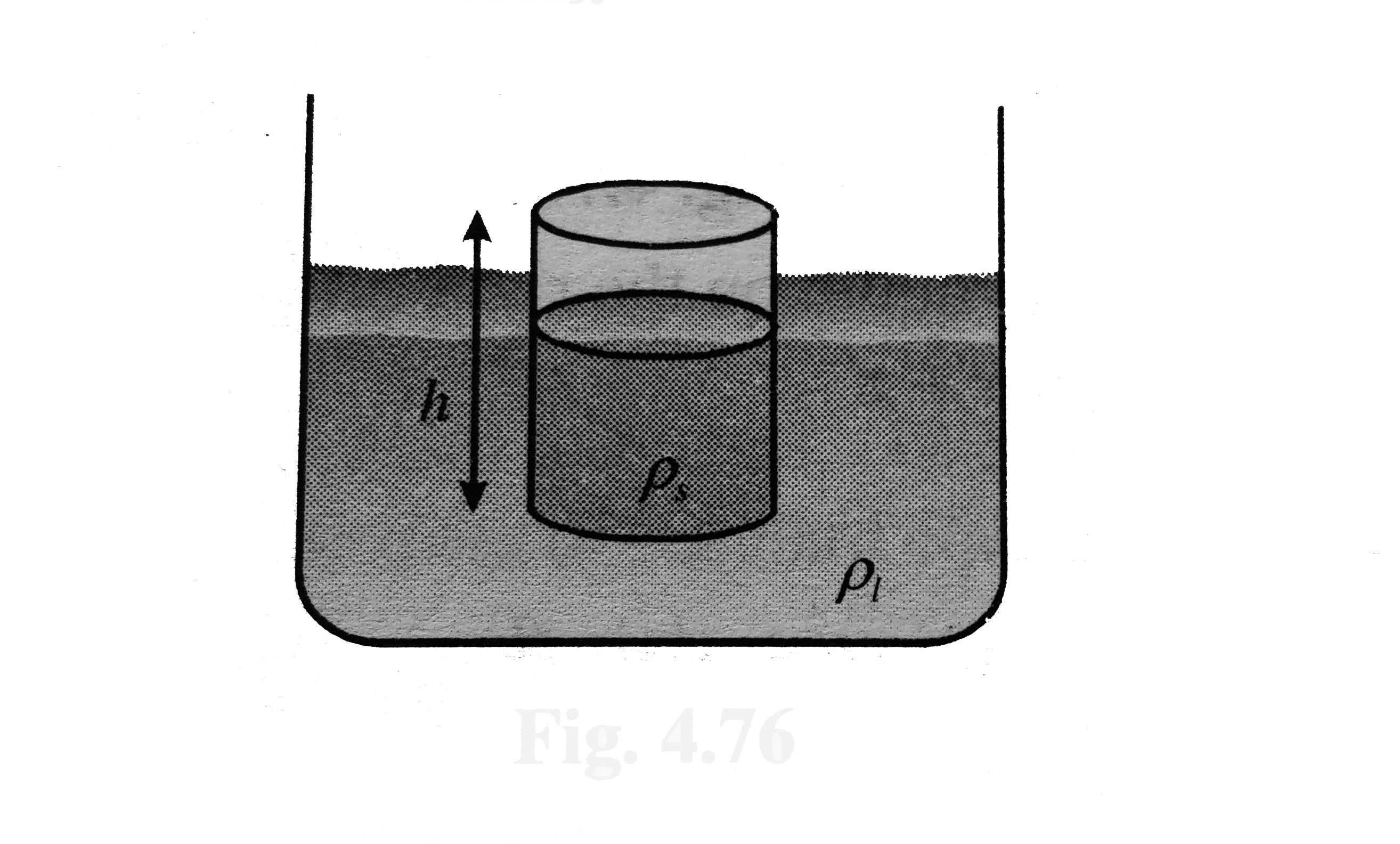
Consider a solid cylinder of the density `rho_(s)` cross section area A and h ploating in a liquid of density `rho_(l)` as shown in figure `(rho_(l) gt rho_(s))` . It is depressed sligtly and allowed to oscillation.

Text Solution

Verified by Experts

At equilibrium the net force on the cylinder is zero in the vertical direction.
`F_("net") = B - W = 0, B = ` the buoyancy and W = the weight of the cylinder direction.
When the cylinder is depresed slightly by x, the buoyancy increases from `B to B + sigma B`, where `sigma B = |x| rho_(l) Ag`
The equation of motion is, therefore.
`rho, Ah (d^(2)x)/(dt^(2) = - (rho_(l) g)/(rho_(s) h)`
and the angular frequency, `omega`, is
`omega = sqrt((g rho_(l))/(h rho_(s)))`
Promotional Banner

Topper's Solved these Questions

  • LINEAR AND ANGULAR SIMPLE HARMONIC MOTION

    CENGAGE PHYSICS|Exercise Solved Example|15 Videos
  • LINEAR AND ANGULAR SIMPLE HARMONIC MOTION

    CENGAGE PHYSICS|Exercise Exercise 4.1|23 Videos
  • KINETIC THEORY OF GASES AND FIRST LAW OF THERMODYNAMICS

    CENGAGE PHYSICS|Exercise Interger|11 Videos
  • MISCELLANEOUS KINEMATICS

    CENGAGE PHYSICS|Exercise Interger type|3 Videos

Similar Questions

Explore conceptually related problems

A solid cylinder of denisty rho_(0) , cross-section area A and length l floats in a liquid rho(gtrho_(0) with its axis vertical, as shown. If it is slightly displaced downward and released, the time period will be :

A cylindrical piece of cork of base area A and height h floats in a liquid of density rho_(1) . The cork is depressed slightly and then released. Show that the cork oscillates up and down simple harmonically with a period T=2pisqrt((hrho)/(rho_(1)g))

A body weighs W_(1) in a liquid of density rho_(1) and W_(2) in a liquid of density rho_(2) . What is the weight of body in a liquid of density rho_(3) ?

A stream line body with relative density rho_(1) falls into air from a height h_(1) on the surface of a liquid of realtive density rho_(2) , where rho_(2) gt rho_(1) . Find the time of immersion of the body into the liquid.

A body of density rho floats with a volume V_(1) of its total volume V immersed in one liquid of density rho_(1) and with the remainder of volume V_(2) immersed in another liquid of density rho_(2)," ""where"" "rho_(1)gt rho_(2). Find the relative volumes immersed in two liquids.

An object with uniform density ρ is attached to a spring that is known to stretch linearly with applied force as shown below. When the spring-object system is immersed in a liquid of density rho_(1) as shown in the figure, the spring stretches by an amount x_(1)(rho gt rho_(1)) . When the experiment is repeated in a liquid of density rho_(2) gt rho_(1) , the spring stretches by an amount x_(2) . Neglecting any buoyant force on the spring, the density of the object is

A body of density rho floats with volume V_(1) of its total volume V immersed in a liquid of density rho_(1) and with the remainder of volume V_(2) immersed in another liquid of density rho_(2) where rho_(1)gtrho_(2) . Find the volume immersed in two liquids. ( V_(1) and V_(2) ).

The speed of transverse waves in a wire of length L , density rho , cross - sectional area A and stretched with a tension T is given by

A ball of volume V and density rho_(1) is moved downwards by a distance 'd' in liquid of density rho_(2) . Find total change in potential energy of the system.
