Home
Class 11
PHYSICS
Figure shown a block P of mass m resting...

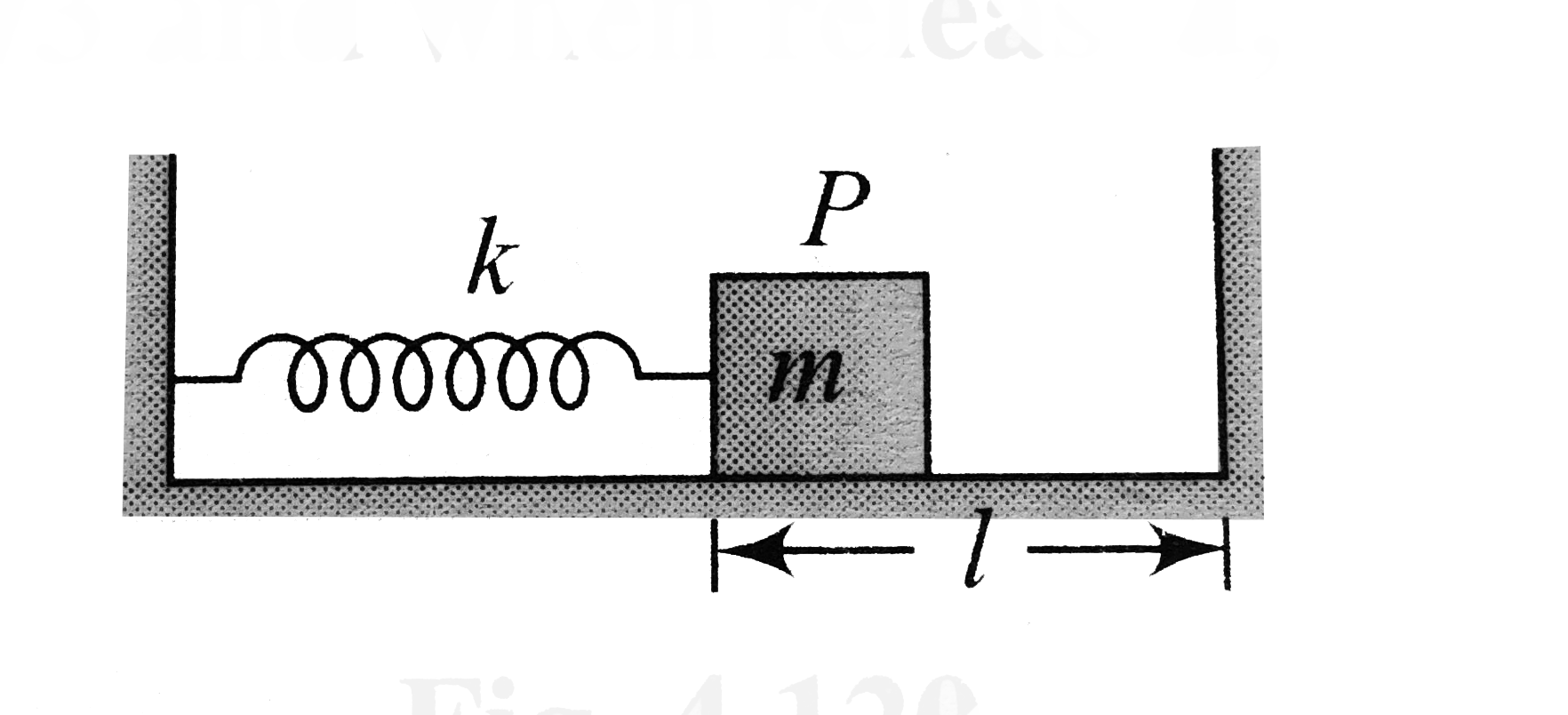
Figure shown a block P of mass m resting on a smooth horizontal surface, attached to a spring of force constant k which is rigidly fixed on the wall on left side, shown in the figure . At a distance l to the right of the block there is a rigid wall. If block is pushed towards loft so that spring is compressed by a distance `5l//3` and when released, if will starts its oscillations. If collision of block with the wall is considered to be perfectly elastic. Find the time period of oscillation of the block.

Text Solution

Verified by Experts
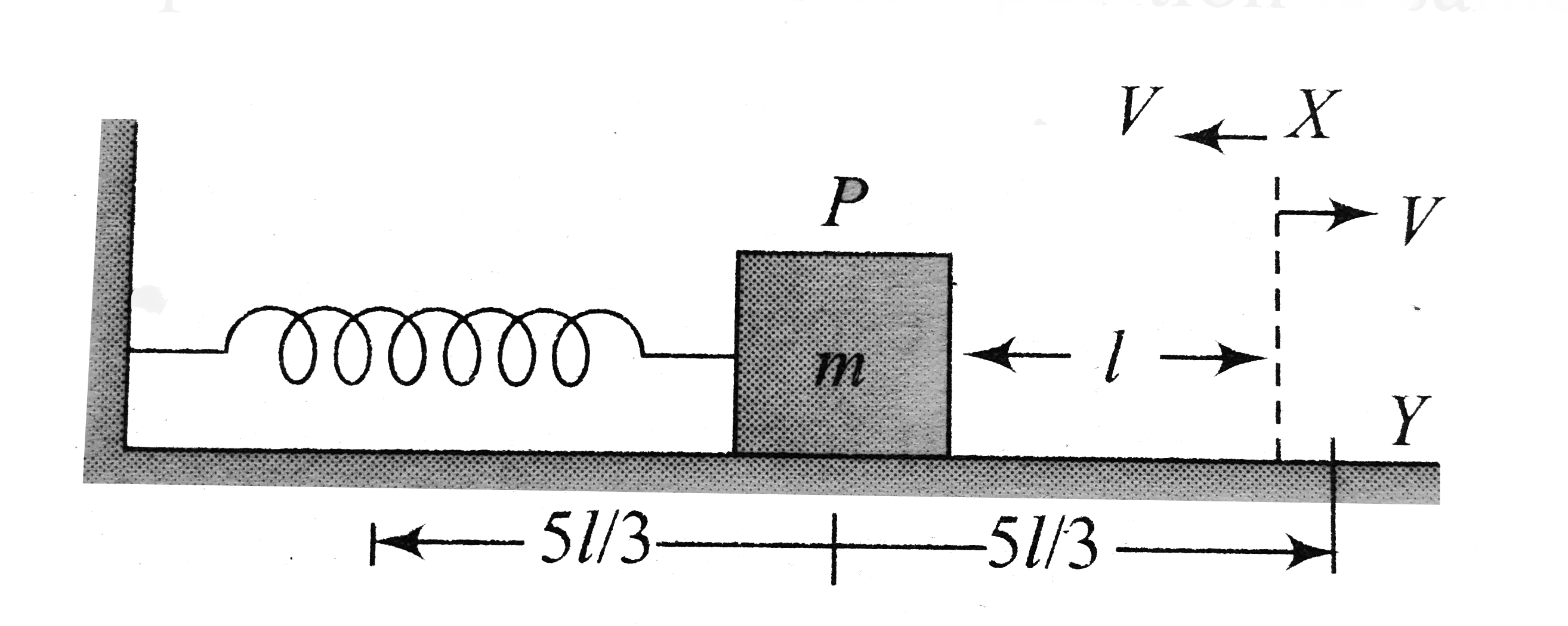
As shown in figure , as the block its released from rest at a distance `5//3` from its mean position, this will be the amplitude of oscillation. But on the other side of mean position block can move only up to a distance `l` from mean position and then it will return from this point with equal velocity due to elastic collision . Consider figure . If no right wall is present during oscillation, block P will excute complete SHM on right side of mean position also up t its amplitude `5l//3` . Thus, we can observe the block P at a point X at distance l from mean position (where in our case wall is present) . if block passes this position at speed v (which is the speed with , which block bites the wall in our case) after reaching its exterme position y, it willl return and during return path it will cross the position X with the same speed v (as displacement from mean position is same).

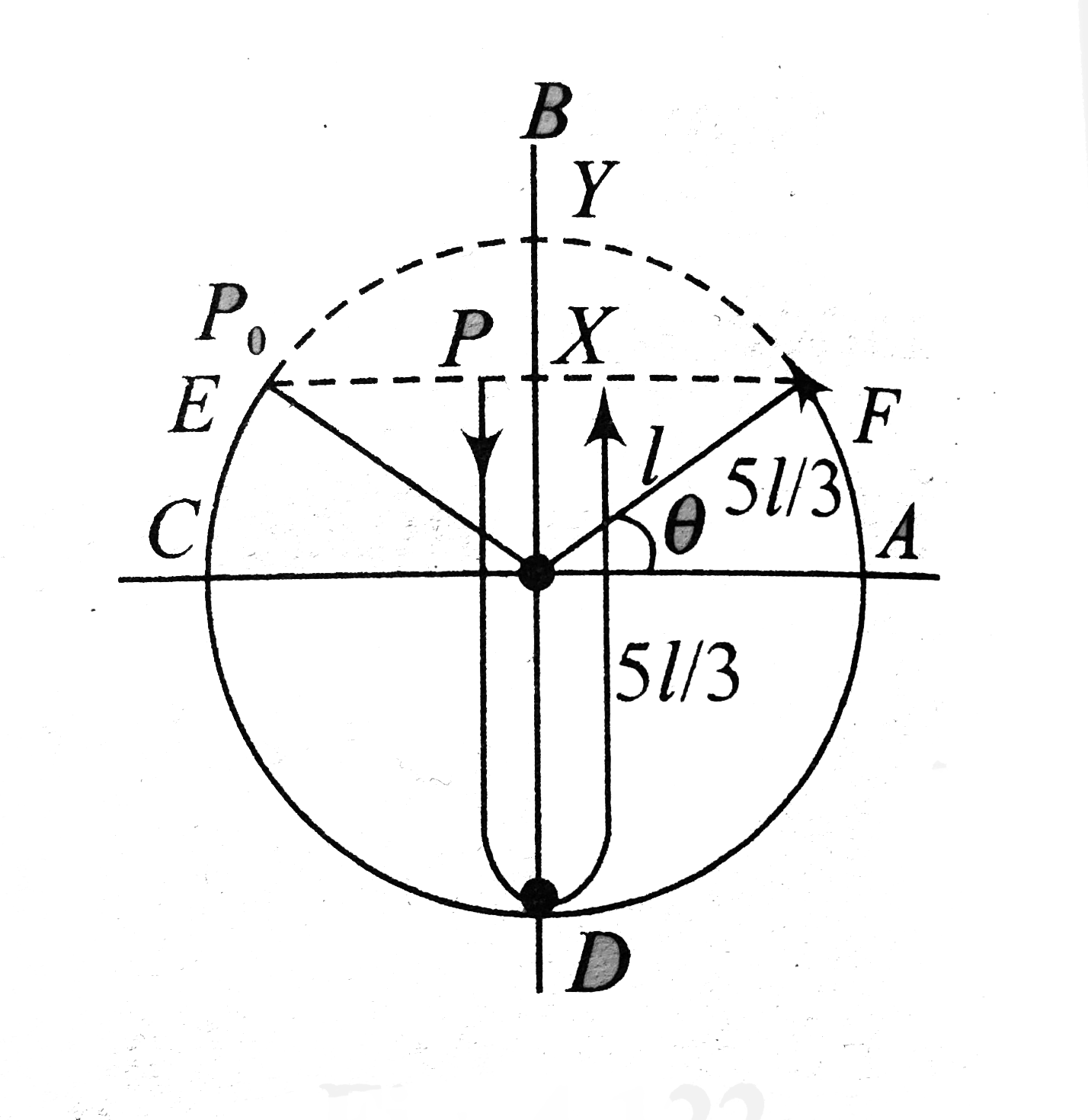
Thus, we can state that in our case of given problem , that block P is executing SHm but it skips a XYX on right half of its motion due to electric collision of the block with the wall. if `T_(0)` is the time period of this oscillation we look at figure which shown the corresponding circular motion repersantation. Here during oscillation of point P partical `P_(0)` covers its circular motion along `ECDAF`, and from F it instantly jumps to E (due to elastic collision of P with wall at X) and again carry out ECDAF and so on thus we can find the time of this total motion as

`t = (pi + 2 theta)/(omega) = (pi + 2 sin ^(-1) (3//5))/(sqrt((k)/(m))`
`= sqrt((m)/(k)) [pi + 2 sin ^(-1) ((3)/(2))]`
We can also find the time period of this motion by sub-tracting the time FYE from the total time period as
`t =(2 pi - 2 cos^-1 ((3)/(5)))/(omega)`
`= sqrt((m)/(k)) [pi + 2 cos^(1) ((3)/(5))]`
Equations (i) and (ii) will result same numerical value.
Promotional Banner

Topper's Solved these Questions

  • LINEAR AND ANGULAR SIMPLE HARMONIC MOTION

    CENGAGE PHYSICS|Exercise Exercise 4.1|23 Videos
  • LINEAR AND ANGULAR SIMPLE HARMONIC MOTION

    CENGAGE PHYSICS|Exercise Exercise 4.2|23 Videos
  • LINEAR AND ANGULAR SIMPLE HARMONIC MOTION

    CENGAGE PHYSICS|Exercise Multiple Correct Answer Type|9 Videos
  • KINETIC THEORY OF GASES AND FIRST LAW OF THERMODYNAMICS

    CENGAGE PHYSICS|Exercise Interger|11 Videos
  • MISCELLANEOUS KINEMATICS

    CENGAGE PHYSICS|Exercise Interger type|3 Videos

Similar Questions

Explore conceptually related problems

A block of mass m moving with velocity v_(0) on a smooth horizontal surface hits the spring of constant k as shown. Two maximum compression in spring is

A block of mass m, lying on a smooth horizontal surface, is attached to a spring (of negligible mass) of spring constant k. The other end of the spring is fixed, as shown in the figure. The block is initally at rest in its equilibrium position. If now the block is pulled withe a constant force F, the maximum speed of the block is :

A block of 10 g slides on smooth horizontal surface with 20 m/s towards a spring of spring constant 100 N/m placed horizontally (as shown in figure). The maximum compression in spring is

In the figure, the block of mass m, attached to the spring of stiffness k is in correct with the completely elastic wall, and the compression in the spring is e. The spring is compressed further by e by displacing the block towards left and is then released. If the collision between the block and the wall is completely eleastic then the time period of oscillation of the block will be

A block of mass m = 25 kg on a smooth horizontal surface with a velocity vec v = 3 ms^(-1) meets the spring of spring constant k = 100 N//m fixed at one end as shown in figure. The maximum compression of the spring and velocity of block as it returns to the original position respectively are. .

One end of aspring of force constant k is fixed to a verticle wall and the other to a block of mass m resing on a smooth horizontal surface There is another and wall at a distance x_(0) from the block The spring is then compressed by 2x_(0) and released The time taken to at the wall is

A block is attached to a spring and is placed on a horizontal smooth surface as shown in which spring is unstretched. Now the spring is given an initial compression 2x_(0) an block is released from rest. Collision with the wall PQ are elastic. Find the time period of motion of the block:

A block of mass m sliding n a smooth horizontal surface with velocity vecv meets a long horizontal spring fixed ast one end and having spring constant k as shown n figure. Find the maximum compression of the spring. Will the velocity of the block be the same as v whenit comes back to the original position shown?