Home
Class 11
PHYSICS
A simple pendulum of length l swings fro...

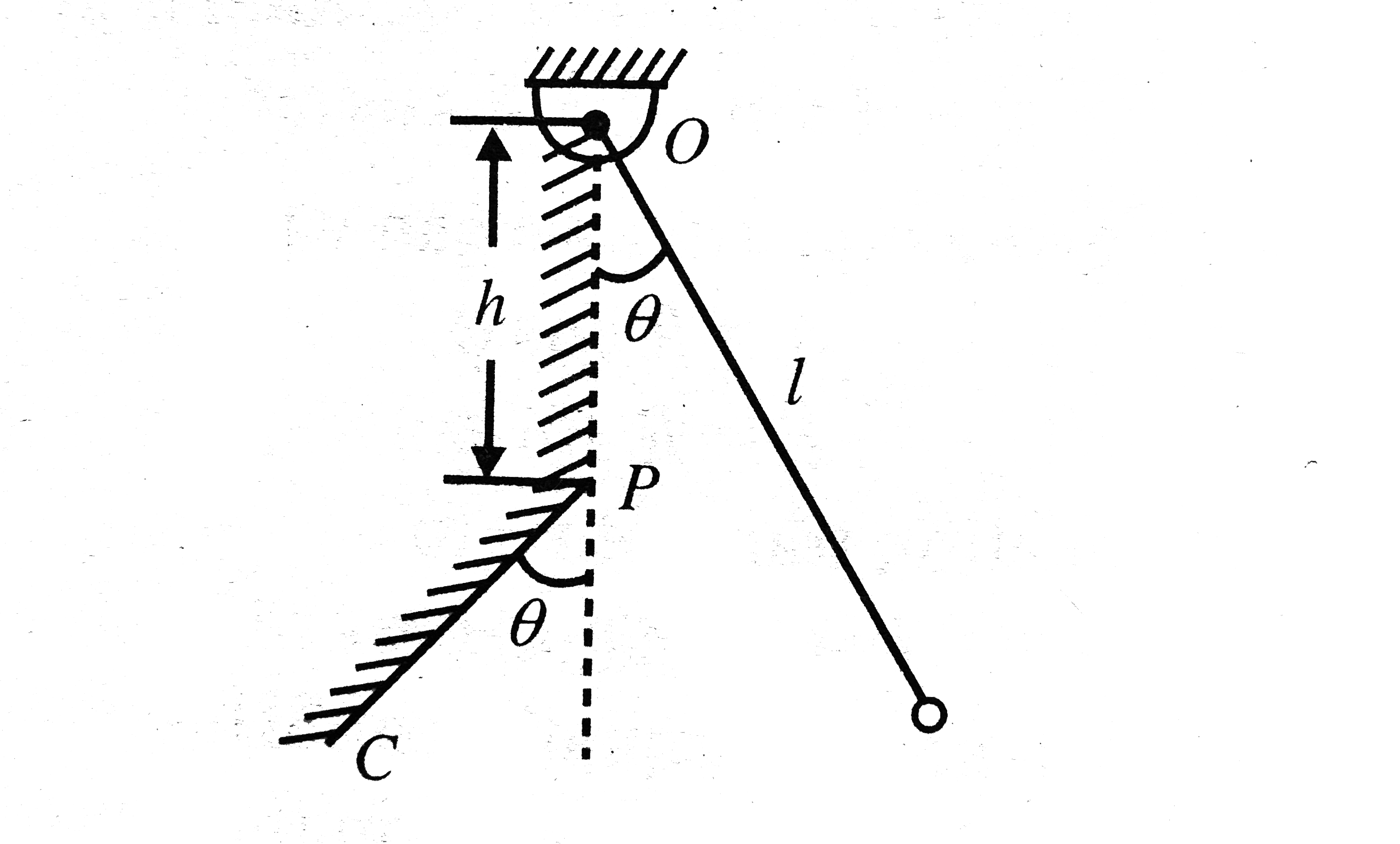
A simple pendulum of length l swings from a small angle `theta` . Its swinging is constrained by the smooth inclined planes OP and PC. Assuming elastic collision of the bob with the plane PC, find
a. angular amplitude for the motion of the bob in the left hand side of its mean position.
b. time period for a complete cycle of motion of the bob.

Text Solution

Verified by Experts
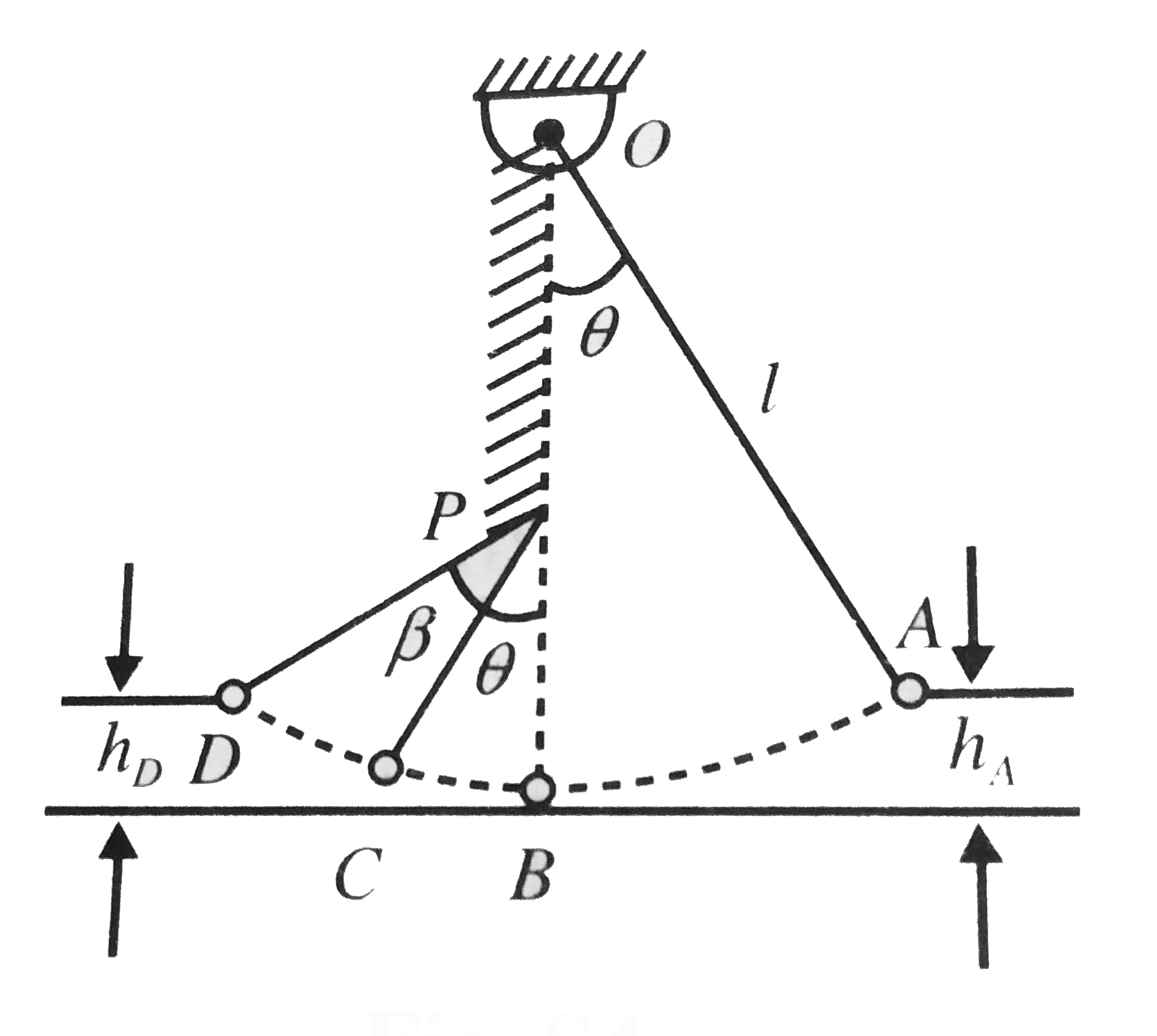
a. Let us assume that the bob swings a maximum a maximum angle `beta` in the left hand side of the mean position in the absence of the position PC of the wall.

Conserving energy at A and D, we have
`U_(A) + K_(A) = U_(D) + K_(D)`
where `U_(A) = mgh_(A). U_(B) = mgh_(B)`
and `K_(A) = K_(D) = 0`
because the bob compes to rest at the exterme positions.
Then, we have `h_(A) = h_(D)`
Substituting `h_(A) = OA (1 - cos theta)`
and `h_(0) = PA (1 - cos theta)` we have
`OA (1 - cos theta) = PD (1 - cos beta)`
Substituting `OA = l. PD = (l - d)`, we have
`beta = (sqrt((l)/(l - h))) theta`
b. Since the bob from A to B
`t_(AB) = (T)/(4)`
where `T = 2 pi sqrt((l)/(g))`
Then `t_(AB) = (pi)/(2) sqrt((l)/(g))`
The time of miotion from B to C can be found by subsituting
`t = t_(BC). theta = 0`
and `theta = beta sqrt((l//(l - h)) theta)`
in the equation `theta = theta_(0) sin omega t`.
where `omega = sqrt(g//(l - h))`
for the swinging position of the string from B to C. This gives
`theta = sqrt((l)/(l - h)) theta sin sqrt((g)/(l - h)) t_(BC)`
Then, we have
` t_(BC) = sqrt((l - h)/(g)) sin ^(-1) sqrt((l - h)/(l))`
Finally, substituting `t_(AB) and t_(BC)` in the expression of time . `T = 2 (t_(AB) + t_(BC))` , we have
`T = pi sqrt((l)/(g)) + sqrt((l - h)/(l)) sin^(-1) sqrt((l - h)/(l))`
Promotional Banner

Topper's Solved these Questions

  • LINEAR AND ANGULAR SIMPLE HARMONIC MOTION

    CENGAGE PHYSICS|Exercise Subjective|21 Videos
  • LINEAR AND ANGULAR SIMPLE HARMONIC MOTION

    CENGAGE PHYSICS|Exercise Single Correct|107 Videos
  • LINEAR AND ANGULAR SIMPLE HARMONIC MOTION

    CENGAGE PHYSICS|Exercise Exercise 4.1|23 Videos
  • KINETIC THEORY OF GASES AND FIRST LAW OF THERMODYNAMICS

    CENGAGE PHYSICS|Exercise Interger|11 Videos
  • MISCELLANEOUS KINEMATICS

    CENGAGE PHYSICS|Exercise Interger type|3 Videos

Similar Questions

Explore conceptually related problems

A simple pendulum of length l is set in motion such that the bob, of mass m, moves along a horizontal circualar path , and the string makes a constant angle theta with the vertical. The time period of rotation of the bob is l and the tension in the thread is T

A simple pendilum with bob of mass m and length l is held in position at an angle theta with t he verticle. Find its speed when it passes the lowest position.

A simple pendulum has a length l & mass of bob m. The bob is given a charge q coulomb. The pendulum is suspended in a uniform horizontal electric field of strength E as shown in figure, then calculate the time period of oscillation when bob is slightly displaced from its mean position.

Show that for small oscillations the motion of a simple pendulum is simple harmonic. Derive an expression for its time period. Does it depend on the mass of the bob ?

A simple pendulum has a bob of mass m and swings with an angular amplitude phi . The tension in thread is T . At a certain time the string makes an angle theta with the vertical (theta le phi)

A bob of mass 2 kg hangs from a string of length 5 m . It swings from its rest position to one of the sides so that the string makes an angle of 60^(@) with the vertical Calculate the gain in potential energy of the bob .

A simple pendulum of length 40 cm oscillates with an angular amplitude of 0.04 rad. Find a. the time period b. the linear amplitude of the bob, c. The speed of the bob when the strig makes 0.02 rad with the vertical and d. the angular acceleration when the bob is in moemntary rest. Take g=10 ms^-2 .

A particle executes a simple harmonic motion of time period T. Find the time taken by the particle to go directly from its mean position to half the amplitude.

CENGAGE PHYSICS-LINEAR AND ANGULAR SIMPLE HARMONIC MOTION-Exercise 4.2
  1. A mass M attached to a spring oscillation with a period of 2 s. If the...

    Text Solution

    |

  2. A horizontal rod of mass m and length L is pivoted at one end The rod'...

    Text Solution

    |

  3. A pendulum has a period T for small oscillations. An obstacle is place...

    Text Solution

    |

  4. A horizontal spring block system of mass M executes simple harmonic mo...

    Text Solution

    |

  5. A spring of spring constant 200 N//m has a block of mass 1 kg hanging ...

    Text Solution

    |

  6. With the assumption of no slipping, determine the mass m of the block ...

    Text Solution

    |

  7. A simple pendulum of length l swings from a small angle theta . Its sw...

    Text Solution

    |

  8. A uniform rod of length l is pivoted distance x from the top of the ro...

    Text Solution

    |

  9. The period of oscillation of a spring pendulum is T. If the spring is ...

    Text Solution

    |

  10. A uniform stick of length l is hinged so as to rotated about a harmoni...

    Text Solution

    |

  11. A ball is released in a smooth dimetrical tunnel of earth a. After ...

    Text Solution

    |

  12. A body is in SHM with period T when oscillated from a freely suspended...

    Text Solution

    |

  13. A point mass m is suspended at the end of a massless wire of length l ...

    Text Solution

    |

  14. In the figure shown, the block A of mass m collides with the identical...

    Text Solution

    |

  15. Figure shown a block P of mass m resting on a smooth floor at a distan...

    Text Solution

    |

  16. Figure shown a block P of mass m resting on a smooth horizontal ground...

    Text Solution

    |

  17. Figure shown a spring block system hanging in equilibrium. If a veloci...

    Text Solution

    |

  18. Find the amplitude of the harmonic motion obtained by combining the mo...

    Text Solution

    |

  19. x(1) = 3 sin omega t,x(2) = 4 cos omega t Find (i) amplitude of resu...

    Text Solution

    |

  20. A partical is subjucted to two simple harmonic motions x(1) = A(1) ...

    Text Solution

    |

