Home
Class 11
PHYSICS
If a listener L is at rest and the siren...

If a listener L is at rest and the siren in previous illustrantion is moving away from L at a speed of `30(m)/(s)`, what frequency does the listener hear?

Text Solution

Verified by Experts
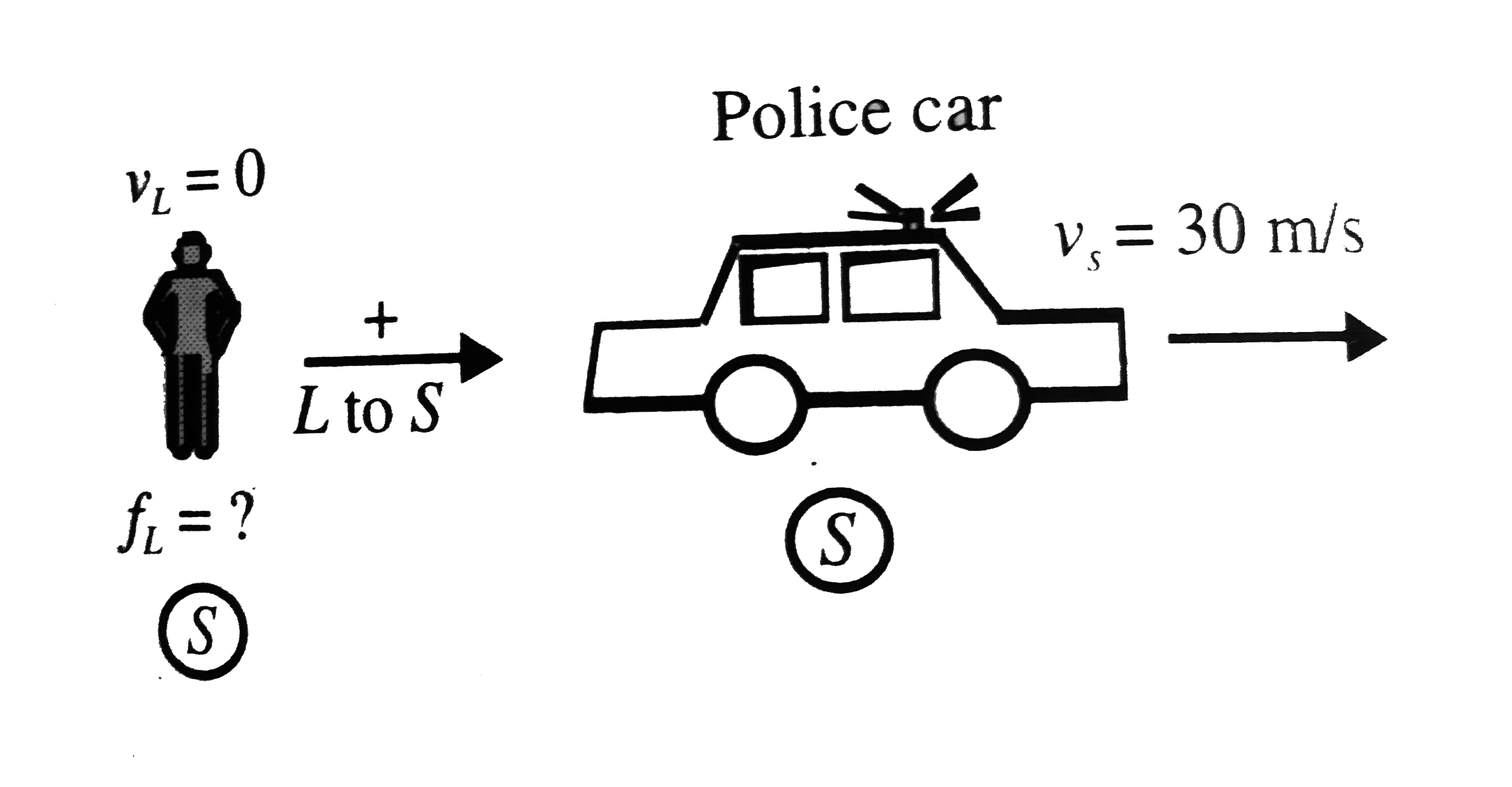

Our target variable is the frequency `f_I`. Heard by the listener, who is behind the moving source Figure. Shows the situation. We know that `v_i=0` and `v_s=30(m)/(s)` (The source velocity `v_S` is positive because the siren is moving in the same direction as the direction from listener to source.)
`f_I=(v)/(v+v_S)f_S=(340(m)/(s))/(340(m)/(s)+30(m)/(s))(300Hz)=276Hz`
The source and listener are moving apart, so the frequency `f_I` heard by the listener is less than the frequency `f_S` emitted by the source.
Here is an alternative approach we can use to chack our result. From previous illustration the wavelength behind the source (which is where the listener in figure is located) is `1.23m`, so
`f_L=(v)/(lamda)=(340(m)/(s))/(1.23m)=276m`
Even though the source is moving, the wave speed v relative to the stationary listener is unchanged.
Promotional Banner

Topper's Solved these Questions

  • SOUND WAVES AND DOPPLER EFFECT

    CENGAGE PHYSICS|Exercise Examples|56 Videos
  • SOUND WAVES AND DOPPLER EFFECT

    CENGAGE PHYSICS|Exercise Exercise 6.1|56 Videos
  • RIGID BODY DYNAMICS 2

    CENGAGE PHYSICS|Exercise Interger|2 Videos
  • SUPERPOSITION AND STANDING WAVES

    CENGAGE PHYSICS|Exercise Comprehension Type|5 Videos

Similar Questions

Explore conceptually related problems

A listener is at rest and a police siren is moving away from the listerner at 60m/s. what frequency does the listerner hear given that the velocity of sound in air is 340m/s and frequency os siren is 500Hz?

A plice siren emits a sound wave of frequency 440 Hz. The speed of sound is 332 m/s. if the siren is moving away from the listerner with a speed of 18 m/s relative to the air and the listerner is moving towards the siren with a speed of 68 m/s relative to the air, then what frequency does the listern hear?

Two train whistles A and B each have a frequency of 220 Hz. A is stationary and B is moving toward the right (away from A) at a speed of 35 m//s . A listener between the two trains is moving towards the right with a speed of 15 m//s . No wind is blowing. What is frequency from A as heard by the listener

As shown if Fig. a vibrating tuning fork of frequency 512 Hz is moving towards the wall with a speed 2(m)/(s) . Take speed of sound as v=340(m)/(s) and answer the following questions. Q. If the listener is at rest and located such that the tuning fork is moving between the listener and the wall, number of beats heard by the listerner per second will be nearly

A siren emiting sound of frequency 800Hz is going away from a static listence with a speed of 30 m//s frequency of sound to be beand by the listener is ("velocity of sound" = 330 m//s)

Two train whistles A and B each have a frequency of 220 Hz. A is stationary and B is moving toward the right (away from A) at a speed of 35 m//s . A listener between the two trains is moving towards the right with a speed of 15 m//s . No wind is blowing. What is the frequency from B as heard by the listener?

CENGAGE PHYSICS-SOUND WAVES AND DOPPLER EFFECT-Integer
  1. If a listener L is at rest and the siren in previous illustrantion is ...

    Text Solution

    |

  2. The average power transmitted across a cross section by two sound wave...

    Text Solution

    |

  3. Loudness of sound from an isotropic point source at a distace of 70cm ...

    Text Solution

    |

  4. Two sound sources are moving away from a stationary observer in opposi...

    Text Solution

    |

  5. The resultant loudness at a point P is n dB higher than the loudness o...

    Text Solution

    |

  6. The average power transmitted across a cross section by two sound wave...

    Text Solution

    |

  7. Loudness of sound from an isotropic point source at a distace of 70cm ...

    Text Solution

    |

  8. Two sound sources are moving away from a stationary observer in opposi...

    Text Solution

    |

  9. The resultant loudness at a point P is n dB higher than the loudness o...

    Text Solution

    |

  10. The average power transmitted across a cross section by two sound wave...

    Text Solution

    |

  11. Loudness of sound from an isotropic point source at a distace of 70cm ...

    Text Solution

    |

  12. Two sound sources are moving away from a stationary observer in opposi...

    Text Solution

    |

  13. The resultant loudness at a point P is n dB higher than the loudness o...

    Text Solution

    |

  14. The average power transmitted across a cross section by two sound wave...

    Text Solution

    |

  15. Loudness of sound from an isotropic point source at a distace of 70cm ...

    Text Solution

    |

  16. Two sound sources are moving away from a stationary observer in opposi...

    Text Solution

    |

  17. The resultant loudness at a point P is n dB higher than the loudness o...

    Text Solution

    |

