Home
Class 11
CHEMISTRY
Explain the following question (based on...

Explain the following question (based on ionisation energy):
(a) Why `IE_(1)` of `N` is higher than that of `O` atom ?
(b) Why `IE_(1)` of `Mg` is higher than that of `Al` atom?
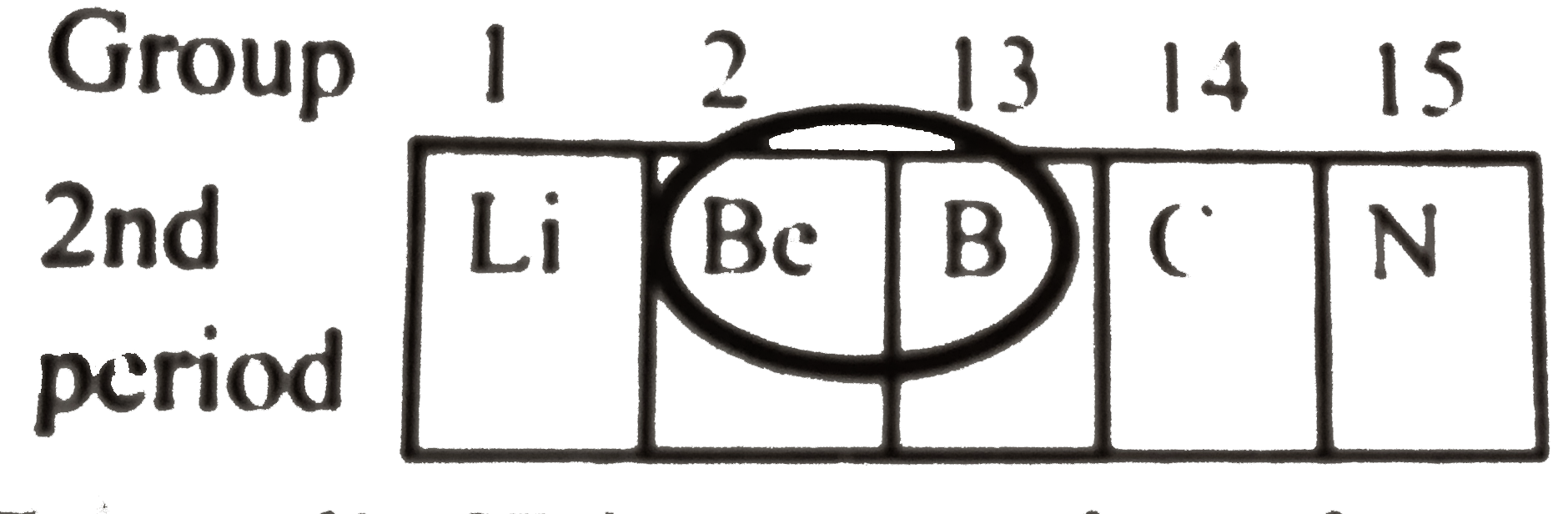
(c ) Why `IE_(1)` of `C` is greater than that of `B` atom whereas `IE_(2)` is reverse ?
(d) In general, `IE` increases along the period `(rarr)`. Explain why the `IE_(2)` of `Cr` is higher than that of `Mn` (Manganese)?
(e) The `IE_(1)` and `IE_(2)` of `K` are `420` and `3050 kJ mol^(-1)` respectively and those of `Ca` are `560` and `1140 kJ mol^(-1)` respectively. Compare their values and comment on the differences.
(f) The `IE` of `Li`, `Be` and `C` are `5.5, 9.3` and `11.3 eV`. What would be the case and explain.
i. `K, Ca,Se` , ii. `N,O,F`
iii. `K^(o+), Ar,Cl^(ɵ)` , iv `Fe, Fe^(2+), Fe^(3+)`
v. `C,N,O` , vi. `Cu,Ag,Au`
vii. `K, Rb, Cs` , viii `Be, B, C`
ix. `Na, Mg, Al`
(h) Explain why `Fe^(2+)` is more easily oxidised to `Fe^(3+)` than `Mn^(2+)` to `Mn^(3+)`.
(i) Explain whether `IE_(1)` of two isotopes of same element would be same or different.
(j) What are the factors on which `IE` of main group elements tends to decrease douwn the group `(darr)`.

Text Solution

Verified by Experts
`N` has half-filled configuration, hence stable. Therefore, `IE_(1) of NgtIE_(1) of O`
b. This is due ot penetration effect. It is difficult to remove on electron from `3s` orbital in comparison to `3 p` orbital. Hence `IE_(1)` of `Mg gt IE_(1)` of `Al`
c. N/A
d. Valence electronic configuration of `Cr=3d^(5)4s^(1)` and that of `Cr^(o+)` is `3d^(5) 4s^(0)` ( stable half-filled configuraion ). Valence electronic configuraion of `Mn=3d^(5) 4s^(2)` and that of `Mn^(o+)` is `3d^(5) 4s^(-1)` ( less stable configuration than that of `Cr^(o+)`).
`:. IE_(2)` of `Cr gt IE_(2)` of `Mn`
(e) Valence electronic configuration of `K = 4s^(1)`.
Valence electronic configuration of `Ca = 4s^(2)`.
Therefore, the removal of the second electron from `K` is extremly difficult because `K` acquires noble gas configuration after the removal of one electron while the removal of both electrons from `Ca` ia comparatively easy, as it requires stable configuration after the removal of the second electron.
(f)
Generally `IE` increases along the period `(rarr)`. But there is an exception in `IE_(1)` of `Be` and `B` ( due ot penetration effect).
Therefore , `IE_(1)` of `B` should be greater than that of `Be`.
But actually, `IE_(1) of Be gt IE_(1) of B`
Therefore, `IE_(1) "or" N ("half-filled configuration") gt IE_(1) "of" C gt IE_(1) "of" Be gt IE_(1) "of" B gt of Li`
g. (1) `Sc gt Ca gt K ( IE "of group"17 gt "group" 2 gt "group" 1)`
i.. `F gt N gt O[ IE "of group"17 gt "group" 15 ( "half-filled configuraion") gt "group" 16]`
iii. `K^(o+) gt Argt Ci^(ɵ) [ IE "if group"1( +ve "charge") gt "Inert gas" gt "group" 17(-"ve charge")`
iv. `Fe^(3+) gt Fe^(2+) gt Fe [IE "of" +3 "charge" gt +2 "charge" gt "neutral element"]`
Valence electronic configuraion of `Fe, Fe^(2+)` and `Fe^(3+)` are `3d^(6)4s^(2),3d^(6)4s^(0)` and `3d^(5) 4s^(0)` respectively.
v. `N gt O gt C [ IE "of half filled configuraion of" N "of group" 15 gt IE "of group" 16 gt IE "of group" 14]`
vi. `Au gt Cu gt Ag`.
`5d gt 3d gt 4d`
`[{:(IE "should decrease from" 3d rarr 4d rarr 5d),((3d gt 4d gt 5d) "transition element series.But"),("due to imperfect screening effect 4 f orbitals"),("in 5d transitions series,the IE of" 5d gt 3d gt 4d):}]`
vii. `K gt Rb gt Cs` [`IE` of group `1` decreases down the group `darr)`]
viii. `{:(,C,gt,Be,gt,B),("Group rArr,14,,2,,13):}`
[Generally `IE` increases along the period, i.e., from group `2 gt "group" 13 gt "group" 14`. But there is exception in the `IE` of `Be` and `B` due to penetration effect, therefore, `IE_(1)` of `Be gt IE_(1)` of `B`]
ix. `Al gt Mg gt Na`
[`IE` of group `13 gt "group" 2 gt "group" 1`]
h. Valence electronic configuration of `Fe` and `Fe^(2+)` are `3d^(6) 4s^(2)` and `3d^(6) 4s^(0)` respectively.
Valence electronic configuration of `Mn` and `Mn^(2+)` are `3d^(5) 4s^(2)` and `3d^(5) 4s^(0)` respectively.
`:. underset(("Less stable configuration"))underset((3d^(6)4s^(0)))(Fe^(2+)) rarr underset("configuration)")underset("("3d^(5), "half-filled more stable")(Fe^(3+)+e^(-))`
`underset(["Half-filled more stable configuration"])underset((3d^(5)4s^(0)))(Mn^(2+)) rarr underset([3d^(4), "less stable configuration"])(Mn^(3+)+e^(-))`
`Fe^(2+)` is easily oxidised to `Fe^(3+)`, since valence electronic configuration to more stable half-filled `3d^(5)` configuration, whereas it is reverse in the case of `Mn^(2+)` to `Mn^(3+)`.
i. Same, since the number of protons and electrons are same but neutrons are different in isotopes of same element. Therefore, `Z_("eff")` and size remains same in the isotops. Neutrons have no effect on `Z_("eff")` and size of isotopes.
(j). i. Increase in size.
ii. Increase in screening effect.
iii. Decrease in `Z_("eff")`.
Promotional Banner

Topper's Solved these Questions

  • PERIODIC CLASSIFICATION OF ELEMENTS AND GENERAL INORGANIC CHEMISTRY

    CENGAGE CHEMISTRY|Exercise Ex 1.1|14 Videos
  • PERIODIC CLASSIFICATION OF ELEMENTS AND GENERAL INORGANIC CHEMISTRY

    CENGAGE CHEMISTRY|Exercise Ex 1.1 (Very Short)|22 Videos
  • PERIODIC CLASSIFICATION OF ELEMENTS AND GENERAL INORGANIC CHEMISTRY

    CENGAGE CHEMISTRY|Exercise Exercises (Archives )Subjective|4 Videos
  • P-BLOCK GROUP 14 - CARBON FAMILY

    CENGAGE CHEMISTRY|Exercise Exercises Archives (Subjective)|9 Videos
  • PURIFICATION OF ORGANIC COMPOUNDS AND QUALITATIVE AND QUANTITATIVE ANALYSIS

    CENGAGE CHEMISTRY|Exercise Assertion Reasoning Type|5 Videos

Similar Questions

Explore conceptually related problems

Why IE_(3) of Mn is high ?

The IE_(1) of Be is greater than that of B. [T/F]

The IE of Be is greater than that of B.

The IE_(1) of C atom is greater than that of boron (B) atom, whereas the reverse is true for IE_(2) . Explain?

IE_(1) value of Mg is more than that of Na while it’s IE_(2) value is less. Explain.

Assertion(A) : IE_(2) of C is greater than that of B . Reason (R ): Due to penetration effect.

The IE of Be is "____" than that of B .

CENGAGE CHEMISTRY-PERIODIC CLASSIFICATION OF ELEMENTS AND GENERAL INORGANIC CHEMISTRY-Solved Examples
  1. (a) The EN of cesium (Cs) is 0.7 and that of chlorine (Cl) is 3.5. Pre...

    Text Solution

    |

  2. Among the elements with Z = 9, 12 and 36, identify by atomic number of...

    Text Solution

    |

  3. Explain the following question (based on ionisation energy): (a) Why...

    Text Solution

    |

  4. Answer the following question (Based on EA, Delta(eg)H^(ɵ) and IE). ...

    Text Solution

    |

  5. Explain the following question (based on size of atoms or ions and oth...

    Text Solution

    |

  6. For the gaseous reaction K+F rarrK^(o+)+F^(ɵ) Delta H = 19 kcal mo...

    Text Solution

    |

  7. For the reaction K(g)+F(g) +K^(o+)+F^(Theta) (separated ions DeltaH = ...

    Text Solution

    |

  8. From N atoms of an element A, when half the atoms transfer one electro...

    Text Solution

    |

  9. The conservation of gaseous atoms K and F to K^(o+) and F^(ɵ) absorbs ...

    Text Solution

    |

  10. Explain the following: a. Which of the following Na, Mg, Si and P wo...

    Text Solution

    |

  11. Classify the following oxides as a. Strongly acidic b. Weakly acidic...

    Text Solution

    |

  12. Select the strongest and weakest acid in each of the following sets: ...

    Text Solution

    |

  13. A 0.10 M aqueous solution of which salt in each of the following pairs...

    Text Solution

    |

  14. Identify: a. The good oxidising agent (s) b. The good reducing age...

    Text Solution

    |

  15. Answer the following: a. Which of the following has the greatest aff...

    Text Solution

    |

  16. Explain the following: a. The formation of Cs(2)O from its element i...

    Text Solution

    |

  17. Give the name and atomic number of the inert gas atom in which the tot...

    Text Solution

    |

  18. Classify the elements having atomic numbers (9,12,16,34,53,56) into th...

    Text Solution

    |

  19. Calculate the electronegativity of fluorine from the following data: ...

    Text Solution

    |

  20. Calculate electronegativity of carbon at Pauling scale Given that : ...

    Text Solution

    |

