Home
Class 11
CHEMISTRY
Calculate the EA of O atom to O^(2-) ion...

Calculate the `EA` of `O` atom to `O^(2-)` ion from the following data:
i. `Delta_(f)H^(ɵ)[MgO(s)] = -600 kJ mol^(-1)`
ii. `Delta_(u)H^(ɵ) [MgO(s)] = -3860 kJ mol^(-1)`
iii. `IE_(1) + IE_(2)` of `Mg(g) = 2170 kJ mol^(-1)`
iv. `Delta_("diss")H^(ɵ)` of `Mg(s) = + 494 kJ mol^(-1)`
v. `Delta_("sub")H^(ɵ)` of `Mg(s) = +150 kJ mol^(-1)`

A

`+693 kJ mol^(-1)`

B

`-693 kJ mol^(-1)`

C

`+69.3 kJ mol^(-1)`

D

`-69.3 kJ mol^(-1)`

Text Solution

Verified by Experts

The correct Answer is:
A

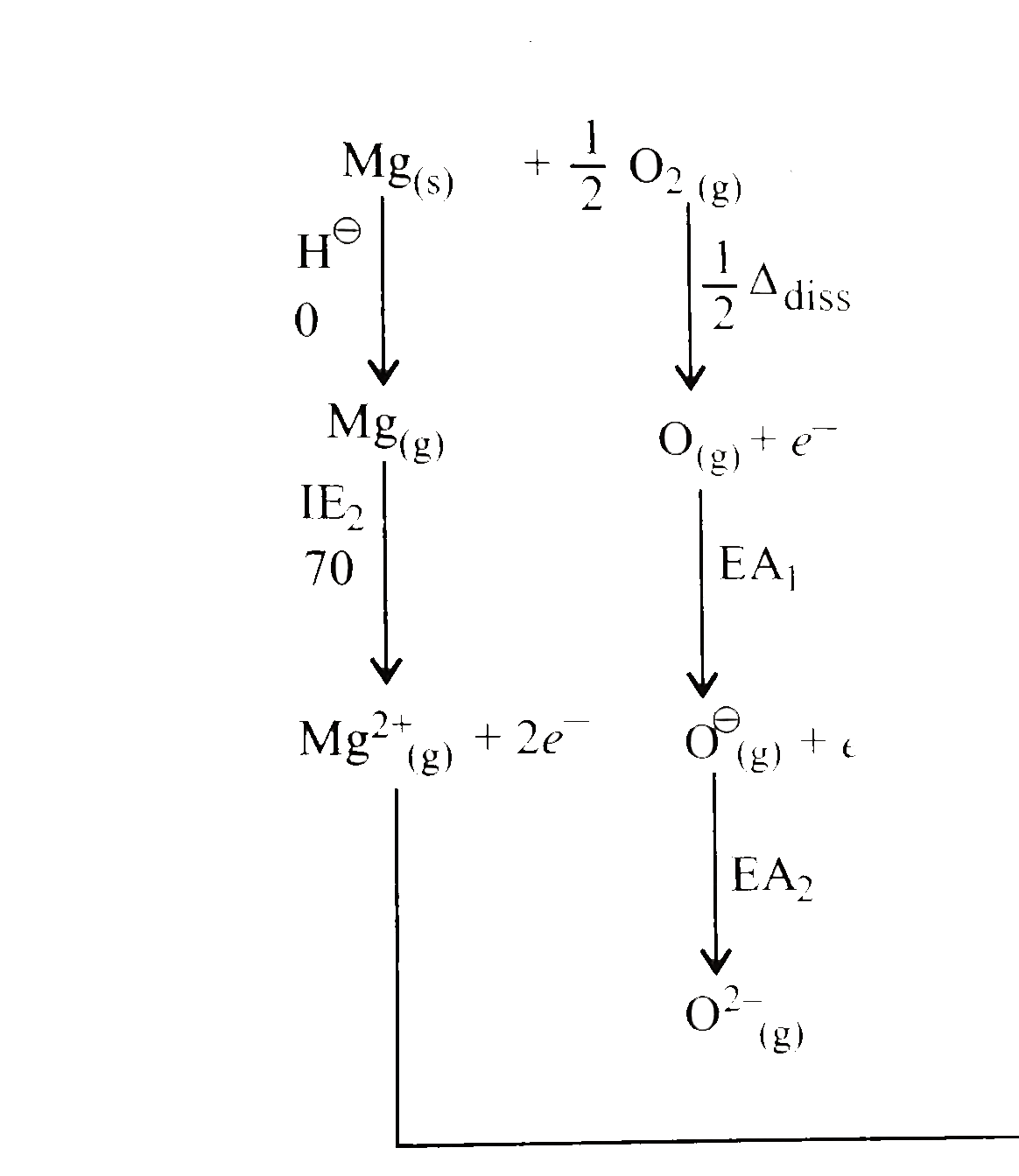
Using Born-Haber cycle for `MgO`, calculation of `EA` of `O` atom to `O^(2-)` ion (All values in `kJ mol^(-1)`)

`:. Delta_(f)H^(ɵ) = Delta_("sub")H^(ɵ) + (IE_(1) + IE_(2)) + (1)/(2) Delta_("diss") + (EA_(1) + EA_(2))+Delta_(U)H^(ɵ)`
`-600 = 150 + 2170 + (1)/(2) xx 494 + (EA_(1)+EA_(2)) - 3860`
`:. (EA_(1) +EA_(2)) = + 693 kJ mol^(-1)`
Promotional Banner

Topper's Solved these Questions

  • PERIODIC CLASSIFICATION OF ELEMENTS AND GENERAL INORGANIC CHEMISTRY

    CENGAGE CHEMISTRY|Exercise Exercises (Single Correct)Miscellaneous|10 Videos
  • PERIODIC CLASSIFICATION OF ELEMENTS AND GENERAL INORGANIC CHEMISTRY

    CENGAGE CHEMISTRY|Exercise Exercises (Assertion Reasoning)|11 Videos
  • PERIODIC CLASSIFICATION OF ELEMENTS AND GENERAL INORGANIC CHEMISTRY

    CENGAGE CHEMISTRY|Exercise Exercises (Single Correct) Bond Angle|4 Videos
  • P-BLOCK GROUP 14 - CARBON FAMILY

    CENGAGE CHEMISTRY|Exercise Exercises Archives (Subjective)|9 Videos
  • PURIFICATION OF ORGANIC COMPOUNDS AND QUALITATIVE AND QUANTITATIVE ANALYSIS

    CENGAGE CHEMISTRY|Exercise Assertion Reasoning Type|5 Videos

Similar Questions

Explore conceptually related problems

Calculate the lattice energy from the following data (given 1 eV = 23.0 kcal mol^(-1) ) i. Delta_(f) H^(ɵ) (KI) = -78.0 kcal mol^(-1) ii. IE_(1) of K = 4.0 eV iii. Delta_("diss")H^(ɵ)(I_(2)) = 28.0 kcal mol^(-1) iv. Delta_("sub")H^(ɵ)(K) = 20.0 kcal mol^(-1) ltbvrgt v. EA of I = -70.0 kcal mol^(-1) vi. Delta_("sub")H^(ɵ) of I_(2) = 14.0 kcal mol^(-1)

Find DeltaH of the process NaOH(s) rarr NaOH(g) Given: Delta_(diss)H^(Theta)of O_(2) = 151 kJ mol^(-1) Delta_(diss)H^(Theta) of H_(2) = 435 kJ mol^(-1) Delta_(diss)H^(Theta) of O-H = 465 kJ mol^(-1) Delta_(diss)H^(Theta) of Na -O = 255 kJ mol^(-1) Delta_(soln)H^(Theta)of NaOH = - 46 kJ mol^(-1) Delta_(f)H^(Theta) of NaOH(s) =- 427 kJ mol^(-1) Delta_("sub")H^(Theta) of Na(s) = 109 kJ mol^(-1)

Calculate the resonance energy of gaseous benzene form the following data. BE(C-H) = 416.3 kJ mol^(-1) BE(C-C) = 331.4 kJ mol^(-1) BE(C=C) = 591.1 kJ mol^(-1) Delta_("sub")H^(Theta)(C,"graphite") = 718.4 kJ mol^(-1) Delta_("diss")H^(Theta)(H_(2),g) = 435.9 kJ mol^(-1) Delta_(f)H^(Theta) ("benzene", g) = 82.9 kJ mol^(-1)

Calculate the lattice energy of the reaction Li^(o+)(g) +CI^(Theta) (g) rarr LiCI(s) from the following data: Delta_("sub")H^(Theta)(Li) = 160.67 kJ mol^(-1), (1)/(2)D(CI_(2)) = 122.17 kJ mol^(-1) IP(Li) = 520.07 kJ mol^(-1),E_(A)(CI) = - 365.26 kJ mol^(-1) and Delta_(f)H^(Theta)(LiCI) =- 401.66 kJ mol^(-1)

Calculate Delta_(f)H^(@) for chloride ion from the following data: 1/2H_(2)(g) + 1/2CI_(2)(g) to HCI(g) Delta_(f)H^(@) = -92.8 kJ mol^(-1) HCI(g) + H_(2)O to H_(3)O^(+)(aq) + CI^(-)(aq) Delta_(diss) H^(@) = - 75.2 kJ mol^(-1) .

If Delta_(f)H^(@) _(C_(3)H_(8)(g))=-85kJ moll^(-1), Delta_(f)H^(@) _(C_(3)H_(8)(g))=-104kJ mol^(-1), DeltaH for C_((s))rarr C_((g)) is 718kJ mol^(-1) and heat of formation of H- atom is 218kJ mol^(-1) , then :

Calculate the temperature at which liquid water will be in equilibrium with water vapour. Delta_(vap)H = 40.00 kJ mol^(-1) and Delta_(vap)S = 0.100 kJ mol^(-1)K^(-1)

