Home
Class 11
CHEMISTRY
Explain : (i) mu of NH3 gt NF3 (i...

Explain :
(i) `mu of NH_3 gt NF_3`
(ii) `mu of CH_3 C1 gt CH_3 F gt CH_3 Br gt CH_3 I`
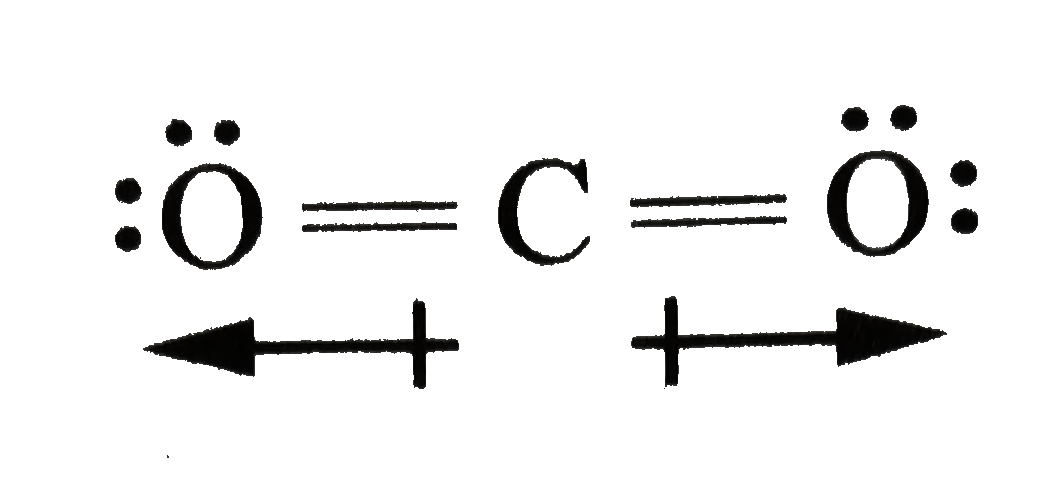
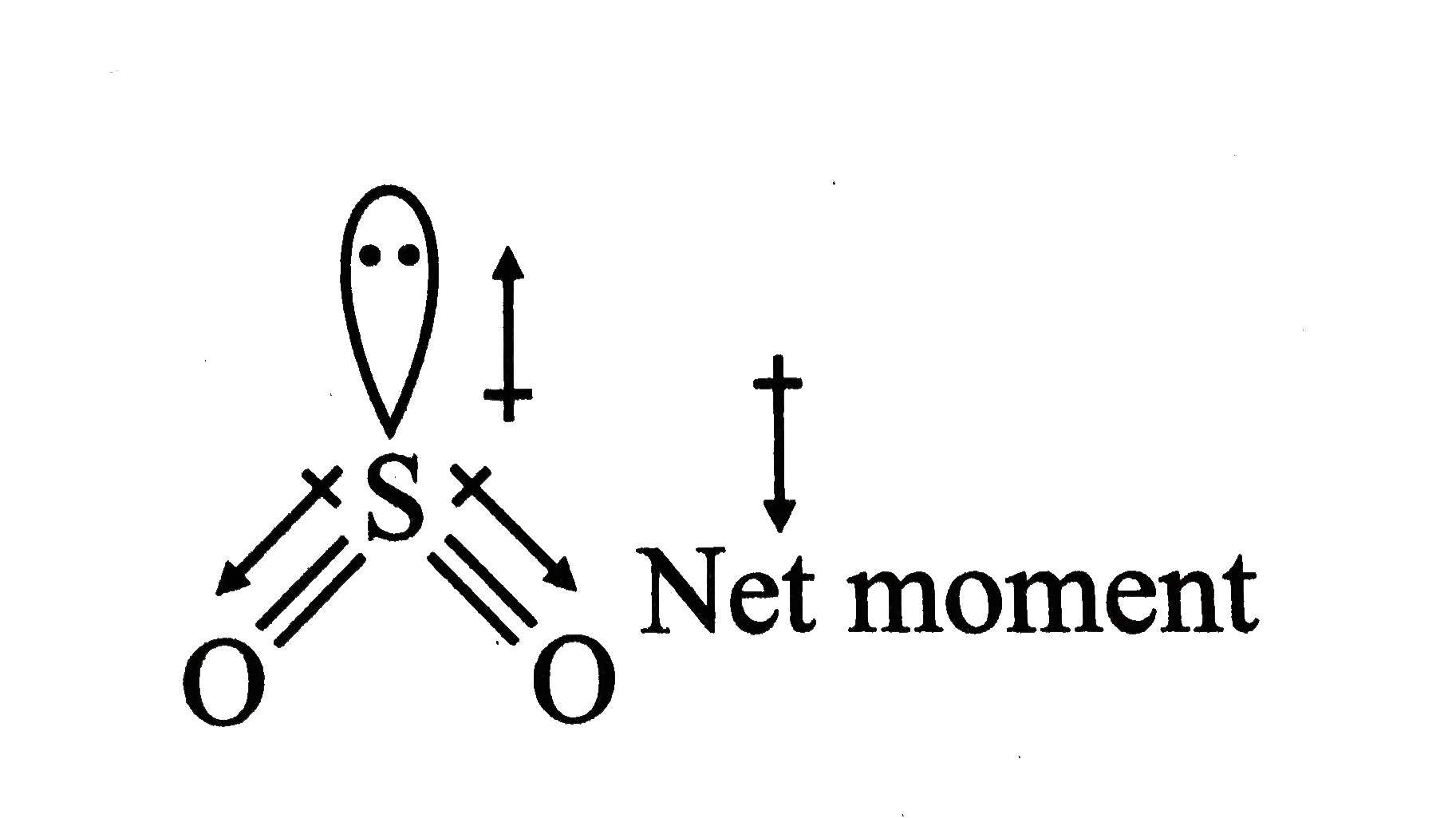
(iii) `mu of CO_2` is zero, nut `mu of SO_2 ne 0`
(iv) Why the lone pair of `overline e^, s` has no effect on the `mu` of `PH_3`. The bond angle in `PH_3` is `92^@`.
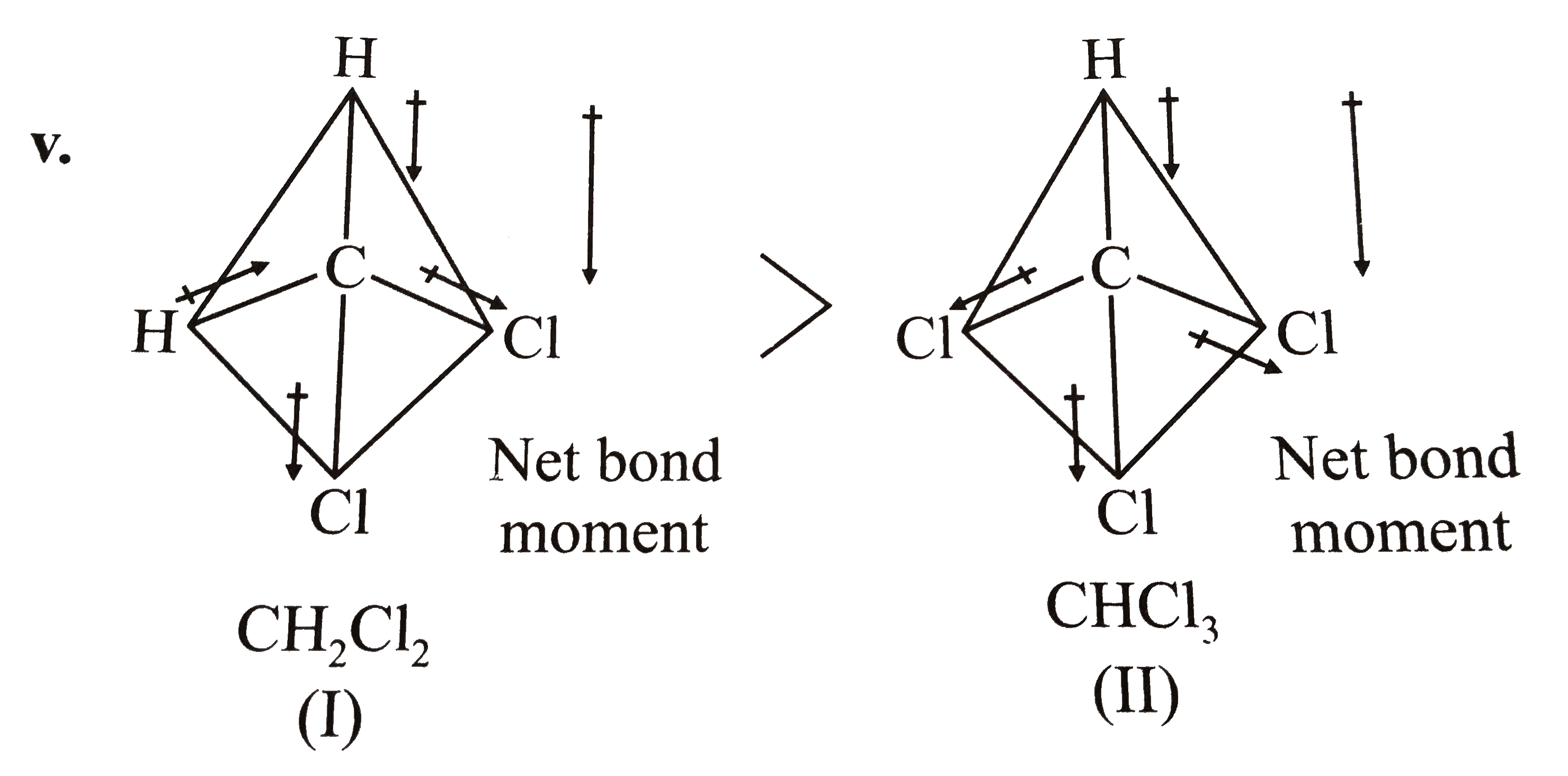
(v) `mu of CH_2 C1_2 gt CH C1_3`.

Text Solution

Verified by Experts
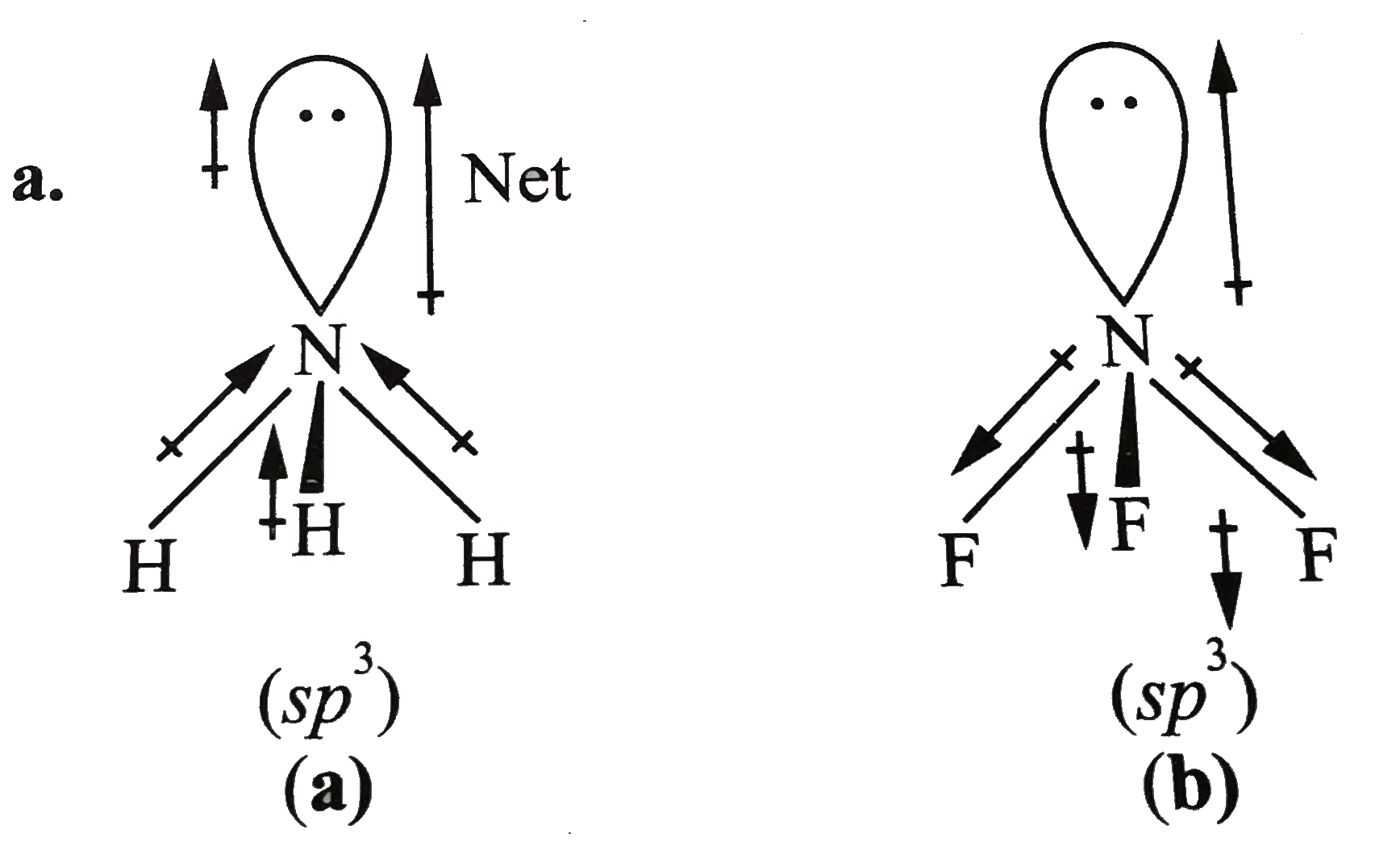
`[{:("Resulant"-(mu) of NH_(3),,"Resultant" - (mu) of NF_(3),,),(=4.90 xx 10^(-3)Cm,,= 0. 80 xx 10^(-30) Cm,,):}]`
In `NH_(3)` the net moment of `(N -H)` bonds and the contribution from the lp `e^(-')s` (lone pair `e^(-')`s) are in the same direction and are additive [see (a) given above] The net moment of teh `(N-F)` bond opposes the dipole effect of the `lpe^(-')` in `NH_(3)` and the resultant is less than `mu So, mu` of `Nh_(3) gtNF_(3)`
(b) The electronegatives of halogens decrease from `F` to So `mu` of `HF gt HCI gtHBr gt HI` But `mu` of `CH_(3)F` is smaller than `CH_(3)CI` due to shorter `(C -F)` bond distance, although `EN` of `F` is greater than that of `CI`
(c ) In `CO_(2')C` is sp hybridised and linear The bond moments of `(C -O)` are equal and in opposite directions and cancel each other Hence `mu` is zero
in `SO_(2)` is `sp^(2)` hybridised having one `lp ebar` on `S` atom. The `(O -S-O)` bond angle is nerly `120(S-O)` bond moment does not cancel and shows a net resultant mu
(d) The `92^(@)` bond angle suggests that `P` uses three `P` atomic orbitals in forming bonds with `H` with one `lp e^(-)` in 3s atomic orbital i.e `P` in `PH_(3)` is `sp^(2)` hybridised (unlike `NH_(3)` in which `N` is `sp^(3)` hybridised) Therefore, due to the presence of `lpee^(-')s` in 3s atomic orbital of `P` which is spherical symmetrical the polarity of the molecule is not affected. In order to effect the polarity of the molecule the `e^(-)s` must be in a directional orbital Moreover, `EN` of `P` and `H` are nearly same so `PH_(3)` molecule is almost non-polar
In (I) all bond momnets are in the same direction so they are additive and the net resultant mu is more than (II) In (II) the bond moment of one of the `CI` atoms opposes, the net moment of the other two, so the net resultant mu is less than that of (I)
.
Promotional Banner

Topper's Solved these Questions

  • CHEMICAL BONDING AND MOLECULAR STRUCTURE

    CENGAGE CHEMISTRY|Exercise Solved Examples|36 Videos
  • CHEMICAL BONDING AND MOLECULAR STRUCTURE

    CENGAGE CHEMISTRY|Exercise Ex 2 .2 Subjective (Intermolecular Forces And H-Bonding)|7 Videos
  • ATOMIC STRUCTURE

    CENGAGE CHEMISTRY|Exercise Concept Applicationexercise(4.3)|19 Videos
  • CHEMICAL EQUILIBRIUM

    CENGAGE CHEMISTRY|Exercise Archives (Subjective)|11 Videos

Similar Questions

Explore conceptually related problems

Which one in each of the following pairs is expected to exhibit hydrogen bonding together ? (a) CH_3 - CH_2 - OH and CH_3 - O - CH_3 (b) CH_3 NH_2 and CH_3 SH (c ) CH_3OCH_3 and (CH_3)_3 N

In the figure shown, mu_(1) gt mu_(2) gt mu_(3) . What are the limits of angle i so that it is neither get total internal reflection at AB nor at CD ?

Which of the following should be most volatile? I) CH_3 CH_2 CH_2 NH_2 II) (CH_3)_3 N III) IV) CH_3 CH_2 CH_3

What is the type of hybridisation of each carbon in the following compounds ? (i) CH_3 CH_3 (ii) CH_3 CI (iii) (CH_3)_2 CO (iv) CH_3 CN

Among (i) C_(6)H_(5) NH_(2) (ii) CH_3NHCH_(3) (iii) (CH_3)_2NCH_(3) and (iv) NH_3 , the correct order of basic strength follows the order

Arrange the following compounds in the order of increasing boiling points : (i) CH_3COC1 (ii) (CH_3 CO)_2 O (iii) CH_3 CONH_2 (iv) CH_3 COOH .

Isoelectronic structures among the following structures are : (I) CH_3^+ , (II) H_3O^+ (III) NH_3, (IV) CH_3^- .

CENGAGE CHEMISTRY-CHEMICAL BONDING AND MOLECULAR STRUCTURE-Archives Subjective
  1. Explain : (i) mu of NH3 gt NF3 (ii) mu of CH3 C1 gt CH3 F gt C...

    Text Solution

    |

  2. State four major physical properties that can be used to distinguish b...

    Text Solution

    |

  3. Write the Lewis dot structural formula for each of the following Also ...

    Text Solution

    |

  4. How many sigma bonds and pi bonds are present in a benzene molecules ?...

    Text Solution

    |

  5. Arrange the following as stated Increasing strenght of hybrogen bond...

    Text Solution

    |

  6. Given reasons in two or there sentences only for the following Hydroge...

    Text Solution

    |

  7. The dipole momnet of KCI is 3.336 xx 10^(-29) Cm which indicates that ...

    Text Solution

    |

  8. Explain the difference in the nature of bonding in LiF and LiI .

    Text Solution

    |

  9. Using the VSEPR theory, identify the type of hybisation and draw the s...

    Text Solution

    |

  10. Interpret the non-linear shape of H(2)S molecule and non-planar shape ...

    Text Solution

    |

  11. Write the MO electron distribution of O(2) Specify its bond order and ...

    Text Solution

    |

  12. Which one is more soluble in diethyl ether : anhydrous AlCl(3) or hydr...

    Text Solution

    |

  13. Using VSEPR theory draw the shape of PCI(5) and BrF(5) ?.

    Text Solution

    |

  14. Draw the shape of XeF(4) and OSF(4) according to VSEPR theory Show the...

    Text Solution

    |

  15. One the basic of ground electronic configuration, arrange the followin...

    Text Solution

    |

  16. Predict whether the following molecules are isostructural or not Justi...

    Text Solution

    |