Home
Class 11
CHEMISTRY
(a) Nitrogen and chlorine have almost sa...

(a) Nitrogen and chlorine have almost same `EN'` s but `N` forms H-bonding
(b) `H_(2)O` is liquid whereas `H_(2)S` is gas
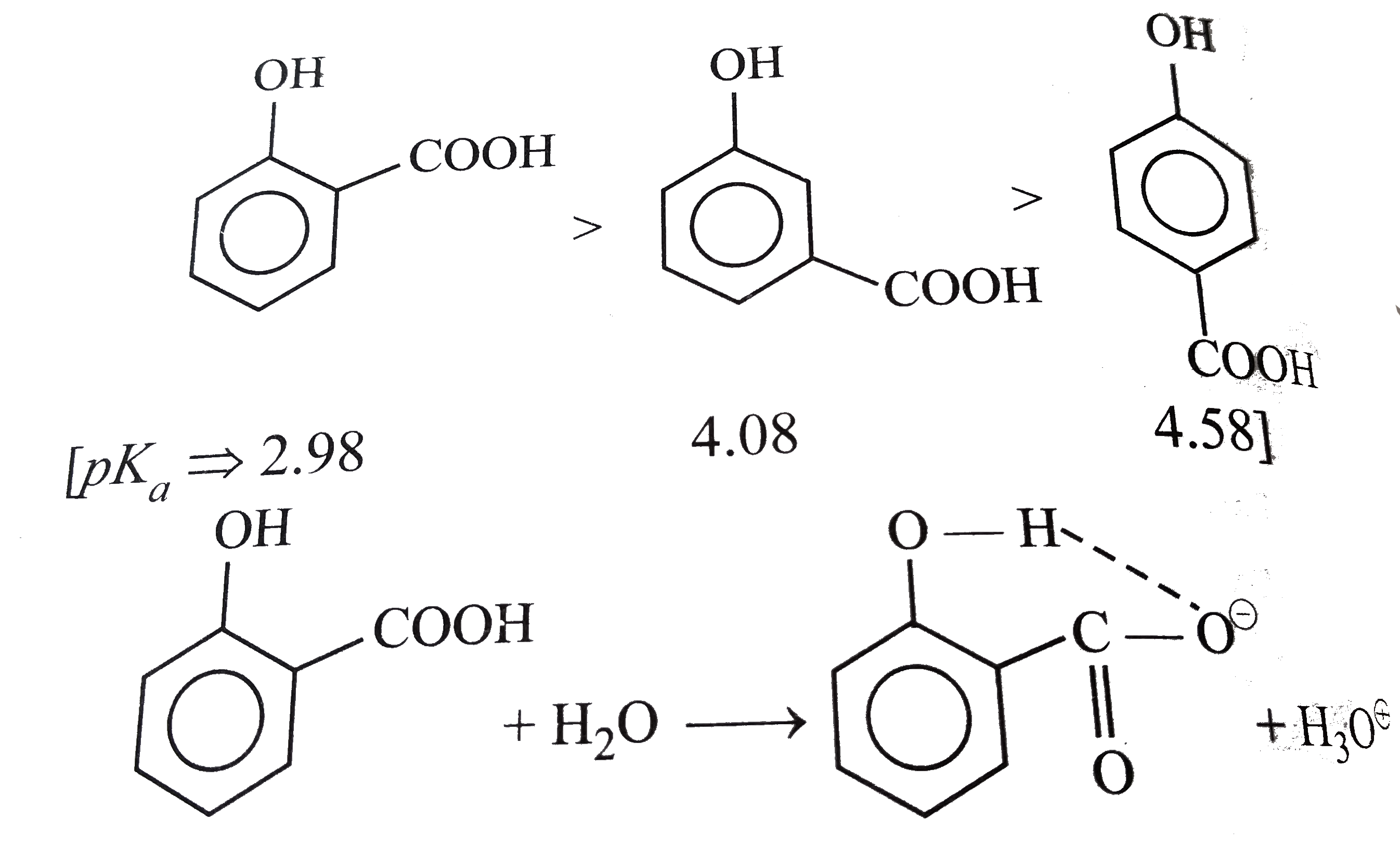
(c ) Compare the acidic strength of o-,m-and p-hydroxy benzoic acid
`(d)NH_(3)` exists as liguid whereas `HCI` as gas
(e) Among the compounds `CH_(3)COOH,NH_(3)HF` and `CH_(4)` in which the strongest H-bonding is persent (f) Among `HF,CH_(3) OH, N_(2)O_(4)` amd which would have intermolecular H-bonding
(g) Salt-like `KHF_(2)` is stable but `KHCI_(2)` is not known (h) `H_(3)PO_(4)` is a syrupy liquid
(i) `H_(2)SO_(4)` is colourless viscous oily liquid and has high boiling point
(j) Water forms four H-bonds as compared to two in `HF` EXplain
(k) Density of ice is less than that of water or ice floats over water .

Text Solution

Verified by Experts
(a) Due to the large size of `CI` interacting with neighbouring molecules is not so strong
(b) In `H_(2)O` there are stron intermolecular forces due to extensive H-bonds No such bonding exists in `H_(2)S` since `EN` of `OgtEN` of `S`
(c ) Stregth of certain acids and bases can be explained on the basis of H-bonding The abnormally high ka or low `pK_(a)` value of o-hydroxybenzoic acid is due to the fact that the conjugate base is stabilised by h-boding Decreasing acidic strength order is ltbr. (d) The size of `N` atom is less than the size of `CI`atom therefore electron density in `N` is more than that of `CI` So `N` forms H-bonding leading to association of molecule Hence `NH_(3)` is liquid H-bonding is not possible with `CI`
(e) `HF` due to maximum `EN` of `F` Decreasing order of strength of H-bonding
`HF gt NH_(3) gt CH_(3) COOH` (exist as dimer) gt `CH_(4)`
(f ) `HF` and `CH_(3) OH`
.
Promotional Banner

Topper's Solved these Questions

  • CHEMICAL BONDING AND MOLECULAR STRUCTURE

    CENGAGE CHEMISTRY|Exercise Solved Examples|36 Videos
  • CHEMICAL BONDING AND MOLECULAR STRUCTURE

    CENGAGE CHEMISTRY|Exercise Ex 2 .2 Subjective (Intermolecular Forces And H-Bonding)|7 Videos
  • ATOMIC STRUCTURE

    CENGAGE CHEMISTRY|Exercise Concept Applicationexercise(4.3)|19 Videos
  • CHEMICAL EQUILIBRIUM

    CENGAGE CHEMISTRY|Exercise Archives (Subjective)|11 Videos

Similar Questions

Explore conceptually related problems

Compare the acidic strength of the following comounds CH_(4), NH_(3), H_(2)O, HF

Arrange H_(2)O, NH_(3) and CH_(4) in the decreasing order of bond angle.

Arrenge NH_(3), H_(2)O and CH_(4) in increasing bond angles.

The bond angles in molecules H_(2)O, NH_(3), CH_(4) and CO_(2) are in the order :

Arrange H_(2)O,NH_(3) and CH_(4) molecules in decreasing order of bond angle.

When the compounds HF, H_(2)O,NH_(3) , and CH_(4) are listed in order of increasing boiling point, which order is correct?

Compounds showing hydrogen bonding among HF,NH_(3), H_(2)Sand PH_(3) are

Among NH_(3),H_(2)O , and HF , which would you expect to have highest magnitude of hydrogen bonding and why?

CENGAGE CHEMISTRY-CHEMICAL BONDING AND MOLECULAR STRUCTURE-Archives Subjective
  1. (a) Nitrogen and chlorine have almost same EN' s but N forms H-bonding...

    Text Solution

    |

  2. State four major physical properties that can be used to distinguish b...

    Text Solution

    |

  3. Write the Lewis dot structural formula for each of the following Also ...

    Text Solution

    |

  4. How many sigma bonds and pi bonds are present in a benzene molecules ?...

    Text Solution

    |

  5. Arrange the following as stated Increasing strenght of hybrogen bond...

    Text Solution

    |

  6. Given reasons in two or there sentences only for the following Hydroge...

    Text Solution

    |

  7. The dipole momnet of KCI is 3.336 xx 10^(-29) Cm which indicates that ...

    Text Solution

    |

  8. Explain the difference in the nature of bonding in LiF and LiI .

    Text Solution

    |

  9. Using the VSEPR theory, identify the type of hybisation and draw the s...

    Text Solution

    |

  10. Interpret the non-linear shape of H(2)S molecule and non-planar shape ...

    Text Solution

    |

  11. Write the MO electron distribution of O(2) Specify its bond order and ...

    Text Solution

    |

  12. Which one is more soluble in diethyl ether : anhydrous AlCl(3) or hydr...

    Text Solution

    |

  13. Using VSEPR theory draw the shape of PCI(5) and BrF(5) ?.

    Text Solution

    |

  14. Draw the shape of XeF(4) and OSF(4) according to VSEPR theory Show the...

    Text Solution

    |

  15. One the basic of ground electronic configuration, arrange the followin...

    Text Solution

    |

  16. Predict whether the following molecules are isostructural or not Justi...

    Text Solution

    |

