Home
Class 11
CHEMISTRY
Give the decreasing order of the propert...

Give the decreasing order of the property mentioned against each of the following
`C_(2)H_(2),BF_(3),H_(2)O,NH_(3),CH_(4)` (bond angle)
(b) `NH_(3),overset(Θ)(NH_(2)),overset(o+)(NH_(4))` (bond angle)
( c) `K-F, Li-CI, Na-I, Br-H, F-H, C-H` (ionic character)
(d) `NH_(3),PH_(3)` (bond angle)
(e) `NF_(3),NH_(3)` (dipole mement)
(f) `CH_(3) CI,CH_(2) CI_(2), CHCI_(3) , C CI_(4)` (dipole moment)
(g) `MgO,CaO` (hardness)
(h) `HCI,HBr` (ionic characacter)
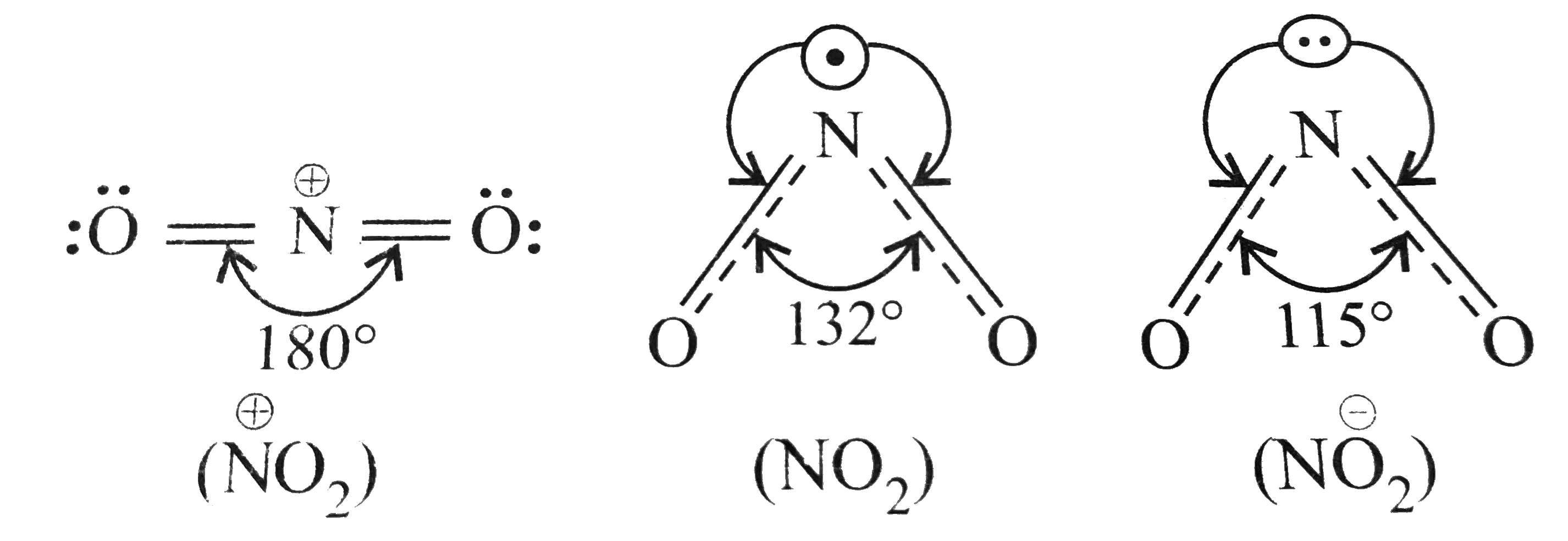
(i) `NO_(2), NO_(2)^(o+) NO_(2)^(Θ)` (bond angle)
(j) `CI_(2),O_(2),F_(2),N_(2)` (bond strenght)
(k) `O,N,F,CI,S` (strength of H - bonging)
(I) `N_(2),N_(2)^(o+),N_(2)^(Θ) , N_(2)^(2-)` (order of stability)
(m) `O_(2)^(2+),O_(2),O_(2)^(o+) , O_(2)^(Θ) O_(2)^(2-)` (order of stability)
(n) `N_(2),F_(2),O_(2),H_(2)` (bond lenght) .

Text Solution

Verified by Experts
`{:(CH-=CH(180^(@)),gt,BF_(3)(120^(@)),gt,CH_(4)(109.5^(@))),([sp,"linear"],,[sp^(2),planar],,[sp^(3),TH]):}`
`overset(..)(NH_(3)) (107^(@)) gt H_(2)overset(..)O: (104.5^(@))gt`
`[(sp^(3)"," "pyramidal",,,,),("Repusion between",,,,),("lp and bp",,,,):}] [(sp^(3)"," "V-shape",,,,),("Repusion between",,,,),("lp and bp",,,,):}]`
(b) `overset(o+)(NH_(4)) (109^(@)) gt NH_(3)(107^(@)) gt :N H_(2) (104^(@))`
`[sp^(3),TH][(sp^(3)"," "pyramidal",,,,),("Repusion between",,,,),("lp and bp",,,,):}] [(sp^(3)"," "V-shape",,,,),("Repusion between",,,,),("lp and bp",,,,):}]`
This is because all of them involve `sp^(3)` hybridisation The number of lp s of electrons on N-atom are 0.1 and 2 respectively Greater the number of lp s greater is the repulsions on the s and hence smaller is the angle
(c ) `K - F gt Na -I gt Li - CI gt F -H gt Br - H gt C -H`
(Apply Fajans rule)
Refer to Section 1.17 (3) Point (v) `NH_(3) gt PH_(3)`
(e) Refer to IIIuration 2.18 (a)
`NH_(3) gtNF_(3)`
(f) Refer to IIIusation 2.19
`CH_(3)CI gt CH_(2)CI_(2) gt CHCI_(3) gt C CI_(4)`
(g) `Mg O gt CaO` (Hardness decreases down the 2nd group `(darr)` due to decreases in lattice energy)
(h) `HCI gt HBr` (Apply Fajans rule )
(i) Refer to section 1.17 (3) Point (v)
`overset(o+)NO_(2) gtNO_(2) gt Noverset(o+)O_(2.)`
`overset(o+)(NO_(2)` has no unshared electron and hence it is linear `NO_(2)` has no unshared electron while `NO_(2)^(Θ)` has one unshared electron pair (i.e lone pairs of electrons)
(j) `N-= N gt O = O gt CI -CI gt F -F`
Triple bond strenght gt doubel bond strenght gt single bond strenght
Bond stregth `F -F` is less than that of `CI -CI` due to repuslsion between the non-bonding `e^(-)` s present on each very small F-atoms
(k) `F gt O gt N gt S gt CI`
Greater the `EN` and small size of the element it forms stroger H-bonding
(i) Refer to Table 2.19
`Na_(2) gt N_(2)^(o+) gt N_(2)^(Θ) gt n_(2)^(2-)`
(m) Refer to Table 2.20
`O_(2)^(2+) gt O_(2)^(o+) gt O_(2) gtO_(2)^(o+) gt O_(2)^(2-)`
(n) `F_(2) (F -F) gt O_(2) (O =O) gt N_(2) (N-= N) gt H_(2) (H -H)`
`[{:(Bond,,,,),(x "lenght (pm)",,,,):}] 144 gt 121 gt 109 gt 74`
Bond lenght of single bond gt double bond gt triple bond
Since the H-atom is very small size so bond lenght of single bond between `H` and `H` is the smallest .
.
Promotional Banner

Topper's Solved these Questions

  • CHEMICAL BONDING AND MOLECULAR STRUCTURE

    CENGAGE CHEMISTRY|Exercise Ex 2 .2 Subjective (Intermolecular Forces And H-Bonding)|7 Videos
  • CHEMICAL BONDING AND MOLECULAR STRUCTURE

    CENGAGE CHEMISTRY|Exercise Ex 2 .2 Subjective (Molecular Orbital Theory)|4 Videos
  • CHEMICAL BONDING AND MOLECULAR STRUCTURE

    CENGAGE CHEMISTRY|Exercise Archives Subjective|15 Videos
  • ATOMIC STRUCTURE

    CENGAGE CHEMISTRY|Exercise Concept Applicationexercise(4.3)|19 Videos
  • CHEMICAL EQUILIBRIUM

    CENGAGE CHEMISTRY|Exercise Archives (Subjective)|11 Videos

Similar Questions

Explore conceptually related problems

IUPAC name of C_(2) H_(5)-overset(CH_(3))overset(|)(C H) - NH_(2) is

The decreasing order of the basic character of NH_(3), CH_(3)NH_(2), C_(2)H_(5)NH_(2) and C_(6)H_(5)NH_(2) is

The correct order of bond angles among the compounds CH_(4) , NH_(3) and H_(2)O is (A) H_(2)O (B) NH_(3) (C) NH_(3) (D) CH_(4) < H_(2)O < NH_(3)

Arrange the following in order of decreasing bond angles (i) CH_(4), NH_(3), H_(2)O, BF_(3), C_(2)H_(2)" "(ii) NH_(3), NH_(2)^(-), NH_(4)^(+)

On the basis of VSEPR theory, predict the shapes of the following molecules/ions? a. AsF_(5) , b. SbCl_(3) , c. F_(2)O , d. H_(3)O^(o+) e. HC-=CH , f. overset(o+)NH_(4) , g. overset(o-)(NH_(2)) , h. GeF_(4)

Which of the following has larger bond angle in each pair ? (i)CO_(2),BF_(3)(ii)NH_(3),CH_(4)(iii)H_(2)O,H_(2)S(iv)SF_(4),C_(2)H_(2).

CENGAGE CHEMISTRY-CHEMICAL BONDING AND MOLECULAR STRUCTURE-Solved Examples
  1. State the bond order and indicate whether the species is paramagnetic ...

    Text Solution

    |

  2. Which properties of element depend on the electronic configuration of ...

    Text Solution

    |

  3. Select from each of the following gropus, the one which has the larges...

    Text Solution

    |

  4. Give the decreasing order of the property mentioned against each of th...

    Text Solution

    |

  5. Answer the following (a) How many sigma, pi non - bonding electrons ...

    Text Solution

    |

  6. Explain (a )Which d-orbital in involved in (i) sp^(3)d hybridisati...

    Text Solution

    |

  7. How do you account for the difference in melting points between (a) an...

    Text Solution

    |

  8. A plant virus was found to consist of uniform cylindrical particles 10...

    Text Solution

    |

  9. Calculate the I-I distance in each of the isomeric compounds C(2)H(2)I...

    Text Solution

    |

  10. Calculate the I-I distance in each of the three isomeric diiodobenzene...

    Text Solution

    |

  11. Enthalpic of hydrogenation of ethene (C(2)H(4)) and benzene (C(6)H(6))...

    Text Solution

    |

  12. Select the species which is best described to the right (a) CI(2),Br...

    Text Solution

    |

  13. The CI-O bond distance in CIO(4)^(Θ) is 144pm What do you conclude abo...

    Text Solution

    |

  14. Draw all geometrical isomers of PBr(2)CI(3) molecule State which isome...

    Text Solution

    |

  15. Write electron dot structures and describe the geometry of the followi...

    Text Solution

    |

  16. Reduce the hybridisation, geometry and shape of the following (i) CH...

    Text Solution

    |

  17. State the bond order and indicate whether the species is paramagnetic ...

    Text Solution

    |

  18. If the internuclear axis in the diatomic molecule AB is designated as ...

    Text Solution

    |

  19. Make a table giving (i) number of orbitals with a given energy (ii) ma...

    Text Solution

    |

  20. When 2s orbital overlaps with 2p(x) or 2p(y) orbital (assuming Z -axis...

    Text Solution

    |

