Home
Class 11
CHEMISTRY
The CI-O bond distance in CIO(4)^(Θ) is ...

The `CI-O` bond distance in `CIO_(4)^(Θ)` is 144pm What do you conclude about the structure of this ion ?
(b) The `POCI_(3)` molecule has the shape of an irregular tetrahedron with the `P` atom located centrally The `CI-P-CI` angle is found to be `1035^(@)` Give a qualitative explanation for the deviation of this structure from a regular tetrahedron .

Text Solution

Verified by Experts
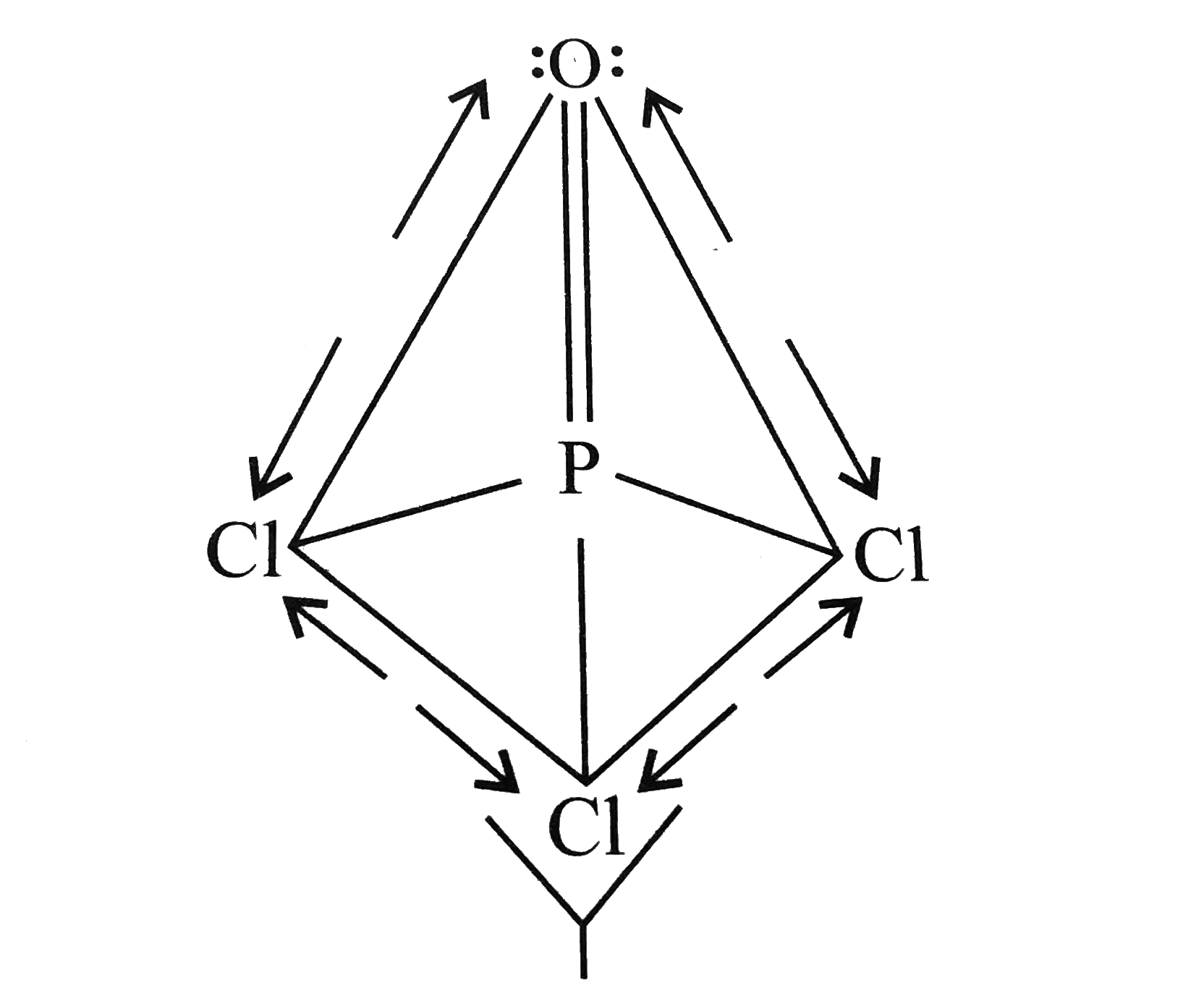
There must be considerable double bond character in the bonds
(b) The Lewis structure for `POCI_(3)` would show some double bond character between `P` and `O` (`P` is allowed to exceed the octet because of the availabbility of 3d orbitals)
The increased `e^(-)` density in the `P=O` bond would make the intrinsic repulsion between the `P=O` bond and a `P-CI` bond greater than between two `(P-CI)` bonds Thus the `CI-P-CI` angle is lowered and the `CI-P=O` angle is raised as compared to regular tetrahedron
.
Promotional Banner

Topper's Solved these Questions

  • CHEMICAL BONDING AND MOLECULAR STRUCTURE

    CENGAGE CHEMISTRY|Exercise Ex 2 .2 Subjective (Intermolecular Forces And H-Bonding)|7 Videos
  • CHEMICAL BONDING AND MOLECULAR STRUCTURE

    CENGAGE CHEMISTRY|Exercise Ex 2 .2 Subjective (Molecular Orbital Theory)|4 Videos
  • CHEMICAL BONDING AND MOLECULAR STRUCTURE

    CENGAGE CHEMISTRY|Exercise Archives Subjective|15 Videos
  • ATOMIC STRUCTURE

    CENGAGE CHEMISTRY|Exercise Concept Applicationexercise(4.3)|19 Videos
  • CHEMICAL EQUILIBRIUM

    CENGAGE CHEMISTRY|Exercise Archives (Subjective)|11 Videos

Similar Questions

Explore conceptually related problems

Read the passage given below and answer the question: In the last 10 years much has been learned about the molecular structure of elemental sulfur. It is now known that many different types of rings are sufficiently metastable to exist at room temperature for several days. It is known that at high temperature, the equilibrium composition allows for a variety of rings and chains to exist in comparable concentration, and it is known that at the boiling point and above, the vapor as well as the liquid contains small species with three, four, and five atoms. The sulfur atom has the same number of valence electrons as oxygen. Thus, sulfur atoms S_2 and S_3 have physical and chemical properties analogous to those of oxygen and ozone. S_2 has a ground state of 38 sigma 3s^2 sigma "*"3s^2 sigma 3pz^2 pi 3px^2=pi3py^2 pi"*"3px^1=pi"*"3py^1.S3 , thiozone has a well- known uv spectrum, and has a bent structure, analogous to its isovalent molecules O_3, SO_2 , and S_2O . The chemistry of the two elements, sulphur and oxygen, differs because sulfur has a pronounced tendency for catenation. The most frequently quoted explanation is based on the electron structure of the atom. Sulfur has low-lying unoccupied 3d orbitals, and it is widely believed that the 4s and 3d orbitals of sulfur participate in bonding in a manner similar to the participation of 2s and 2p orbitals in carbon. (source: Meyer, B. (1976). Elemental sulfur. Chemical Reviews, 76(3), 367-388. doi:10. 1021//cr603010003 ) In the following question, a statement of assertion followed by a statement of reason is given. Choose the correct answer out of the choices on the basis of the above passage. Assertion: Thiozone has bent structure like ozone. Reason: Ozone has a lone pair which makes the molecule bent.

Read the passage given below and answer question: In the last 10 years much has been learned about the molecular structure of elemental sulfur. It is now known that many different types of rings are sufficiently metastable to exist at room temperature for several days. It is known that at high temperature, the equilibrium composition allows for a variety of rings and chains to exist in comparable concentration, and it is known that at the boiling point and above, the vapor as well as the liquid contains small species with three, four, and five atoms. The sulfur atom has the same number of valence electrons as oxygen. Thus, sulfur atoms S_2 and S_3 have physical and chemical properties analogous to those of oxygen and ozone. S_2 has a ground state of 38 sigma 3s^2 sigma "*"3s^2 sigma 3pz^2 pi 3px^2=pi3py^2 pi"*"3px^1=pi"*"3py^1.S3 , thiozone has a well- known uv spectrum, and has a bent structure, analogous to its isovalent molecules O_3, SO_2 , and S_2O . The chemistry of the two elements, sulphur and oxygen, differs because sulfur has a pronounced tendency for catenation. The most frequently quoted explanation is based on the electron structure of the atom. Sulfur has low-lying unoccupied 3d orbitals, and it is widely believed that the 4s and 3d orbitals of sulfur participate in bonding in a manner similar to the participation of 2s and 2p orbitals in carbon. (source: Meyer, B. (1976). Elemental sulfur. Chemical Reviews, 76(3), 367-388. doi:10. 1021//cr603010003 ) In the following question, a statement of assertion followed by a statement of reason is given. Choose the correct answer out of the choices on the basis of the above passage. Assertion: Sulphur belongs to same group in the periodic table as oxygen. Reason: S_2 has properties analogous to O_2 .

Read the passage given below and answer the question: In the last 10 years much has been learned about the molecular structure of elemental sulfur. It is now known that many different types of rings are sufficiently metastable to exist at room temperature for several days. It is known that at high temperature, the equilibrium composition allows for a variety of rings and chains to exist in comparable concentration, and it is known that at the boiling point and above, the vapor as well as the liquid contains small species with three, four, and five atoms. The sulfur atom has the same number of valence electrons as oxygen. Thus, sulfur atoms S_2 and S_3 have physical and chemical properties analogous to those of oxygen and ozone. S_2 has a ground state of 38 sigma 3s^2 sigma "*"3s^2 sigma 3pz^2 pi 3px^2=pi3py^2 pi"*"3px^1=pi"*"3py^1.S3 , thiozone has a well- known uv spectrum, and has a bent structure, analogous to its isovalent molecules O_3, SO_2 , and S_2O . The chemistry of the two elements, sulphur and oxygen, differs because sulfur has a pronounced tendency for catenation. The most frequently quoted explanation is based on the electron structure of the atom. Sulfur has low-lying unoccupied 3d orbitals, and it is widely believed that the 4s and 3d orbitals of sulfur participate in bonding in a manner similar to the participation of 2s and 2p orbitals in carbon. (source: Meyer, B. (1976). Elemental sulfur. Chemical Reviews, 76(3), 367-388. doi:10. 1021//cr603010003 ) In the following question, a statement of assertion followed by a statement of reason is given. Choose the correct answer out of the choices on the basis of the above passage. Assertion: Sulphur has a greater tendency for catenation than oxygen. Reason: 3d and 4s orbitals of Sulphur have same energy.

Early crystallographers had trouble solving the structures of inorganic solids using X-ray diffraction because some of the mathematical tools for analyzing the data had not yet been developed. Once a trial structure was proposed, it was relatively easy to calculate the diffraction pattern, but it was difficult to go the other way (from the diffraction pattern to the structure) if nothing was known a priori about the arrangement of atoms in the unit cell. It was important to develop some guidelines for guessing the coordination numbers and bonding geometries of atoms in crystals. The first such rules were proposed by Linus Pauling, who considered how one might pack together oppositely charged spheres of different radii. Pauling proposed from geometric considerations that the quality of the "fit" depended on the radius ratio of the anion and the cation. If the anion is considered as the packing atom in the crystal, then the smaller catin fills interstitial sites ("holes"). Cations will find arrangements in which they can contact the largest number of anions. If the cation can touch all of its nearest neighbour anions then the fit is good. If the cation is too small for a given site, that coordination number will be unstable and it will prefer a lower coordination structure. The table below gives the ranges of cation/anion radius ratios that give the best fit for a given coordination geometry. {:("Coordiantion number","Geometry",rho =(r_("cation"))/(r_("amion"))),(2,"linear",0-0.155),(3,"triangular",0.155 - 0.225),(4,"tetrahedral",0.225 - 0.414),(4,"square planar",0.414 - 0.732),(6,"octahedral",0.414 - 0.732),(8,"cubic",0.732 - 1.0),(12,"cuboctahedral",1.0):} (Source : Ionic Radii and Radius Ratios. (2021, June 8). Retrieved June 29, 2021, from https://chem.ibretexts.org/@go/page/183346) A solid AB has square planar structure. If the radius of cation A^(+) is 120 pm, calculate the maximum possible value of anion B^(-) .

The approximate shape of a molecule can often be predicted by using what is called the valence-shell electron-pair repulsion (VSEPR) model. Electrons in bonds and in lone pairs can be thought of a ''charge cloud'' that repel one another nad stay as far apart as possible, thus causing molecules to assume specific shapes. The repulsive interactions of electron pairs decrease in the order: Lone pair - Lone pair gt Lone pair - Bond pair gt Bond pair - Bond pair These repulsive effects result in deviations from idealised shapes and alteration in bond angles in molecules. Which among the following molecules have sp^(3)d hybridization with one lone pair of electron on the central atom? (P) SF_(4) (Q) [PCl_(4)]^(+) (R) XeO_(2)F_(2) (S) ClOF_(3)

Read the passage given below and answer the question: In the last 10 years much has been learned about the molecular structure of elemental sulfur. It is now known that many different types of rings are sufficiently metastable to exist at room temperature for several days. It is known that at high temperature, the equilibrium composition allows for a variety of rings and chains to exist in comparable concentration, and it is known that at the boiling point and above, the vapor as well as the liquid contains small species with three, four, and five atoms. The sulfur atom has the same number of valence electrons as oxygen. Thus, sulfur atoms S_2 and S_3 have physical and chemical properties analogous to those of oxygen and ozone. S_2 has a ground state of 38 sigma 3s^2 sigma "*"3s^2 sigma 3pz^2 pi 3px^2=pi3py^2 pi"*"3px^1=pi"*"3py^1.S3 , thiozone has a well- known uv spectrum, and has a bent structure, analogous to its isovalent molecules O_3, SO_2 , and S_2O . The chemistry of the two elements, sulphur and oxygen, differs because sulfur has a pronounced tendency for catenation. The most frequently quoted explanation is based on the electron structure of the atom. Sulfur has low-lying unoccupied 3d orbitals, and it is widely believed that the 4s and 3d orbitals of sulfur participate in bonding in a manner similar to the participation of 2s and 2p orbitals in carbon. (source: Meyer, B. (1976). Elemental sulfur. Chemical Reviews, 76(3), 367-388. doi:10. 1021//cr603010003 ) In the following question, a statement of assertion followed by a statement of reason is given. Choose the correct answer out of the choices on the basis of the above passage. Assertion: S2 is paramagnetic in nature Reason: The electrons in pi"*"3px and pi"*"3py orbitals in S_2 are unpaired.

CENGAGE CHEMISTRY-CHEMICAL BONDING AND MOLECULAR STRUCTURE-Solved Examples
  1. State the bond order and indicate whether the species is paramagnetic ...

    Text Solution

    |

  2. Which properties of element depend on the electronic configuration of ...

    Text Solution

    |

  3. Select from each of the following gropus, the one which has the larges...

    Text Solution

    |

  4. Give the decreasing order of the property mentioned against each of th...

    Text Solution

    |

  5. Answer the following (a) How many sigma, pi non - bonding electrons ...

    Text Solution

    |

  6. Explain (a )Which d-orbital in involved in (i) sp^(3)d hybridisati...

    Text Solution

    |

  7. How do you account for the difference in melting points between (a) an...

    Text Solution

    |

  8. A plant virus was found to consist of uniform cylindrical particles 10...

    Text Solution

    |

  9. Calculate the I-I distance in each of the isomeric compounds C(2)H(2)I...

    Text Solution

    |

  10. Calculate the I-I distance in each of the three isomeric diiodobenzene...

    Text Solution

    |

  11. Enthalpic of hydrogenation of ethene (C(2)H(4)) and benzene (C(6)H(6))...

    Text Solution

    |

  12. Select the species which is best described to the right (a) CI(2),Br...

    Text Solution

    |

  13. The CI-O bond distance in CIO(4)^(Θ) is 144pm What do you conclude abo...

    Text Solution

    |

  14. Draw all geometrical isomers of PBr(2)CI(3) molecule State which isome...

    Text Solution

    |

  15. Write electron dot structures and describe the geometry of the followi...

    Text Solution

    |

  16. Reduce the hybridisation, geometry and shape of the following (i) CH...

    Text Solution

    |

  17. State the bond order and indicate whether the species is paramagnetic ...

    Text Solution

    |

  18. If the internuclear axis in the diatomic molecule AB is designated as ...

    Text Solution

    |

  19. Make a table giving (i) number of orbitals with a given energy (ii) ma...

    Text Solution

    |

  20. When 2s orbital overlaps with 2p(x) or 2p(y) orbital (assuming Z -axis...

    Text Solution

    |

