Home
Class 11
CHEMISTRY
Reduce the hybridisation, geometry and s...

Reduce the hybridisation, geometry and shape of the following
(i) `CH_(2)^(2+)` (ii) `Br_(3)^(Θ)` (iii) `CIO_(3)^(o+)`
(iv) `F_(2)SeO` (v) `IO_(2)F_(2)^(Θ)`
Either of the hybridisation (i) `sp^(2)` and (ii) `sp^(3)d^(2)` of a central atom can lead to a squar planar molecule Give one example of each .

Text Solution

Verified by Experts
`CH_(2)^(2+)`
` H= (1)/(2) (V + M` - no. of + ve charge)
` = (1)/(2) (4 + 2 - 2) = 2 =sp`
The molecule is linear. There will be no multiple bonding since H-atoms have no orbitals available and C-atom has lost the extra electrons
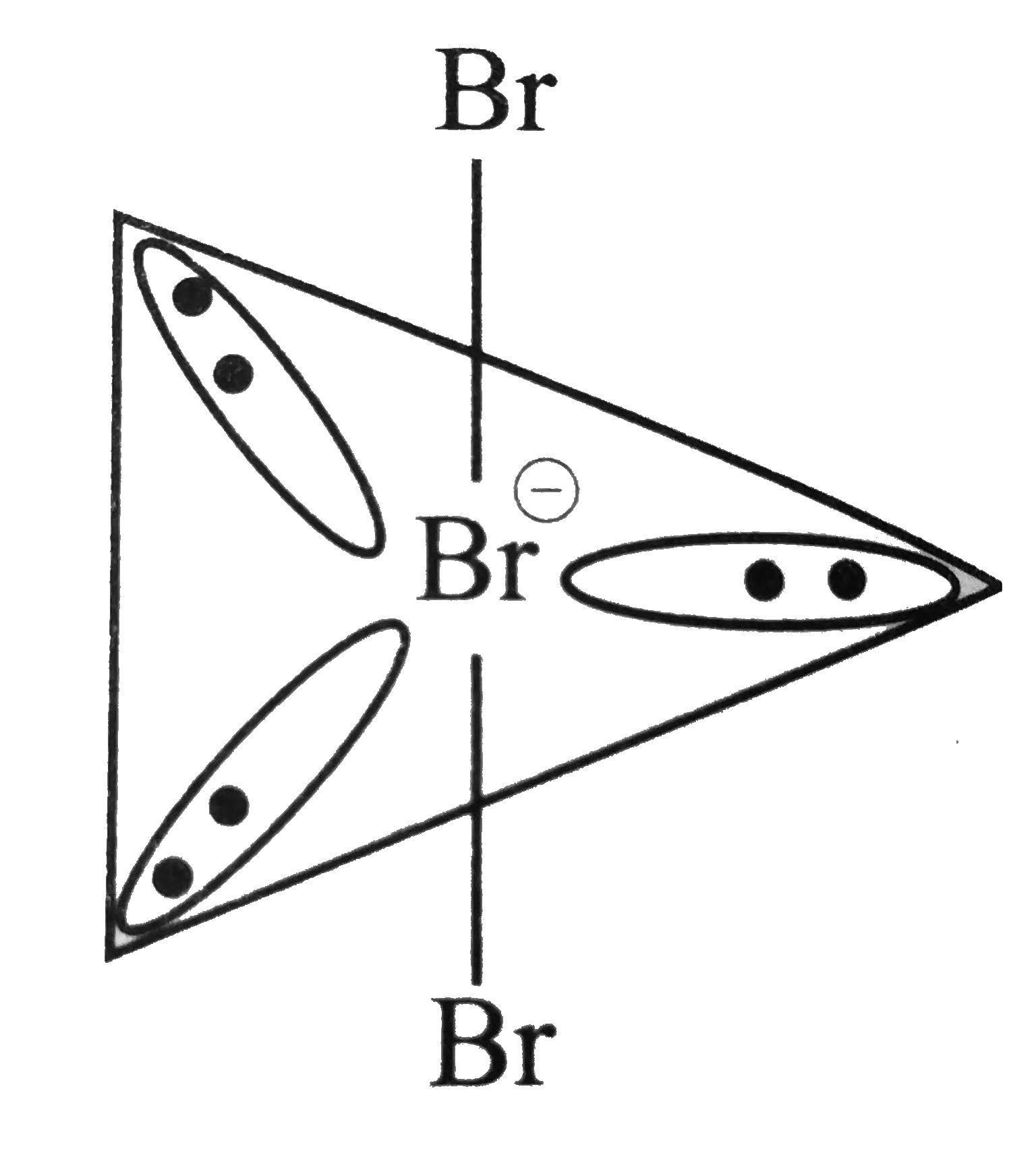
`H = (1)/(2) (V + M+` on . of -ve charge)
` = (1)/(2) (7 + 2 + 1)`
` = 5 = sp^(3) d = Tbp`
`Br_(3)^(Θ)` has Tbp geometry but due to the presence of three `lp's` it is linear in shape
(iii) `C1O_(3)^(o+): :underset(..)O=overset(o+)underset( :underset(..)O)underset(||)(C1)=ddotO:`
`H = (11)/(2) (V +M` - no of +ve charge)
` (1)/(2) (7 +0 -1) = 3 = sp^(2) =` planar
`CIO_(3)^(o+)` is unstable ion, `(CI =O)` bonding is expected
`H= (1)/(2) (V +M) = (1)/(2) ( 6 + 2) = 4 = sp^(3) =TH`
`FeSeO` has terahedral geometry but due to the presence of one lp it has pyramidal in shape This structure is analogous
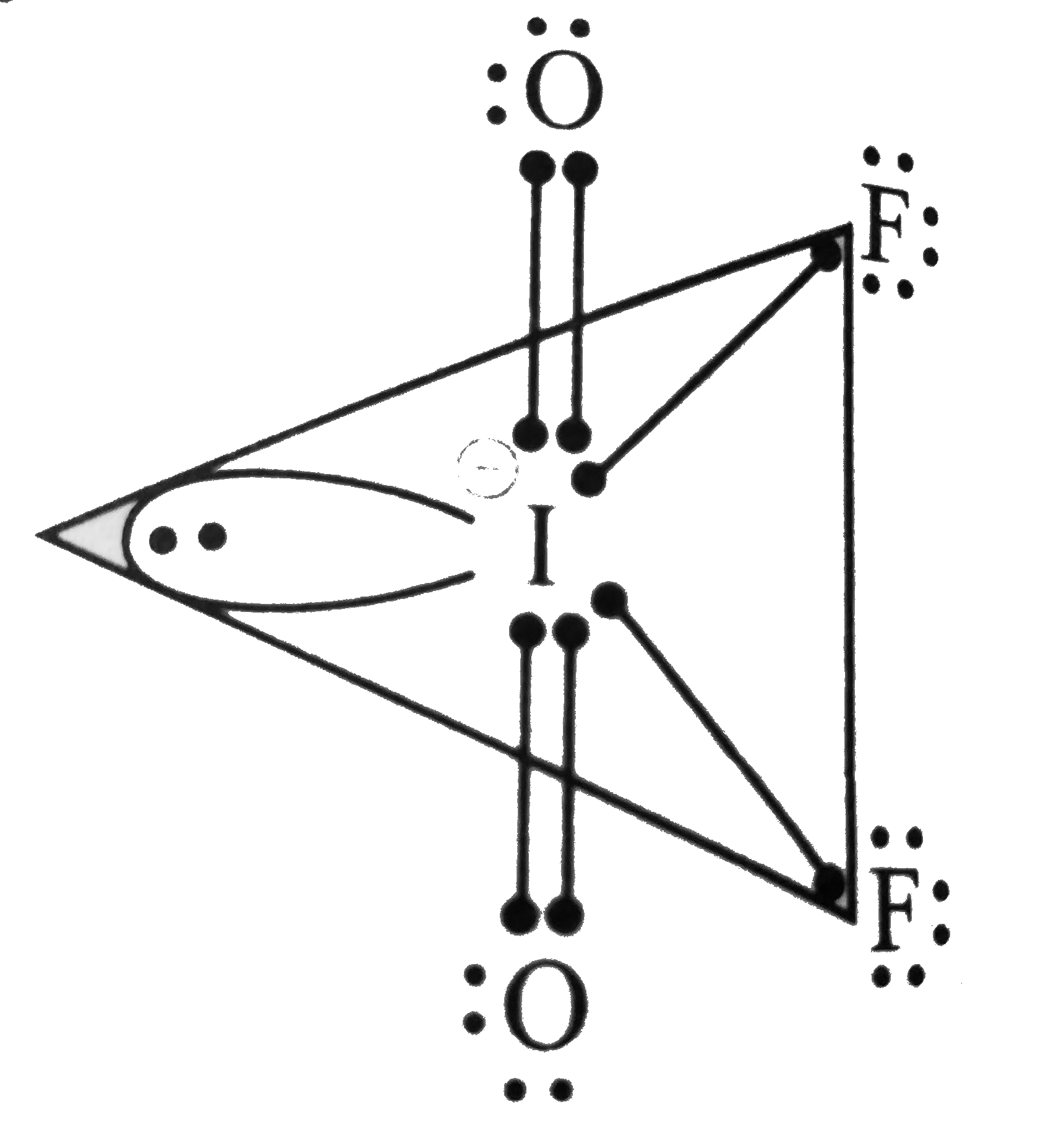
(v) `IO_(2)F_(2)^(Θ)`
`H=(1)/(2) (V +M +` no. of -ve charge)
`(1)/(2)(7 + 2 +1) =5 = sp^(3) d`
It has `sp^(3)d` hybridisation with Tbp geometry but due to the presence of one lp of `e^(-)` it has see-saw shape
(b) `[Ni(CN)_(4)]^(2-)]`
(ii) `:overset(..)X eF_(4)`

Promotional Banner

Topper's Solved these Questions

  • CHEMICAL BONDING AND MOLECULAR STRUCTURE

    CENGAGE CHEMISTRY|Exercise Ex 2 .2 Subjective (Intermolecular Forces And H-Bonding)|7 Videos
  • CHEMICAL BONDING AND MOLECULAR STRUCTURE

    CENGAGE CHEMISTRY|Exercise Ex 2 .2 Subjective (Molecular Orbital Theory)|4 Videos
  • CHEMICAL BONDING AND MOLECULAR STRUCTURE

    CENGAGE CHEMISTRY|Exercise Archives Subjective|15 Videos
  • ATOMIC STRUCTURE

    CENGAGE CHEMISTRY|Exercise Concept Applicationexercise(4.3)|19 Videos
  • CHEMICAL EQUILIBRIUM

    CENGAGE CHEMISTRY|Exercise Archives (Subjective)|11 Videos

Similar Questions

Explore conceptually related problems

The hybridisation of Xe is sp^(3)d^(2) in

On the basis of hydribidsation predict the shape of the following molecules (i) CH_(3)F (ii) CH_(2)=O

On the basis of type of hybridisation, predict the shape of the following molecules : (i) H_2 C = O (ii) CH_3 F (iii) HC -= N

How many of the following compounds have sp^(3) hybridisation (i) SO_(4)^(2-) (ii) SO_(5)^(2-) (iii) PO_(4)^(3-) (iv) PO_(5)^(3-) (v) I_(3)^(Theta) (iv) CO_(3)^(2-) (vii) CO_(4)^(2-) .

Hybridisation (sp3d2, sp3d3) with examples

Which molecule is polar in each of the following pairs ? (i) HF, F_(2)" (ii) "CO_(2), H_(2)O (iii) n_(2),NH_(3)" (iv) "CH_(4),CH_(3)Cl.

Give hybridisation state of each carbon atom in the following molecules : (i) CH_3 - CH = CH_2 (ii) CH_2 = C = O (iii) CH_2 = CHCN (iv) HCONH_2

sp^(3)d^(2) hybridisation is present in

CENGAGE CHEMISTRY-CHEMICAL BONDING AND MOLECULAR STRUCTURE-Solved Examples
  1. State the bond order and indicate whether the species is paramagnetic ...

    Text Solution

    |

  2. Which properties of element depend on the electronic configuration of ...

    Text Solution

    |

  3. Select from each of the following gropus, the one which has the larges...

    Text Solution

    |

  4. Give the decreasing order of the property mentioned against each of th...

    Text Solution

    |

  5. Answer the following (a) How many sigma, pi non - bonding electrons ...

    Text Solution

    |

  6. Explain (a )Which d-orbital in involved in (i) sp^(3)d hybridisati...

    Text Solution

    |

  7. How do you account for the difference in melting points between (a) an...

    Text Solution

    |

  8. A plant virus was found to consist of uniform cylindrical particles 10...

    Text Solution

    |

  9. Calculate the I-I distance in each of the isomeric compounds C(2)H(2)I...

    Text Solution

    |

  10. Calculate the I-I distance in each of the three isomeric diiodobenzene...

    Text Solution

    |

  11. Enthalpic of hydrogenation of ethene (C(2)H(4)) and benzene (C(6)H(6))...

    Text Solution

    |

  12. Select the species which is best described to the right (a) CI(2),Br...

    Text Solution

    |

  13. The CI-O bond distance in CIO(4)^(Θ) is 144pm What do you conclude abo...

    Text Solution

    |

  14. Draw all geometrical isomers of PBr(2)CI(3) molecule State which isome...

    Text Solution

    |

  15. Write electron dot structures and describe the geometry of the followi...

    Text Solution

    |

  16. Reduce the hybridisation, geometry and shape of the following (i) CH...

    Text Solution

    |

  17. State the bond order and indicate whether the species is paramagnetic ...

    Text Solution

    |

  18. If the internuclear axis in the diatomic molecule AB is designated as ...

    Text Solution

    |

  19. Make a table giving (i) number of orbitals with a given energy (ii) ma...

    Text Solution

    |

  20. When 2s orbital overlaps with 2p(x) or 2p(y) orbital (assuming Z -axis...

    Text Solution

    |