Home
Class 11
CHEMISTRY
Expalin the following (a) The central ...

Expalin the following
(a) The central `C-C` bond in Buta 1,3 diene is shorter than that of n-butane
(b) Why the dipole moment of `cis-1,2` dichloroethene is greater than that of trans -1,2 -dichloroethene
(c ) `CIF_(2)^(Θ)` is linear, but `CIF_(2)^(o+)` is bent
(d )Two different bond lengths are observed in `PF_(5)` but only one bond lenght is observed in `SF_(6)` .

Text Solution

Verified by Experts
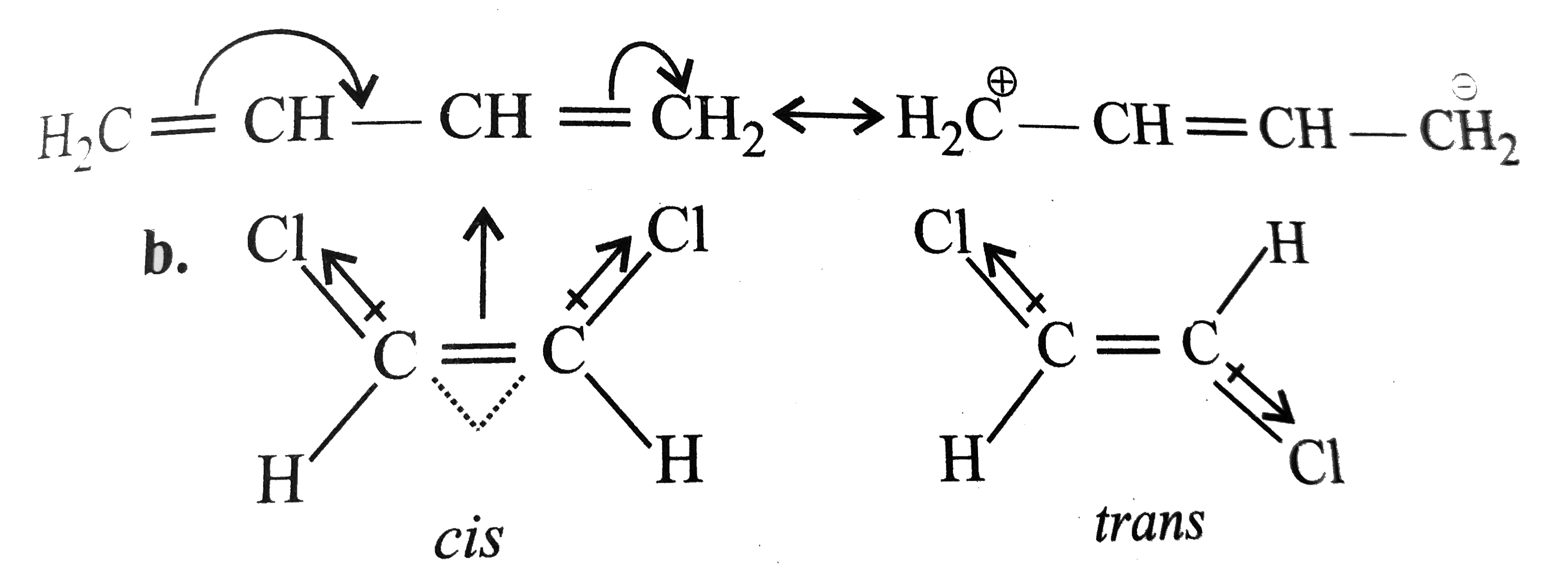
Due to resonance in conjugated dienes In the the cis compound the dipoles do not cancel each other and the resultant is a higher value while in the trans compound `C-CI` bond dipoles are equal and opposite and hence cancel each other and `mu =0`
(c ) In `CIF_(2)^(Θ)` ion the central chlorine atom involves `sp^(3)` d hybridisation to have minimum electronic repulsion Three lone pairs should be in equatorial position to give linear shape to the ion Whereas in case of `CIF_(2)^(o+)` ion the central chlorine atom involves `sp^(3)` hybridisation having two lone pairs resulting in bent shape for the ion (bond angle less than `109^(@)28'` due to bp-lp repulsion)
(d) `PF_(5)` has trigonal pyramidal structure `sp^(3)` d hybridisation of central atom) in which bond angles are `90^(@)` and `120^(@)` respectively and there are two types of bonds axial and equatorial (axial being longer than equatorial) In case of `SF_(6)` the structure is octahedral (`sp^(3)` hybridisation of the central atom `S`) resulting only one type of bond bond angle `90^(@)` and one type of bond lenght
.
Promotional Banner

Topper's Solved these Questions

  • CHEMICAL BONDING AND MOLECULAR STRUCTURE

    CENGAGE CHEMISTRY|Exercise Exercises Linked Comprehension|43 Videos
  • CHEMICAL BONDING AND MOLECULAR STRUCTURE

    CENGAGE CHEMISTRY|Exercise Exercises Multiple Correct(Chemical Bonding )|7 Videos
  • CHEMICAL BONDING AND MOLECULAR STRUCTURE

    CENGAGE CHEMISTRY|Exercise Ex 2 .2 Subjective (Molecular Orbital Theory)|4 Videos
  • ATOMIC STRUCTURE

    CENGAGE CHEMISTRY|Exercise Concept Applicationexercise(4.3)|19 Videos
  • CHEMICAL EQUILIBRIUM

    CENGAGE CHEMISTRY|Exercise Archives (Subjective)|11 Videos

Similar Questions

Explore conceptually related problems

Dipole moment of cis-2, 3-dichloro-2 butne is ….. Than the dipole moment of cis1, 2-dichloroethene.

S-I: The boiling point of cis-1,2-dichloroethene is higher than corresponding trans-isomer. S-II: The dipole moment of cis-1,2-dichloroethene is higher than trans isomer.

Give reasons for the following in one or two sentences. the central carbon-carbon bond 1, 3-butadiene is shorter than that of n -butane.

Give reasons for the following in one or two sentences ' The central carbon - carbon bond in 1,3- butadiene is shorter than that in n- butane ' .

The C-NH_(2) bond in acetamide is 0.1 A shorter than the C-NH_(2) bond in ethylamine. Way?

The electronegaivity difference between N and F is greater than that between N and H yet the dipole moment of NH_2 ( 1 .5 D) is larger than that of NF_3 ( 0. 2 D) . This is because :

Assertion : The central carbon - carbon bond in 1, 3- butadiene is shorter than n -butane. Reason : In butadiene the central bond has sp^(2)-sp^(2) nature whereas in butane it is sp^(3)-sp^(3) .

CENGAGE CHEMISTRY-CHEMICAL BONDING AND MOLECULAR STRUCTURE-Ex 2 .2 Objective
  1. Arrange the following as directed (a) N(2),O(2),F(2),CI(2) (Decreasi...

    Text Solution

    |

  2. Expalin the following (a) The central C-C bond in Buta 1,3 diene is ...

    Text Solution

    |

  3. Arrange the following in decreasing order of dipole moment (a) Tolue...

    Text Solution

    |

  4. Predict the shape of the following Xenon compounds (a) XeO(3) (b) Xe...

    Text Solution

    |

  5. Considering X axis as the internuvlear axis, which out of the followin...

    Text Solution

    |

  6. Arrange the following types of interation in order of decreasing stabi...

    Text Solution

    |

  7. Arrange the following types of intermolecular forces in order of decre...

    Text Solution

    |

  8. Name the types of interaction or intermolecular forces of which potent...

    Text Solution

    |

  9. List properties of water that stem from H-bonding (b) Two two molecu...

    Text Solution

    |

  10. Perdict the order of decreasing boiling points of noble gases (b) Pr...

    Text Solution

    |

  11. Which of the following pairs is expected to exhibit H-bonding (a) CH...

    Text Solution

    |

  12. Give the decreasing order of melting points of the following NH(3),PH(...

    Text Solution

    |

  13. How many nodal planes are present in the following MO's (Taking Z-axis...

    Text Solution

    |

  14. Compare the relative stabilities and magnetic behaviour of the followi...

    Text Solution

    |

  15. Expalin (a) H(2)^(o+) and H(2)^(Θ) ions have same bond order but H(2...

    Text Solution

    |

  16. Which of the following species have same bond order and same shape (...

    Text Solution

    |

  17. Which of the following is soluble in water

    Text Solution

    |

  18. Which one among the following does not have the hybrogen bond ?

    Text Solution

    |

  19. The molecule having one unpaired electrons is .

    Text Solution

    |

  20. The H-bond is strongest in

    Text Solution

    |

