Text Solution
Verified by Experts
The correct Answer is:
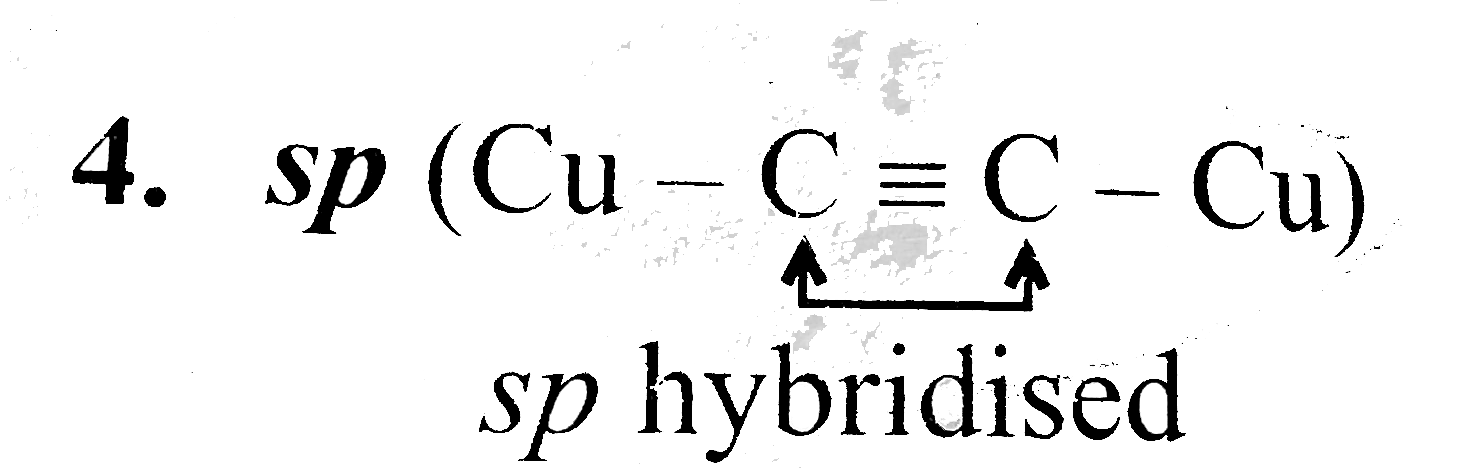 .
.


Topper's Solved these Questions
CHEMICAL BONDING AND MOLECULAR STRUCTURE
CENGAGE CHEMISTRY|Exercise Exercises True/False|20 VideosCHEMICAL BONDING AND MOLECULAR STRUCTURE
CENGAGE CHEMISTRY|Exercise Archives Multiple Correct|10 VideosCHEMICAL BONDING AND MOLECULAR STRUCTURE
CENGAGE CHEMISTRY|Exercise Exercises Integer|10 VideosATOMIC STRUCTURE
CENGAGE CHEMISTRY|Exercise Concept Applicationexercise(4.3)|19 VideosCHEMICAL EQUILIBRIUM
CENGAGE CHEMISTRY|Exercise Archives (Subjective)|11 Videos
Similar Questions
Explore conceptually related problems
CENGAGE CHEMISTRY-CHEMICAL BONDING AND MOLECULAR STRUCTURE-Exercises Fill In The Blanks
- The Type of hybrid orbitals used by the chlorine atom in CIO(2)^(Theta...
Text Solution
|
- The cyanide ion CN and N(2) are isoelectronic, but in contrast to CN^(...
Text Solution
|
- The shape of CH(3)^(+) is ………….
Text Solution
|
- The valence atomic orbital on C in silver acetynide is ……………hybridised...
Text Solution
|
- Out of CH(3)^(o+),H(3)O^(o+),NH(3),CH(3)^(Theta) the species which is ...
Text Solution
|
- The experimentally determined N-F bond length in NF(3) is than the sum...
Text Solution
|
- When N(2) goes to N(2)^(+), the N-N bond distance …………, and when O(2) ...
Text Solution
|
- The central bond in 1,3 butadience isthan that of n-butane .
Text Solution
|
- Out of (A) toluene (B) m-dichloro benzene (C ) o-dichloro benzene and ...
Text Solution
|
- In BaC(2)sigma andpi bonds are present between two C-atoms .
Text Solution
|
- During the formation of a chemical bond, the potential energy of the i...
Text Solution
|
- Comparatively low melting point and insolubility in water of AICI(3) i...
Text Solution
|
- The dipole moment of CH(3)OH isthan that of CH(3)SH .
Text Solution
|
- Dipole moment of NH(3) isthan NF(3) .
Text Solution
|
- In a compound A,B if the element B attracts electrons more than elemen...
Text Solution
|
- The strenght of covalent bond will depend on the extent to which atomi...
Text Solution
|
- Salicyaldehyde involveshydrogen bonding .
Text Solution
|
- The bond multiplicity leads toin bond length .
Text Solution
|
- The angle between two covalent bonds is maximum in ……..(CH(4),H(2)O,CO...
Text Solution
|
- Due to hybridisationhybrid orbitals are formed .
Text Solution
|