Home
Class 11
CHEMISTRY
When a colourless gas (A), which is pois...

When a colourless gas `(A),` which is poisonous and burns with blue flame, is passed through aqueous `NaOH` solution, gives a compound `(B)`. Compound `(B)` on heating gives `(C )`. `(C )` gives a white precipitate `(D)` with `CaCl_(2)`. Both `(C )` and `(D)` decolourises `KMnO_(4)`. Identify `(A)` to `(D)`.

Text Solution

Verified by Experts
`underset("blue flame")underset("gas burns with")underset("Colourless,poisonous")((A))overset(+NaOH soln)(rarr)(B)`
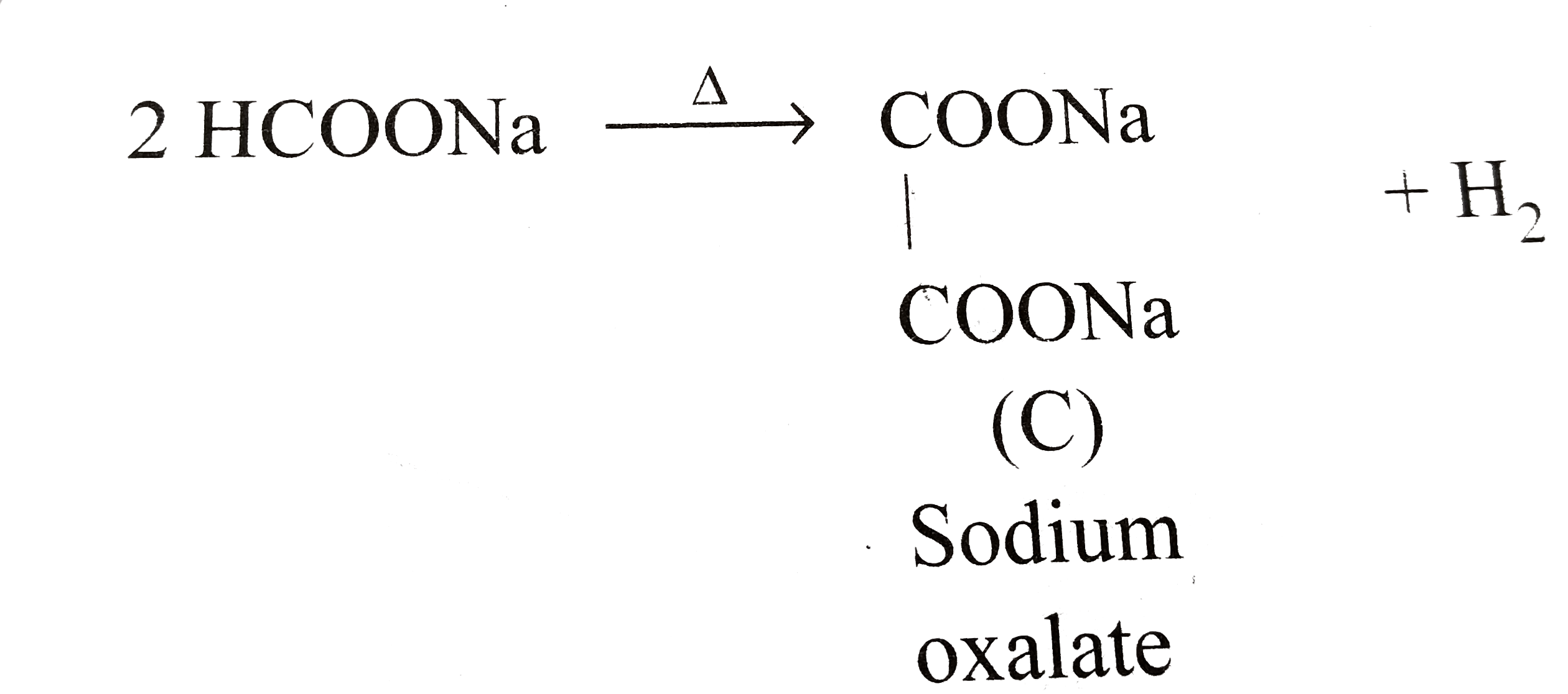
(B) `overset(Delta)(rarr) (C )`
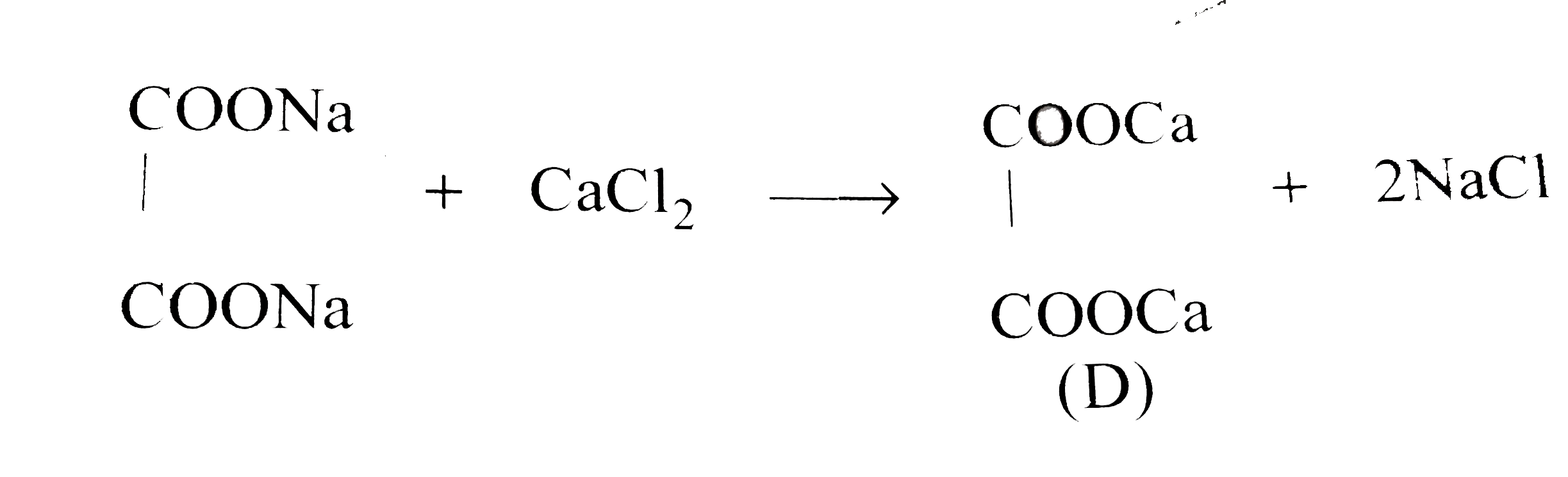
(C) `+CaCl_(2)rarr underset("White ppt".)((D))`
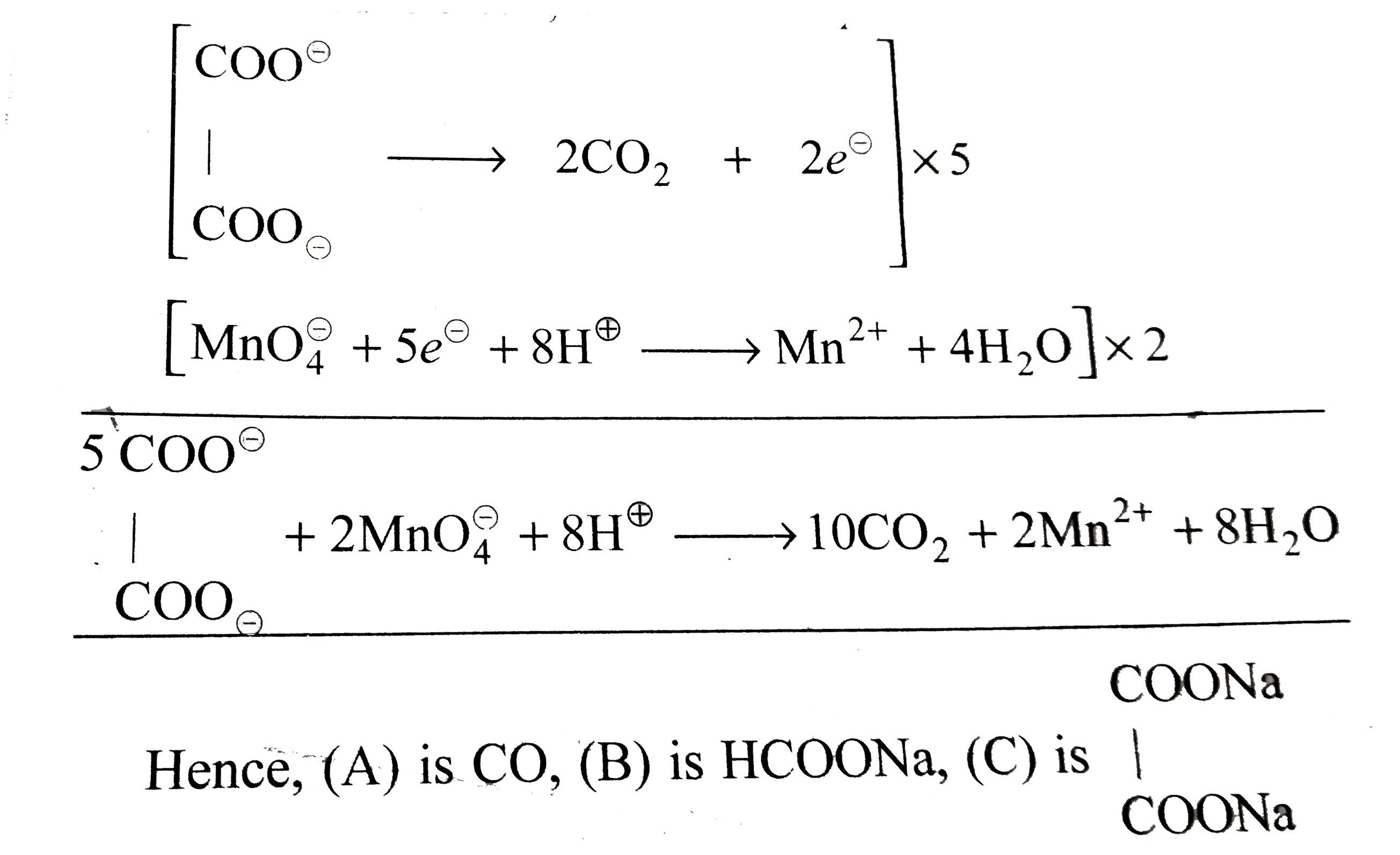
`(C )` and `(D)` decolourise `KMnO_(4)`, this indicates that both are reducing agents.
`(A)` is `CO`, i.e. carbon monoxide which burns with blue flame and is poisonous.
`underset((A))(CO)+NaOHrarrunderset((B))underset("Sodium formate")(HCOONa)`


Promotional Banner

Topper's Solved these Questions

  • S-BLOCK GROUP 2 - ALKALINE EARTH METALS

    CENGAGE CHEMISTRY|Exercise Exercises Linked Comprehension|42 Videos
  • S-BLOCK GROUP 2 - ALKALINE EARTH METALS

    CENGAGE CHEMISTRY|Exercise Exercises Multiple Correct|25 Videos
  • S-BLOCK GROUP 2 - ALKALINE EARTH METALS

    CENGAGE CHEMISTRY|Exercise Ex 5.1 Objective|2 Videos
  • S-BLOCK GROUP 1 - ALKALI METALS

    CENGAGE CHEMISTRY|Exercise Archives Subjective|8 Videos
  • SOME BASIC CONCEPTS AND MOLE CONCEPT

    CENGAGE CHEMISTRY|Exercise Archives Subjective|11 Videos

Similar Questions

Explore conceptually related problems

A compound (A) is used in paints instead of salts of lead. . Compound(A) is obtained when a white compound (B) is strongly heated . Compound (B) is insoluble in water but dissolves in sodium hydroxide forming a solution of compound (C ) the compounds (A) on heating with coke gives a metal (D) and a gas (E) which burns with blue flame . (B) also dissolves in ammonium sulphate solution mixed with ammonium hydroxide. solution of compound (A) in dilute HCl gives a bluish white//white precipitate (F) with excess of (F) with excees of K_(4)[Fe(CN)_(6)] identify (A) to (F) and explain the reactions.

Zinc on reaction with NaOH gives a salt (A) alongwith a gas (B). (A) on reaction with H_(2)S gas gives a white precipitate (C ). Identify (A), (B) and (C ).

alkali metal (A) on flame test gives a crimson red colour to the Busen flame. (A) on heating in air gives compound (C ) and gas (D). Gas (D) with Nessler's regent gives a brown precipitate Identify (A), (B), (C ) and (D).

A white substance (A) reacts with dilute H_(2)SO_(4) to produce a colourless suffocating gas (B) and a colourless solution (C )/ The reaction of gas (B) with potassium iodate and starch solution produce a blue colour solution. Aqueous Solution of (A) gives a white precipitate with BaCl_(2) solution which is soluble in dilute HCl . Addition of aqueous NH_(3) or NaOH to (C ) produced first a precipitate which dissolves in excess of the respective reagent to poduced a clear solution. Similarly addition of excess of potassium ferrocyanide to (C ) produced a precipitate (D) which also dissolves in aqeous NaOH giving a clear solution. Identify (A),(B),(C ) and (D ). Write the equation of the reactions involved.

Magnesium on heating in air gives (A) and (B) . On reaciton with water (B) gives a colourless gas (C ).(C ) when passed through CuSO_(4) solution, gives a blue coloured solution (D) . Identify (A),(B),(C ) and (D) .

An aqueous solution of a salt (A) gives a white precipitate (B) with sodium chloride solution. The filtrate gives a black precipitate (C ) when H_(2)S is passed into it. Compound (B) dissolves in hot water and the solution gives a yellow precipitate (D) on treatment with sodium iodide. The compound (A) does gas on heating. Identify the compounds (A) to (D). Compound C is :

An aqueous solution of a salt (A) gives a white precipitate (B) with sodium chloride solution. The filtrate gives a black precipitate (C ) when H_(2)S is passed into it. Compound (B) dissolves in hot water and the solution gives a yellow precipitate (D) on treatment with sodium iodide. The compound (A) does gas on heating. Identify the compounds (A) to (D). Compound D is :

An aqueous solution of a salt (A) gives a white precipitate (B) with sodium chloride solution. The filtrate gives a black precipitate (C ) when H_(2)S is passed into it. Compound (B) dissolves in hot water and the solution gives a yellow precipitate (D) on treatment with sodium iodide. The compound (A) does gas on heating. Identify the compounds (A) to (D). Compound B is :