Home
Class 11
CHEMISTRY
An awueous solution of salt (A) gives a ...

An awueous solution of salt (A) gives a give a whes a white precipitate ( B) with sodium chloride solution . Compound ( B) dissolves in hot water and the solution on treatment with souium iodide give a uellow precipitate ( D) ,. and on passing ` H_2 S` through solution ( B) gives a blck ppt . (C) . Compound (A) does not gvive any gas with dil `HCl`, but liberates a reddish brown gas on heating identhigy compounds (A), (B), ( C) , and (D) .

Text Solution

Verified by Experts
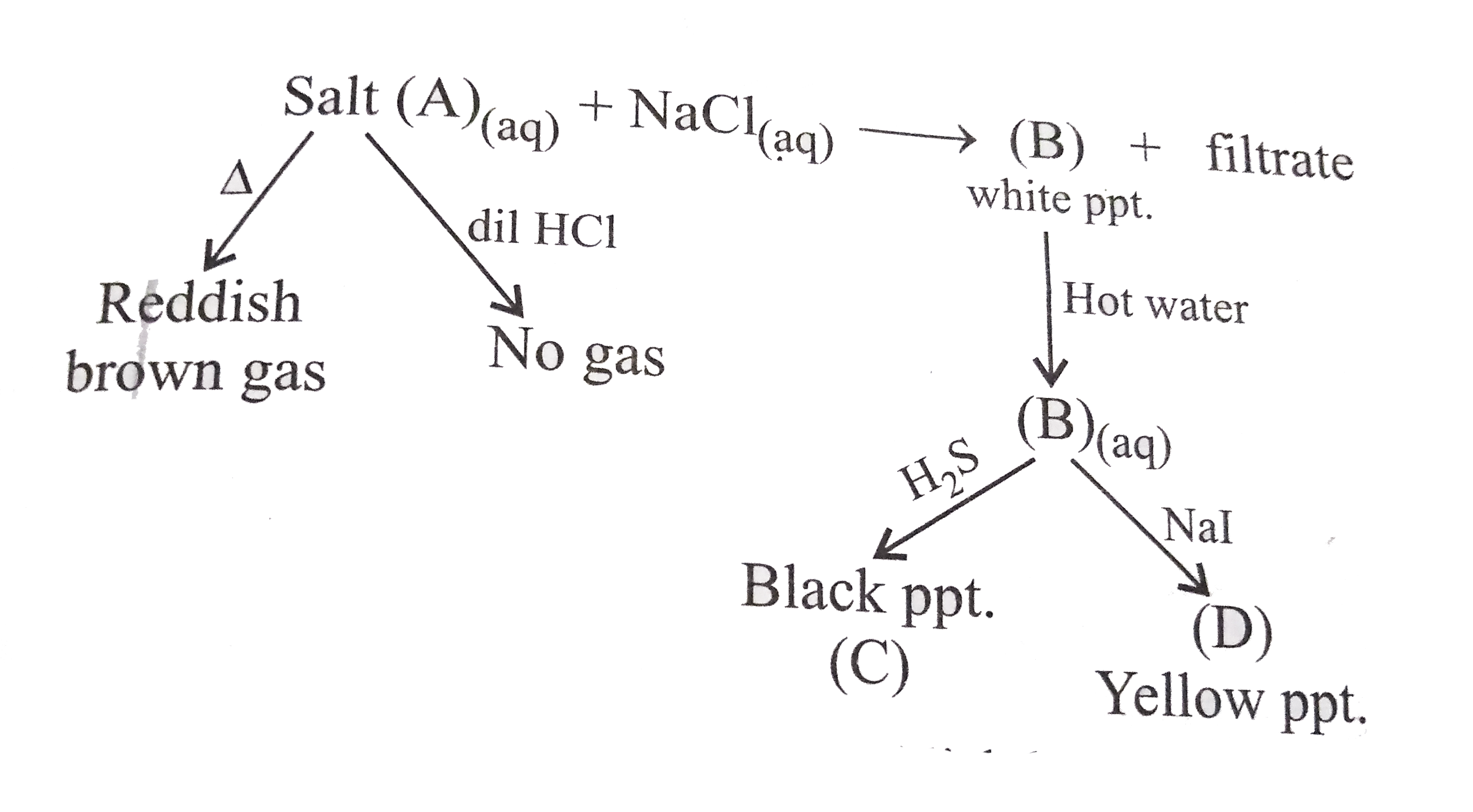

Salt (A) on heating libreates reddish brown gas , hence, it contains nitrate.
(B) dissolves in hot water and gives a yellow ppt. with Nal , hence , it is `PbCl_(2)` and slt (A) is `Pb(NO_(3)_(2)`.
Pbunderset((A))(NO_(3)_(2(aq)))+2 Na Cl_((aq)) rarrunderset((B))underset("White ppt")(PbCl_(2)darr)+2NaNO_(3(aq))`
2Pn(NO_(3))_(2)overset(Delta)(rarr)2PbO+underset((B))underset(Reddish brown)(2NO_(2)uarr)+3Ouarr`
`underset((B))underset("White ppt")(Pb(nO_(3))_(2))overset(Hot water)(rarr)Pb_((aq))^(2+)+2Cl_((aq))^(Θ)`
`PbCl_(2(qa)) +2Nal rarr 2Nal rarr 2NaCl+ underset("Yellow ppt.(D)")(Pbl_(2)darr)`
`PbCl_(2(aq)) +H_(2)S rarr underset ("Black ppt. (C)")(PbSdarr+2HCl)`
Hebnce, (A) is `Pb(NO_(3))_(2)`, lead chloride
(B) is `PbCl_(2)`, lead chloride
(C) is `PbS`, lead sulphide
(D) is `Pbl_(2)`, lead iodide.
Promotional Banner

Topper's Solved these Questions

  • P-BLOCK GROUP 14 - CARBON FAMILY

    CENGAGE CHEMISTRY|Exercise Ex (Subjective)|21 Videos
  • P-BLOCK GROUP 14 - CARBON FAMILY

    CENGAGE CHEMISTRY|Exercise Ex (Objective)|19 Videos
  • P-BLOCK GROUP 14 - CARBON FAMILY

    CENGAGE CHEMISTRY|Exercise Exercises Archives (Subjective)|9 Videos
  • P-BLOCK GROUP 13 - BORON FAMILY

    CENGAGE CHEMISTRY|Exercise Exercise Archives (Subjecive)|9 Videos
  • PERIODIC CLASSIFICATION OF ELEMENTS AND GENERAL INORGANIC CHEMISTRY

    CENGAGE CHEMISTRY|Exercise Exercises (Archives )Subjective|4 Videos

Similar Questions

Explore conceptually related problems

Concentrated solution of which salt gives white precipitate with ferric chloride solution:

A white salt gives a white precipitate with barium chloride solution which is insoluble in ammonia and hot water. The salt is

An aqueous solution of a salt (A) gives a white precipitate (B) with sodium chloride solution. The filtrate gives a black precipitate (C ) when H_(2)S is passed into it. Compound (B) dissolves in hot water and the solution gives a yellow precipitate (D) on treatment with sodium iodide. The compound (A) does gas on heating. Identify the compounds (A) to (D). Compound B is :

An aqueous solution of a salt (A) gives a white precipitate (B) with sodium chloride solution. The filtrate gives a black precipitate (C ) when H_(2)S is passed into it. Compound (B) dissolves in hot water and the solution gives a yellow precipitate (D) on treatment with sodium iodide. The compound (A) does gas on heating. Identify the compounds (A) to (D). Compound C is :

An aqueous solution of a salt (A) gives a white precipitate (B) with sodium chloride solution. The filtrate gives a black precipitate (C ) when H_(2)S is passed into it. Compound (B) dissolves in hot water and the solution gives a yellow precipitate (D) on treatment with sodium iodide. The compound (A) does gas on heating. Identify the compounds (A) to (D). Compound D is :

An aqueous solution of a salt (A) gives a white precipitate (B) with sodium chloride solution. The filtrate gives a black precipitate (C ) when H_(2)S is passed into it. Compound (B) dissolves in hot water and the solution gives a yellow precipitate (D) on treatment with sodium iodide. The compound (A) does gas on heating. Identify the compounds (A) to (D). Compound A is :

An aqueous solution of salt (A) gives a white crystalline precipitate (B ) with NaCl solution. The filtrate gives a black precipitate (C ) when H_(2)S gas is passed into it. Compound (B) is precipitate (D) with NaI solution and cooling. The compound (A) does not give any gas with dil HCl but liberates a reddish brown gas on heating. Identify the compounds A,B,C and D. Write the chemical equations for varius reactions involved.

