Home
Class 11
CHEMISTRY
Chooser the correct option : a. A mixt...

Chooser the correct option :
a. A mixtrue of two fgasses is formed when an organic acid is heater with cons `H_2 SO_4` . When the gaseous mixture is passsed throughh `KOH` solution on gas is absorbed . The unabsorbed gas combines with chlorine and forms a posisonous gas . The organci acid and the two gases evolved with consc `H_2 SO_4` ar , respectively :
i. `CH_3 COOH, CO_2 CO `
ii , Oxalic acid , `CO_2, CO`
ii.` HCOOH, CO H_2 O`
iv. None of these
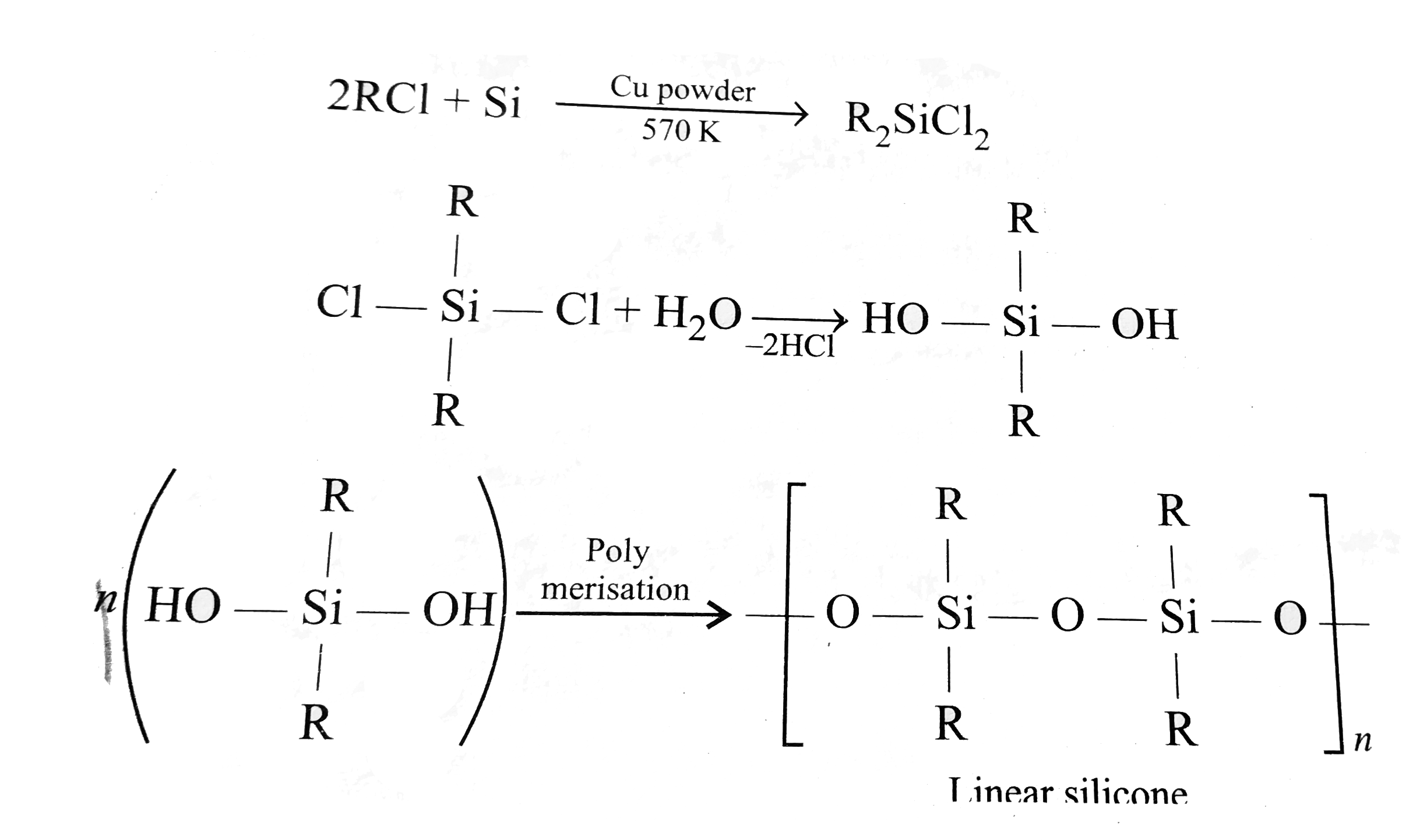
b) .
(X) is
i. Cyclic silicon
ii. Cross -linkd slilcone
ii. Linear silicon
iv. None of these
c . Lead oxide `PbO` can be dissoveld in
i. `HNO_3`, ii. `HCl iv`, iii `H_2O`.
d. A colourless slulution (A) gives halck precipitate on passing `H_2 S` . (A) also give a white precipitate with stannous chloride which graually changes to gvrey . Identigy (A) .
i. `PbCl_2`
ii. `CdBr_2`
iii. `HgCL_2`
iv . `Cu(NO_3)_2)`.

Text Solution

Verified by Experts

a. Opltion (ii) si correct .
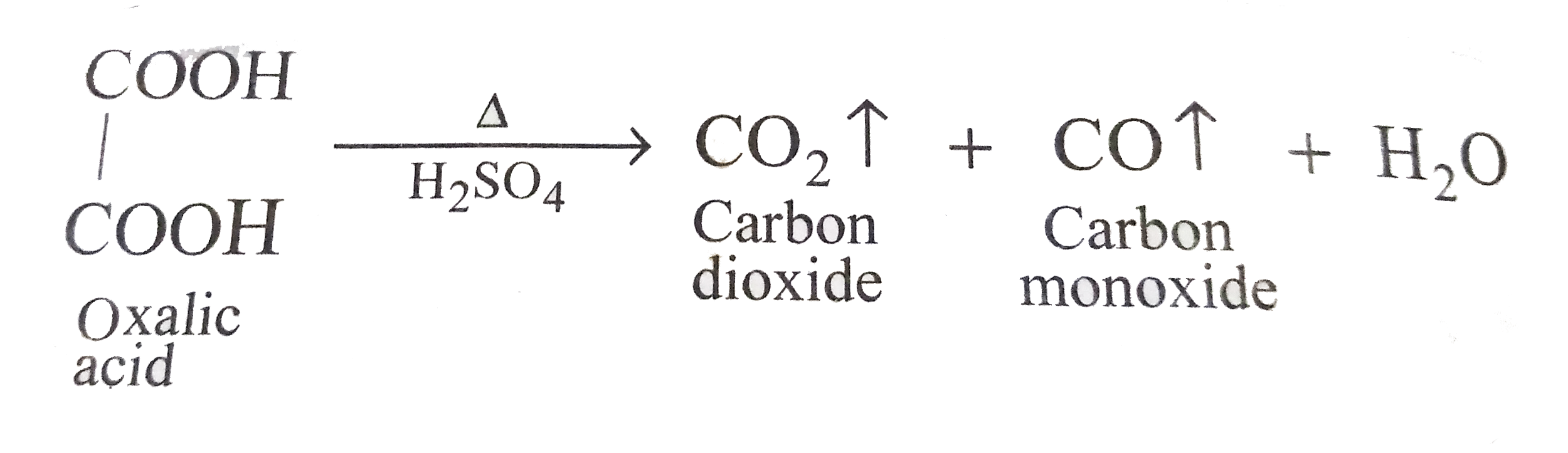
Oxalic acid on heating with `H_2 SO_4` gives a mixture of two fases : `CO_2` and `CO, H_2SO_4` acts as a dehydrating agent,

When this gasesous mixture , i.e. `CO_2` and `CO`, is passed through `KOH, CO_2` gets absorbed due to the formation of `K_2 CO_3` , wherease `CO` remains as such .
`2 KOH + CO_2 rarr k_2 CO_3 +H_2 O`
`CO` combnines with `Cl_2` to form phosgene, `COCl_2` a poisonous gas . Thus , the organic acid and the two gases evlolved onm heating with conce `H_2 SO_4` are oxalic acid . `CO_2` and `CO` .
b. option (ii) is corrcet .
.
c. Option (i) is correct .
Lead oxide . `PbO`, dissolves in ` HNO_3` due to formation of lead intrate `Pb (NO_3)_2` which si soluyble .
` PbO+ 2 HNO_3 rarrr Pb (NO_3)_2 +H_2 O`
However in `HC l, H_2 SO_4` and `H_2 O`, it is insolble .
`Pb + 2HCl rarr underset (white ppt.) (PbCl_2 darr) + H_2O`
`Pb + 2HCl rarr underset (white ppt.) (PbSO_4 darr) + H_2O`
`Pb + 2HCl rarr underset ("white ppt.") (Pb(OH)_2 darr) + H_2O`
d. Option (iii) is correct .
(A) the sulphide formed by passing `H_2` s gas is black , hence it cannot be `CdBr_2` as `CdS` is yellow
`Cd^(2+) + S^(2-) rarr underset ("Yellow") (Cdsdarr)`
(A) also reacts with `SnCl_2` to give whith ppt ., wghich means (A) acts as on oxdiesing agent , oxidising
`Sn^(2+) rarr Sn^(4+)` and itself it is redcued .
`HgCl_2 + H_2S rarr underset ("Black ppt") (HgS darr) + 2 H Cl`
` HgCl_2 + SnCl_2 rarr underset ("Whits ") (Hg_2Cl_2 ) +SnCl_4`
`Hg_2Cl_2 +SnCl_2 rarr underset (Grey) ( 2 Hg) + SnCl_4` .
Promotional Banner

Topper's Solved these Questions

  • P-BLOCK GROUP 14 - CARBON FAMILY

    CENGAGE CHEMISTRY|Exercise Ex (Subjective)|21 Videos
  • P-BLOCK GROUP 14 - CARBON FAMILY

    CENGAGE CHEMISTRY|Exercise Ex (Objective)|19 Videos
  • P-BLOCK GROUP 14 - CARBON FAMILY

    CENGAGE CHEMISTRY|Exercise Exercises Archives (Subjective)|9 Videos
  • P-BLOCK GROUP 13 - BORON FAMILY

    CENGAGE CHEMISTRY|Exercise Exercise Archives (Subjecive)|9 Videos
  • PERIODIC CLASSIFICATION OF ELEMENTS AND GENERAL INORGANIC CHEMISTRY

    CENGAGE CHEMISTRY|Exercise Exercises (Archives )Subjective|4 Videos

Similar Questions

Explore conceptually related problems

What is formed when oxalic acid is dehydrated by conc. H_2 SO_4 ?

Oxalic acid when heated with conc. H_2 SO_4 it gives out

When formic acid or oxalic acid is treated with conc. H_(2)SO_(4) , the gas evolved is

Formic acid when heated with conc . H_2 SO_4 produces …….. .

When the nitrate is heated with conc. H_(2)SO_(4) , gas evolved is