

Home
Class 10
MATHS
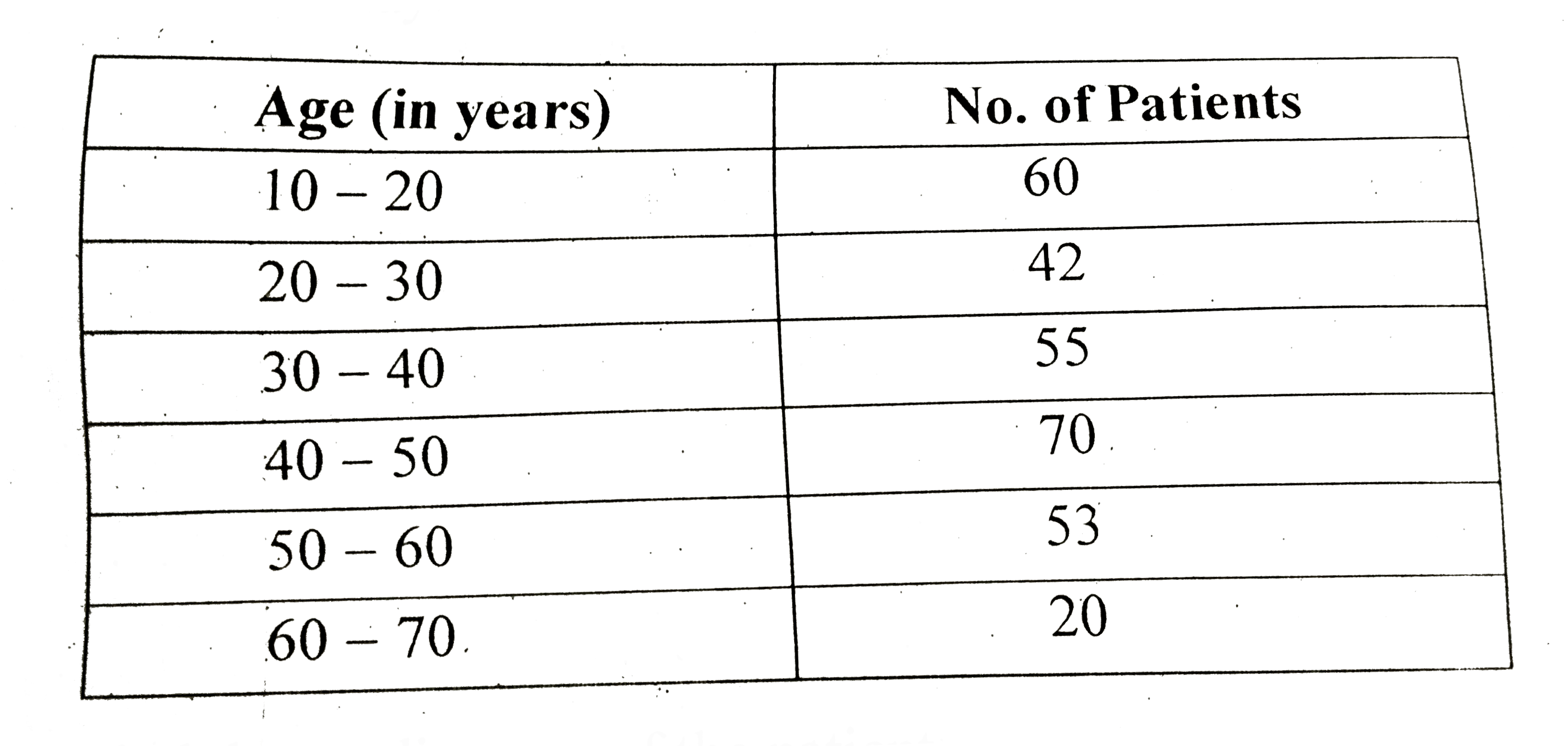
The following table shows ages of 300 pa...

The following table shows ages of 300 patients getting medical treatment in a hospital on a particular day:

Find the median age of the patient.

Promotional Banner

Topper's Solved these Questions

  • ALGEBRA MARCH 2015

    GURUKUL PUBLICATION - MAHARASHTRA PREVIOUS YEAR PAPERS|Exercise Attempt any three of the following sub-questions:|5 Videos
  • ALGEBRA JULY 2017

    GURUKUL PUBLICATION - MAHARASHTRA PREVIOUS YEAR PAPERS|Exercise QUESTIONS|22 Videos
  • ALGEBRA MARCH 2016

    GURUKUL PUBLICATION - MAHARASHTRA PREVIOUS YEAR PAPERS|Exercise Attempt any two of the following subquestions :|3 Videos

Similar Questions

Explore conceptually related problems

The following are the ages of 300 patients getting medical treatment in a hospital on a particular day: Form less than type cumulative frequency distribution.

The following are the ages of 300 patients getting medical treatment in a hospital on a particular day: Form more than type cumulative frequency distribution.

The following are the ages of 300 patients getting medical treatment in a hospital on a particulat day Form (i) Less than type cumulative frequency distribution. (ii) More than type cumulative frequency distribution.

The following table shows ages of 200 patients (in years) and the number of patients getting medical tretment on a particular day in a hospital in a day. Find the median age of a patient.

The following frequency distribution table gives the ages of 200 patients treated in a hospital in a weak. Find the mode of ages of the patients.

The following table shows the ages of the patients admitted in a hospital during a year: Find the mode and the mean of the data given above.Compare and interpret the two measures of central tendency.

The given table shows the ages (in years) of 360 patients, getting medical treatment in a hospital. One of the patients is selected at random. The probability that the selected patient's age is 30 year s or more but less than 40 years, is

The given table shows the ages (in years) of 360 patients, getting medical treatment in a hospital. One of the patients is selected at random. The probability that the selected patient's age is 10 years or more, is

The following frequency distribution table gives the ages of 200 patients treated in a hospital in a week. Find the mode of ages of the patients.

Following are the ages (in years) of 300 patients, getting medical treatment in a hospital. One of the patients is selected at random. Find the probability that the age of the selected patient is 10 years or more.