Home
Class 12
CHEMISTRY
What type of isomers are the following ...

What type of isomers are the following
(a) `[Mn(CO)_(5)(SCN)]` and `[Mn(CO)_(5)(NCS)]`
(b) `[Co(en)-(3)][Cr(CN)_(6)]` and `[Cr(en)_(3)][Co(CN)_(6)]`
( c) `[Co(NH_(3))_(5)NO_(3)]SO_(4)` and `[Co(NH_(3))_(5)SO_(4)] NO_(3)`
(d) `[Co(py)_(2)(H_(2)O)_(2)CI_(2)]CI` and `[Co(py)_(2)(H_(2)O)CI_(3)]H_(2)O`
(II) (a) `[Cr(NH_(3))_(6)][Cr(CN)_(6)]` and `[Cr(NH_(3))_(4)(CN)_(2))][Cr(NH_(3))_(2)(CN)_(4)]`
(b) `[Pt(NH_(3))_(4)Br_(2)]CI_(2)` and `[Pt(NH_(3))_(4)CI_(2)]Br_(2)` .

Text Solution

Verified by Experts
The given complexes are linkage is isomers since these complexes have ambidentate ligand viz `SCN^(Θ)` ion
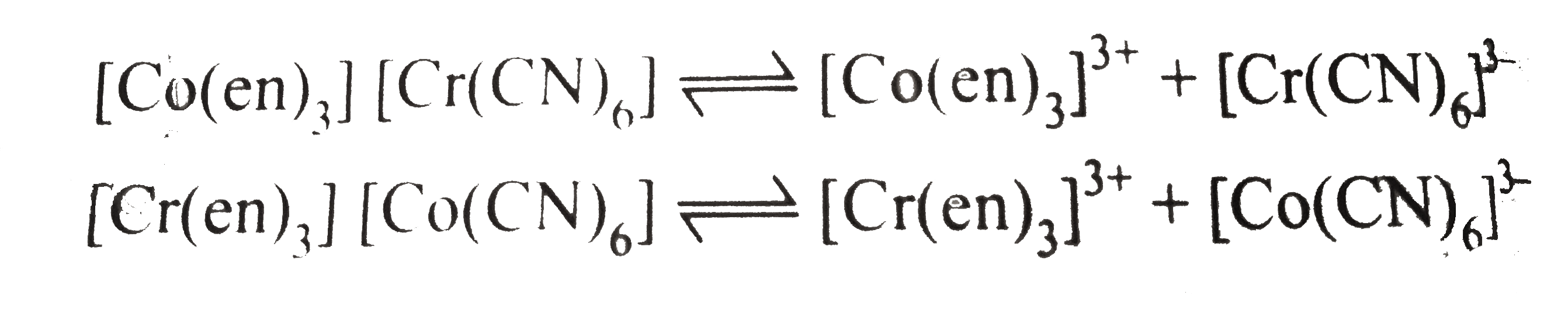
(b) The given coplex compounds are coordination isomers since each of them contains complex cation and complex anion as shown below and these complex compounds can be obtained by interchanging the ligands present in complex cation and complex anion

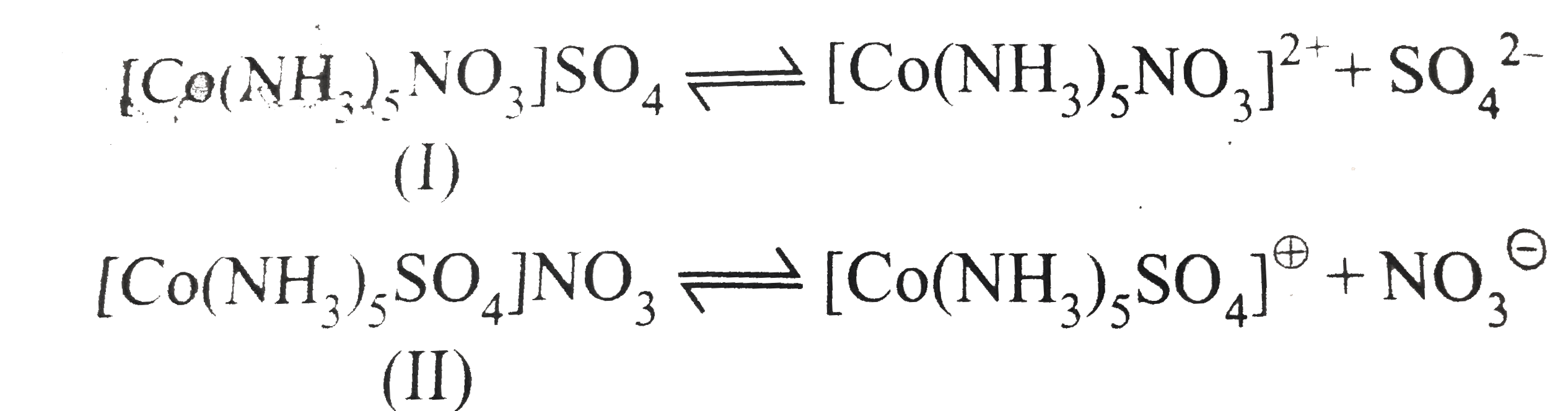
( c) These are ionisation isomers since they give different ions in aqueous solution as shwn below

(I) gives `SO_(4)^(2-)` ions and (II) gives `NO_(3)^(Θ)` ions Complex cations given by them are also different Due to the production of `SO_(4)^(2-)` ions (I) gives a white precipitate of Ba`SO_(4)` with `BaCI_(2)` sloution On the other hand (II) give the test pf `NO_(3)^(Θ)` ions
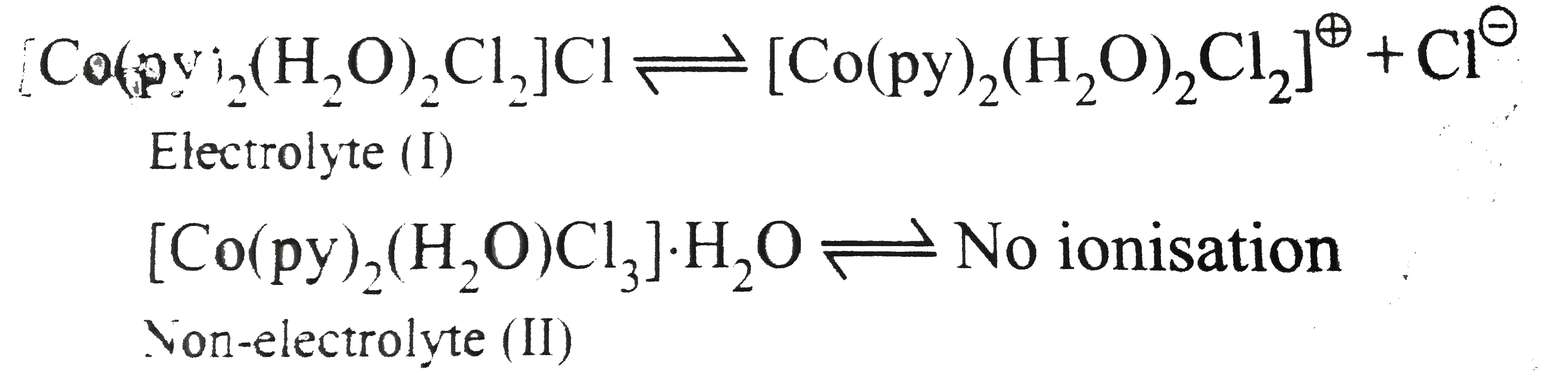
(d) These compounds are hydrate isomers since they contain different number of `H_(2)O` molecules inside and outside coordination sphere

` (##KSV_P2_CHM_C07_S01_032_S04.png" width="80%">
The given complex compounds are coordination isomers since each of them contains complex cation and complex anion as shown below and these isomers can be obtained by interchanging thire ligands

The given complex compounds are ionisation isomers since they give different ions in aqueous solution as shown below
(I) gives `CI^(Θ)` ions and (II) gives `Br^(Θ)` ions (I) gives white precipitate of AgCI with `AgNO_(3)` solution On the other hand (II) gives yellow precipitate of `AgBr` with `AgNO_(3)` solution .
Promotional Banner

Topper's Solved these Questions

  • COORDINATION COMPOUNDS

    CENGAGE CHEMISTRY|Exercise Solved Examples|42 Videos
  • COORDINATION COMPOUNDS

    CENGAGE CHEMISTRY|Exercise Ex 7.1 Subjective (Terminology)|5 Videos
  • CHEMICAL KINETICS

    CENGAGE CHEMISTRY|Exercise Archives Subjective|23 Videos
  • D AND F BLOCK ELEMENTS

    CENGAGE CHEMISTRY|Exercise Archives Subjective|29 Videos

Similar Questions

Explore conceptually related problems

What type of isomers are the following : (i) [Mn(CO)_(5)SCN] and [Mn(CO)_(5)NCS] (ii) [Co(en)_(3)[Cr(CN)_(6)] and [Cr(en)_(3)][Co(CN)_(6)] (iii) [Co(NH_(3))_(5)NO_(3)]SO_(4) and [Co(NH_(3))_(5)SO_(4)]NO_(3) (iv) [Co(H_(2)O)_(2)Cl_(2)(py)_(2)]Cl and [Co(H_(2)O)Cl_(3)(py)_(2)]H_(2)O

Name the type of isomerism exibited by the following isomers : (1) [Cr(NH_(3))_(6)][Cr(CN)_(6)] and [Cr(NH_(3))_(4)(CN)_(2)][Cr(NH_(3))_(2)(CN)_(4)] (2) [Co(py)_(2)(H_(2)O)_(2)Cl_(2)]Cl and [Co(py)_(2)(H_(2)O)Cl_(3)]H_(2)O (3) [Pt(NH_(3))_(4)Br_(2)]Cl_(2) and [Pt(NH_(3))_(4)Cl_(2)]Br_(2) (4) [Co(NH_(3))_(5)NO_(2)]Cl_(2) and [Co(NH_(3))_(5)ONO]Cl_(2)

The compexes [Co(NH_(3))_(6)][Cr(C_(2)O_(4))_(3)] and [Cr(NH_(3))_(6)][Co(C_(2)O_(4))_(3)]

The IUPAC name for [Co(NH_(3))_(6)] [Cr(CN)_(6)] is

Which isomerism is exhibited by [Co(NH_(3))_(6)][Cr(CN)_(6)] and [Cr(NH_(3))_(6)][Co(CN)_(6)] ?

CENGAGE CHEMISTRY-COORDINATION COMPOUNDS-Archives Subjective
  1. What type of isomers are the following (a) [Mn(CO)(5)(SCN)] and [Mn(...

    Text Solution

    |

  2. Write the balanced chemical equations for the following "Potassium fer...

    Text Solution

    |

  3. Give reasons in two or three sentences only for the following "The s...

    Text Solution

    |

  4. The acidic aqueous solution of ferrous ion forms a brown complex in th...

    Text Solution

    |

  5. Identify the complex which are expected to be coloured Explain (a) [...

    Text Solution

    |

  6. Write the IUPAC name for the following compounds (a) [Co(NH(3))(5)O...

    Text Solution

    |

  7. Write the IUPAC name for [Cr(NH(3))(5)CO(3)]CI .

    Text Solution

    |

  8. Write a balanced equation for the reaction of argentite with KCN and n...

    Text Solution

    |

  9. Write the formulae of the following complexes (a) Pentamminechloroco...

    Text Solution

    |

  10. A,B and C are three complexes of chromium(III) with the empirical form...

    Text Solution

    |

  11. An aqueous solution containing 1 mol of HgI(2) and 2mol of Nal is ora...

    Text Solution

    |

  12. Draw the structures of [Co(NH(3))(6)]^(3+),[Ni(CN)(4)]^(2-) and [Ni(CO...

    Text Solution

    |

  13. A metal complex having composition Cr(NH(3))(4)CI(2) Br has been isola...

    Text Solution

    |

  14. Dedue the structures of [NiCI(4)]^(2-) and [Ni(CN)(4)]^(2-) considerin...

    Text Solution

    |

  15. Write the IUPAC nomenclature of the given complex along with its hybri...

    Text Solution

    |

  16. NiCI(2) in the presence of dimethy1 glyoxime (DMG) gives a complex whi...

    Text Solution

    |

  17. AIF(3) is insoluble in anhydrous HF but when little KF is added to the...

    Text Solution

    |

  18. Write the balanced chemical equations for developing a black and white...

    Text Solution

    |

  19. Fe^(3+)overset(SNC^(Θ)("Excess"))rarrunderset("Bloodre"d)(A)overset(F^...

    Text Solution

    |