Home
Class 12
CHEMISTRY
Explain the following giving reasons (...

Explain the following giving reasons
(a) `[NiCI_(4)]^(2-)` is tetrahedral and paramagnetic whereas `[Ni(CN)_(4)]^(2-)` is square plannar and dimagnetic
(b) `[Fe(H_(2)O)_(6)]^(3+)` ion is more paramagnetic than `[Fe(CN)_(6)]^(3-)` ion
(c ) `Ni(CO)_(4)` is tetrahedral while `[Ni(CN)_(4)]^(2-)` ion is square planar
(d) `[Co(F_(6))]^(3-)` is a high spin complex whereas `[Co(CN)_(6)]^(3-)` ion is a low spin complex .

Text Solution

Verified by Experts
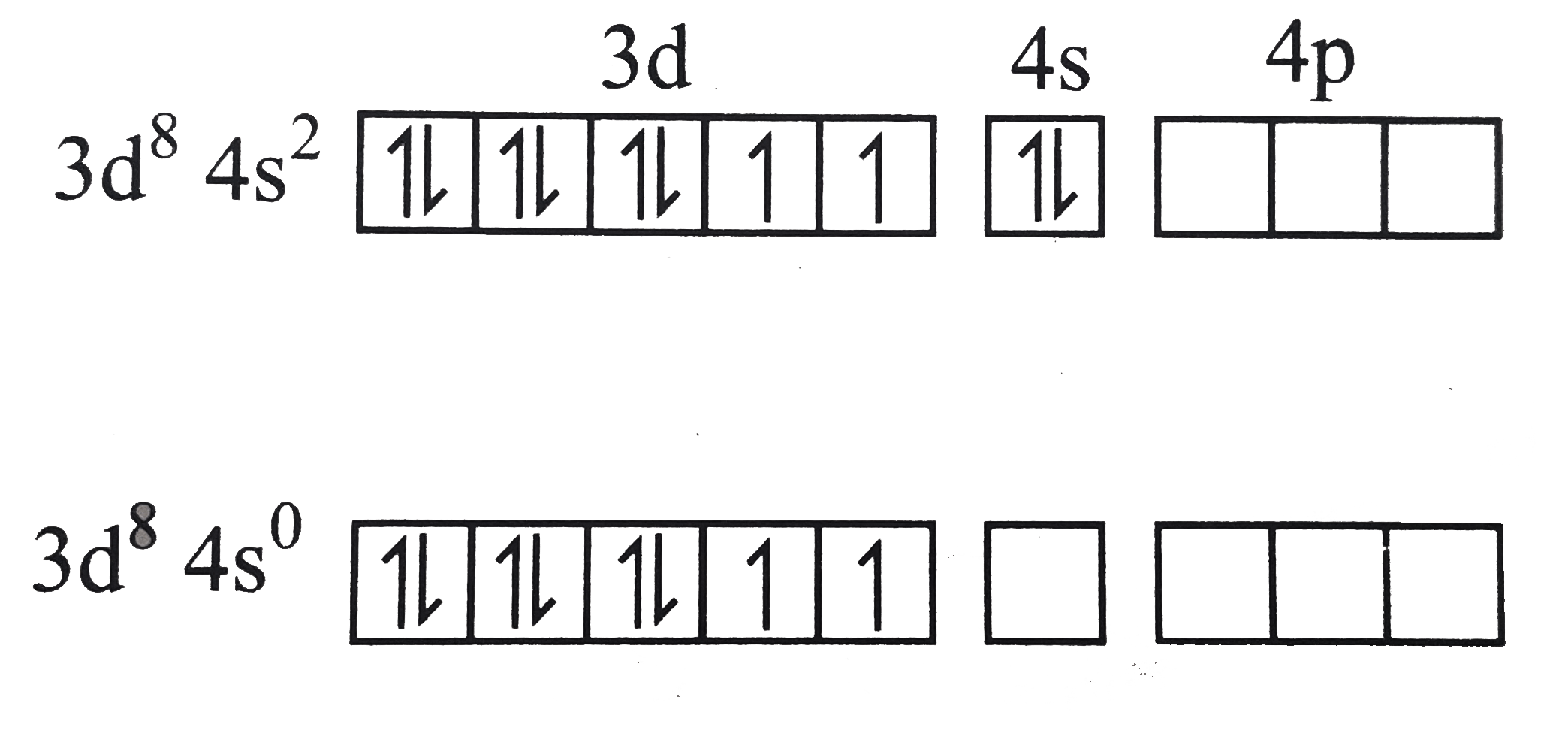
In the complex, `[NiCI_(4)]^(2)` and `[Ni(CN)_(4)]^(2-)` oxidation state of `Ni is + 2 ion `


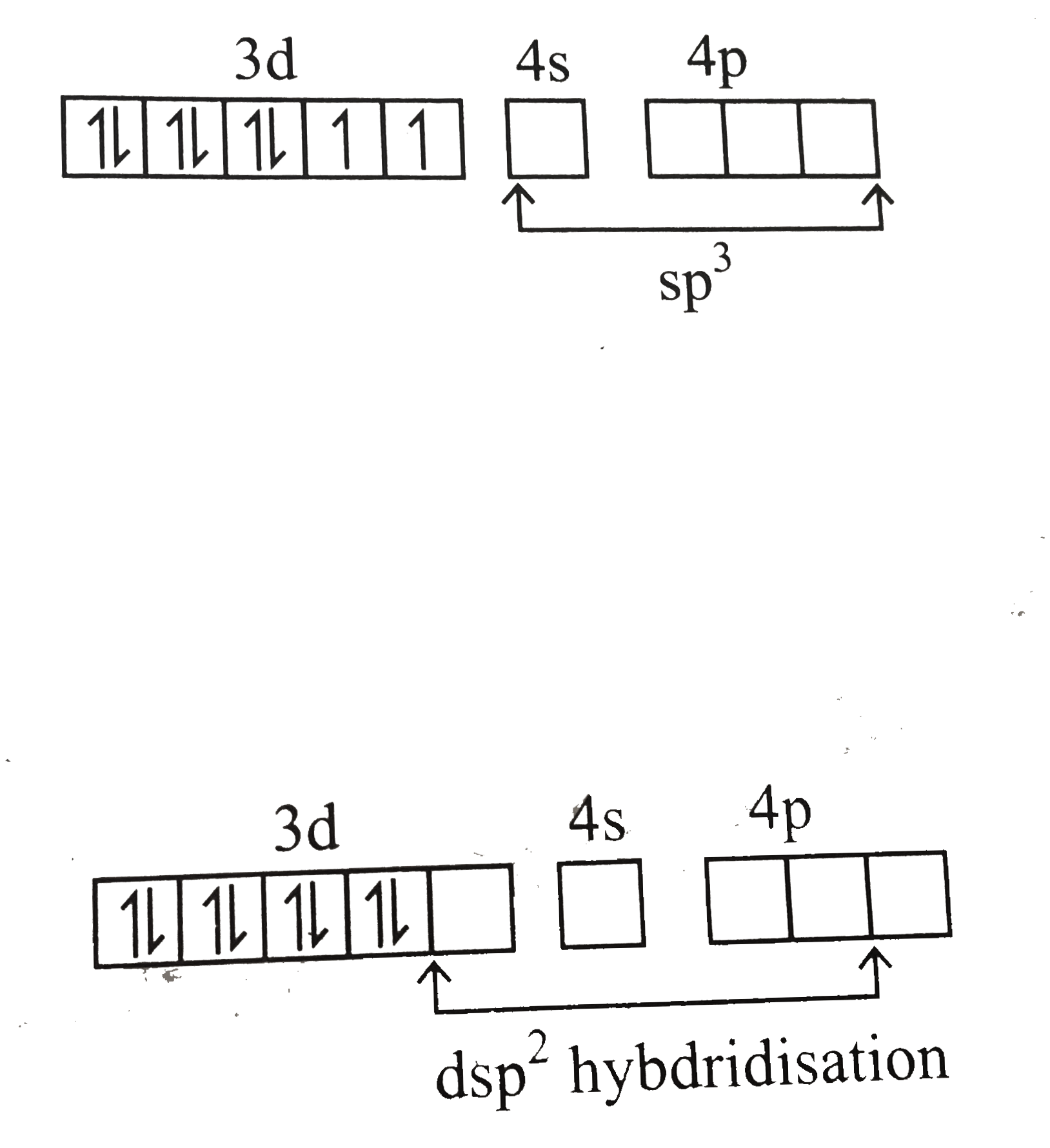
Since `CI^(Θ)` ion is weak field ligand electronic configuration of `Ni^(2+)` in `[NiCI_(4)]^(2-)` remains the same

Since `Ni^(2+)` in `[NiCI_(4)]^(2-)` ion is `sp^(3)` hybridised and have two unpaired electrons it is tetrahedral and paramagnetic
Since `CN^(Θ)` ion is strong field ligand electronic configuration of `Ni^(2+)` in `[Ni(CN)_(4)]^(2-)` is

one electron from `3d_(x2) -_(y2)` orbital gets paired with that in `3d_(z2)` ortbital Thus one d-orbital `(3d_(x2)- _(y2)` orbital)` becomes available for `dsp^(2)` hybridisation which gives square planar geometry with `n=0` The `[Ni(CN)_(4)]^(2-)` is diamagentic
(b) Oxidation state of Fein `[Fe(H_(2)O)_(6)]^(3+)` ion is `+3`


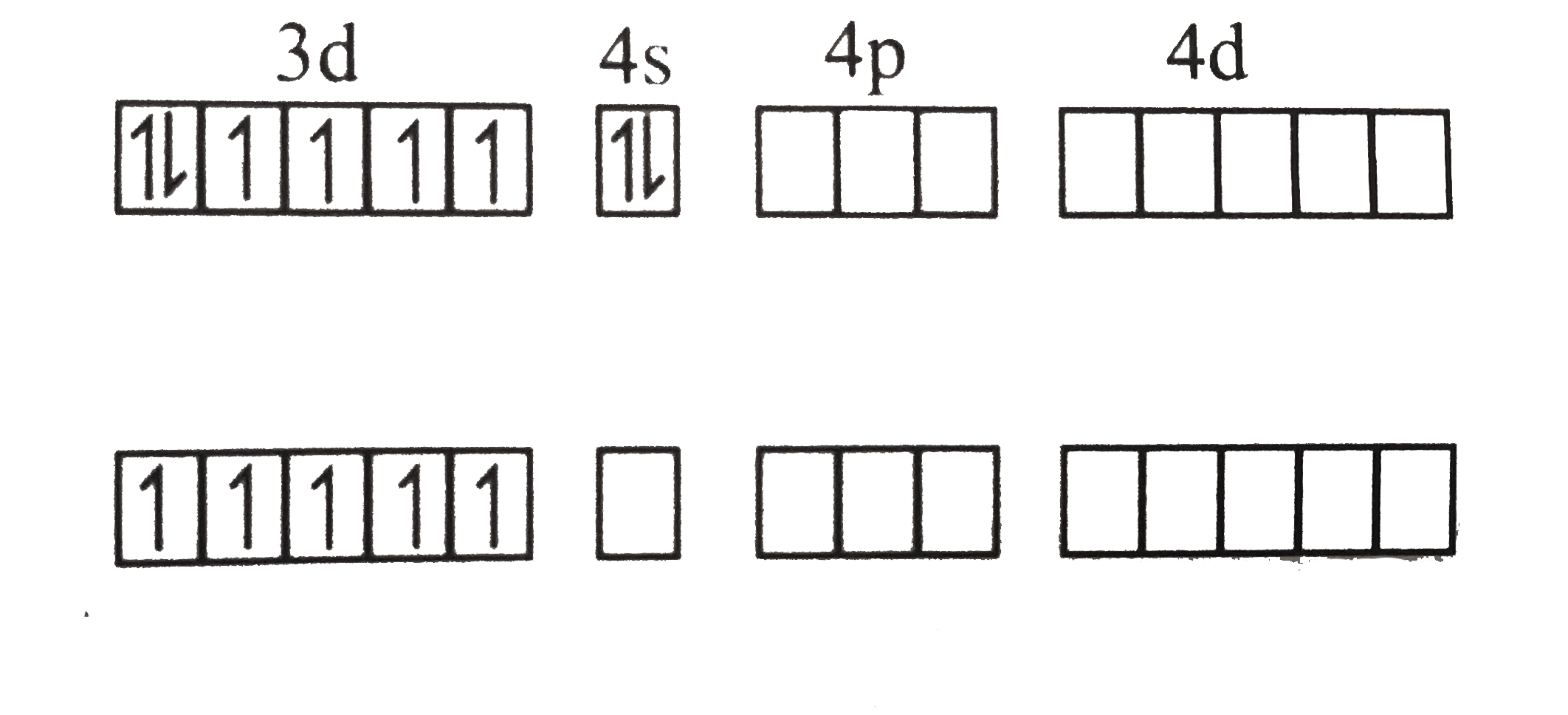
Since `H_(2)O` is weak field ligand no pairing of electrons takes place and

i.e there are 5 uppaired electrons `n=5`
`Whereeas in `[Fe(CN)_(6)]^(3-)` oxidation state of `Fe is + 3`
Since `CN^(Θ)` ion is strong field ligand pairing up of electrons in `3d` orbitals takes place is
i.e. there is only one unpaired electron `n=1`
Since in `[Fe(H_(2)O)_(6)_(6)]^(3+)` ion number of unpaired electrons are more than `[Fe(CN)_(6)]^(3-)` ion,`[Fe(H_(2)O)_(6)]^(3+)`
more is paramagnetic `[Fe(CN)_(6)]^(3-)` ion
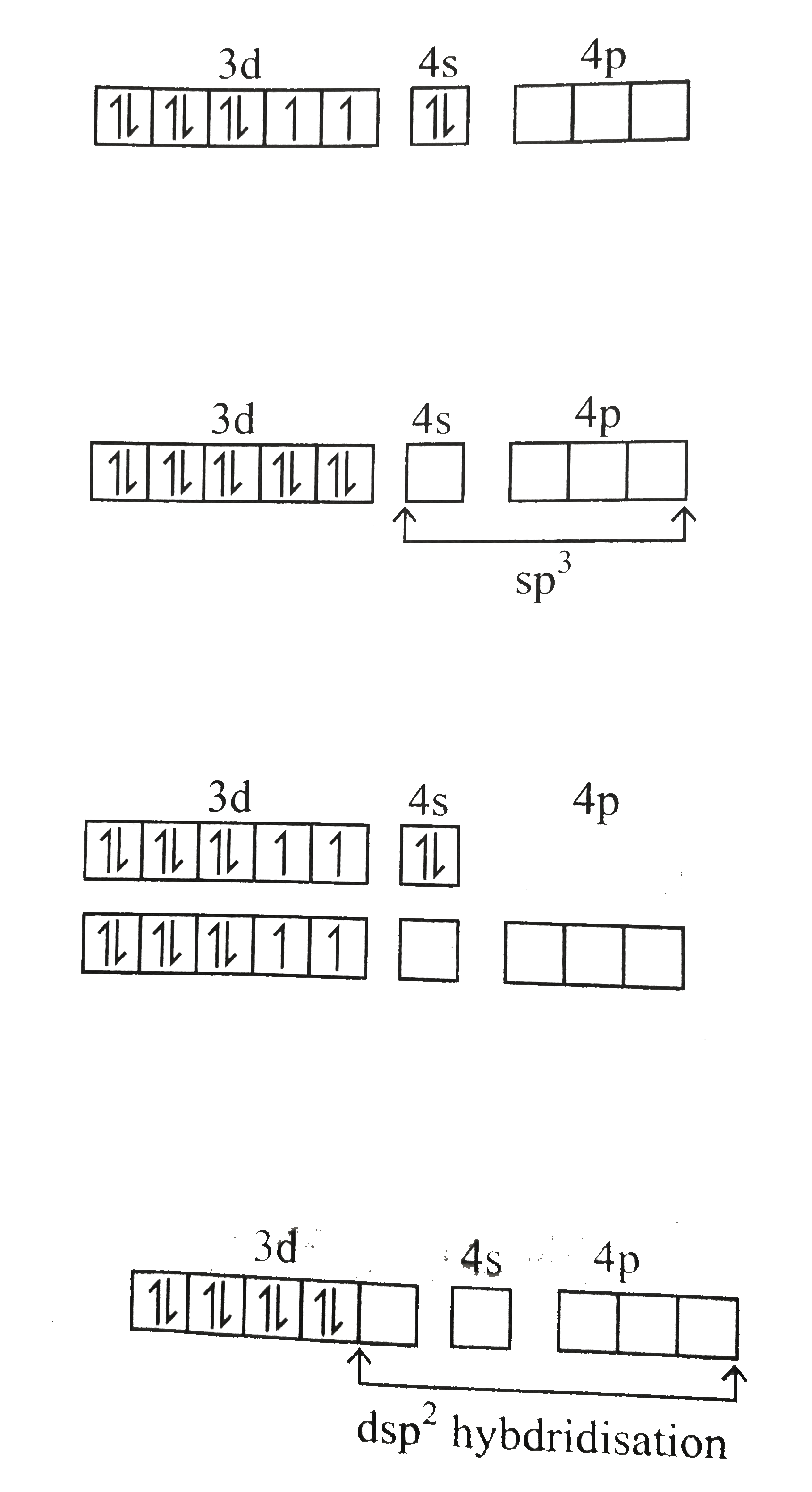
(c ) In `Ni (CO)_(4)` oxidation state of Ni is zero
Since `Co` is strong field ligands hence pairing of electrons takes place
Because of `sp^(3)` hybridisation `[Ni(CO)_(4)]` is tetrahedral In `[Ni(CN)_(4)]^(2)` oxidation state of `Ni is+2`
Since `CN^(Θ)` is strong field which results in pairing up of electron present in `3d_(x2)- _(y2)` and `3dd_(x2)-_(y2)` becomes available for `dsp^(2)` hybridisation
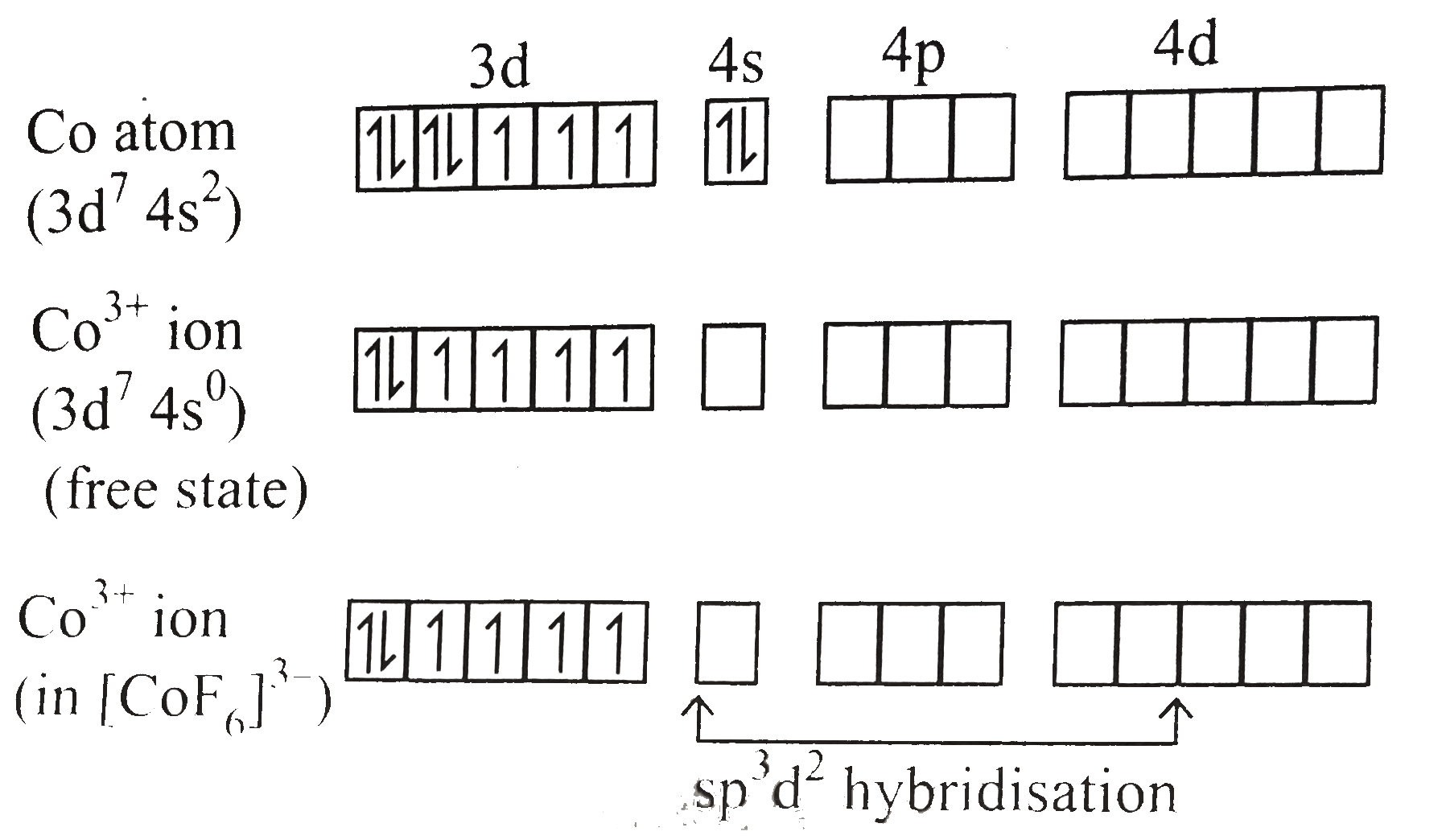
(d) `[CoF_(6)]^(3-)` is a high spin complex wherese `[Co(CN)_(6)]^(3-)` is alow spin complex This can be explained as
Since `F^(Θ)` ion is weak field ligand no pairing up of electrons present `3d` orbital takes place Since there are four unpaired electrons `[CoF_(6)]^(3-)` is paramagnetic complex Since outer orbitals (i.e 4d) are involved it is also known as high spin or outer orbital complex
Oxalate generally behaves as a weak fiels ligand but with `Co` it behaves as a strong field ligand like `NH_(3)` and `H_(2)O`
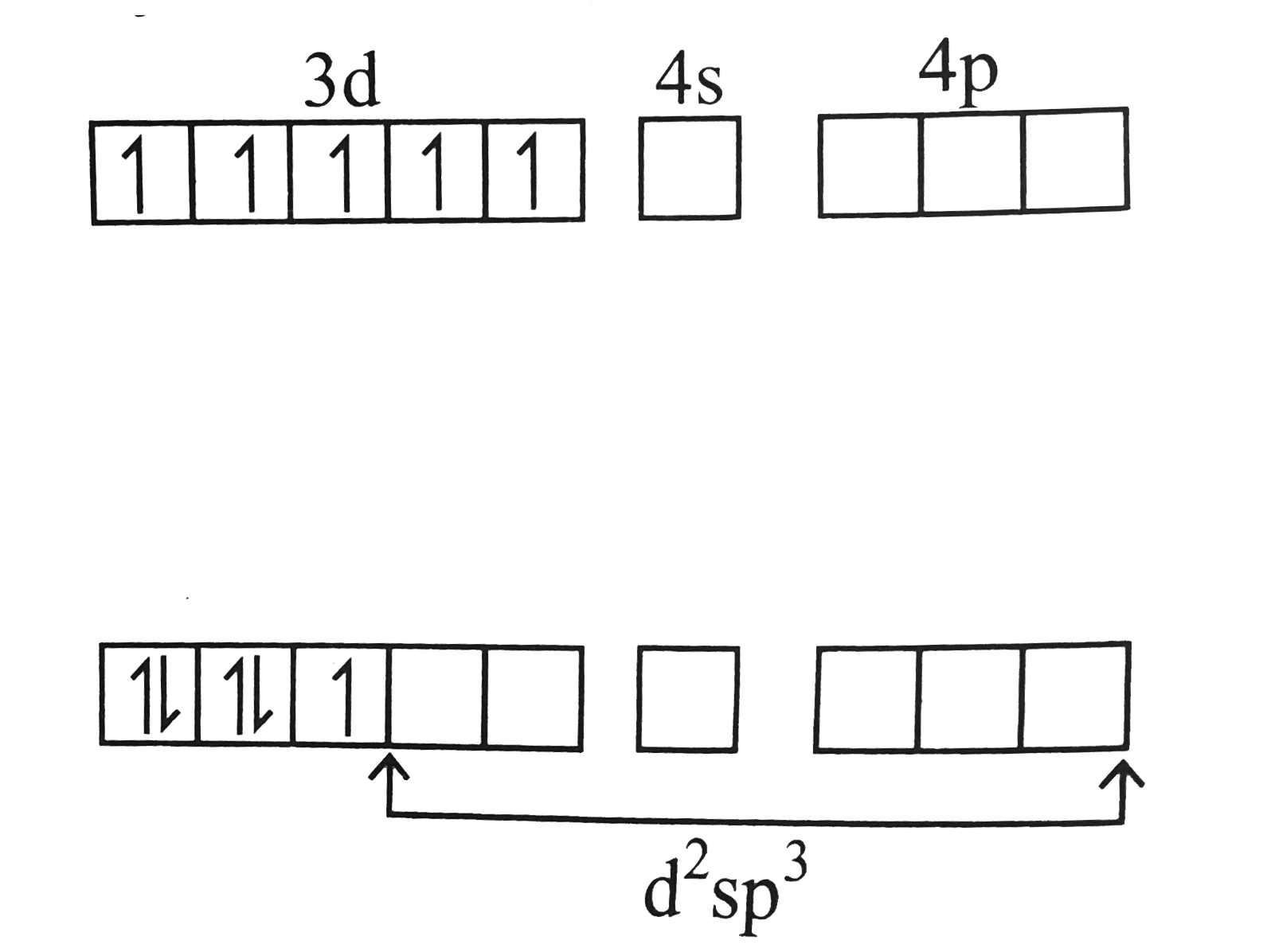
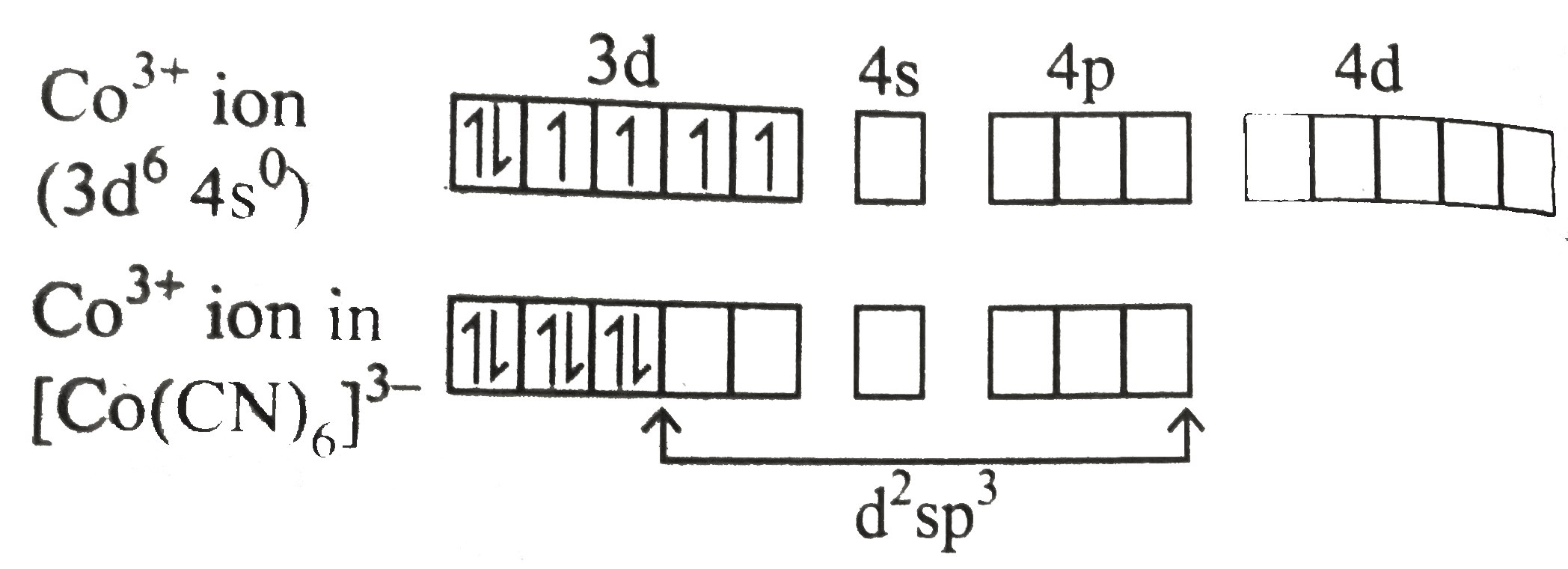
In `[Co(CN)_(6)]^(3-)` oxidation sate of Co is `+3`
Since `CN^(Θ)` is a strong field ligands pairing of `3d` electrons takes place `n=0` Since inner d orbitals `(3d)` are involved in hybridistion `(d^(2)sp^(3))` it is also known as low spin or inner orbital complex
In `[COF_(6)]^(3-), n =4` whereas in `[Co(CN_(6)]^(3-) , n=0` hence `[CoF_(6)]^(3-)` is a high spin complex whereas `[Co(CN)_(6)]^(3-)` is a low spin complex .
Promotional Banner

Topper's Solved these Questions

  • COORDINATION COMPOUNDS

    CENGAGE CHEMISTRY|Exercise Solved Examples|42 Videos
  • COORDINATION COMPOUNDS

    CENGAGE CHEMISTRY|Exercise Ex 7.1 Subjective (Terminology)|5 Videos
  • CHEMICAL KINETICS

    CENGAGE CHEMISTRY|Exercise Archives Subjective|23 Videos
  • D AND F BLOCK ELEMENTS

    CENGAGE CHEMISTRY|Exercise Archives Subjective|29 Videos

Similar Questions

Explore conceptually related problems

The complex [NiCl_(4)]^(2-) has tetrahedral geometry while [Ni(CN)_(4)]^(2-) has square planar geometry. Explain.

The [Fe(CN)_(6)]^(3-) complex ion :

The name of complex ion, [Fe(CN_(6))]^(3-) is

CENGAGE CHEMISTRY-COORDINATION COMPOUNDS-Archives Subjective
  1. Explain the following giving reasons (a) [NiCI(4)]^(2-) is tetrahedr...

    Text Solution

    |

  2. Write the balanced chemical equations for the following "Potassium fer...

    Text Solution

    |

  3. Give reasons in two or three sentences only for the following "The s...

    Text Solution

    |

  4. The acidic aqueous solution of ferrous ion forms a brown complex in th...

    Text Solution

    |

  5. Identify the complex which are expected to be coloured Explain (a) [...

    Text Solution

    |

  6. Write the IUPAC name for the following compounds (a) [Co(NH(3))(5)O...

    Text Solution

    |

  7. Write the IUPAC name for [Cr(NH(3))(5)CO(3)]CI .

    Text Solution

    |

  8. Write a balanced equation for the reaction of argentite with KCN and n...

    Text Solution

    |

  9. Write the formulae of the following complexes (a) Pentamminechloroco...

    Text Solution

    |

  10. A,B and C are three complexes of chromium(III) with the empirical form...

    Text Solution

    |

  11. An aqueous solution containing 1 mol of HgI(2) and 2mol of Nal is ora...

    Text Solution

    |

  12. Draw the structures of [Co(NH(3))(6)]^(3+),[Ni(CN)(4)]^(2-) and [Ni(CO...

    Text Solution

    |

  13. A metal complex having composition Cr(NH(3))(4)CI(2) Br has been isola...

    Text Solution

    |

  14. Dedue the structures of [NiCI(4)]^(2-) and [Ni(CN)(4)]^(2-) considerin...

    Text Solution

    |

  15. Write the IUPAC nomenclature of the given complex along with its hybri...

    Text Solution

    |

  16. NiCI(2) in the presence of dimethy1 glyoxime (DMG) gives a complex whi...

    Text Solution

    |

  17. AIF(3) is insoluble in anhydrous HF but when little KF is added to the...

    Text Solution

    |

  18. Write the balanced chemical equations for developing a black and white...

    Text Solution

    |

  19. Fe^(3+)overset(SNC^(Θ)("Excess"))rarrunderset("Bloodre"d)(A)overset(F^...

    Text Solution

    |