Home
Class 12
CHEMISTRY
On the basic VBT answer the following qu...

On the basic `VBT` answer the following questions for the 4-coordinated complex compounds
(a) `[CoBr_(4)]^(2-)`, (b) `[Zn(CN)_(4)]^(2-)`, (c ) `[MnCI_(4)]^(2-)`
(i) What is the oxidation state of the central metal atom//ion?
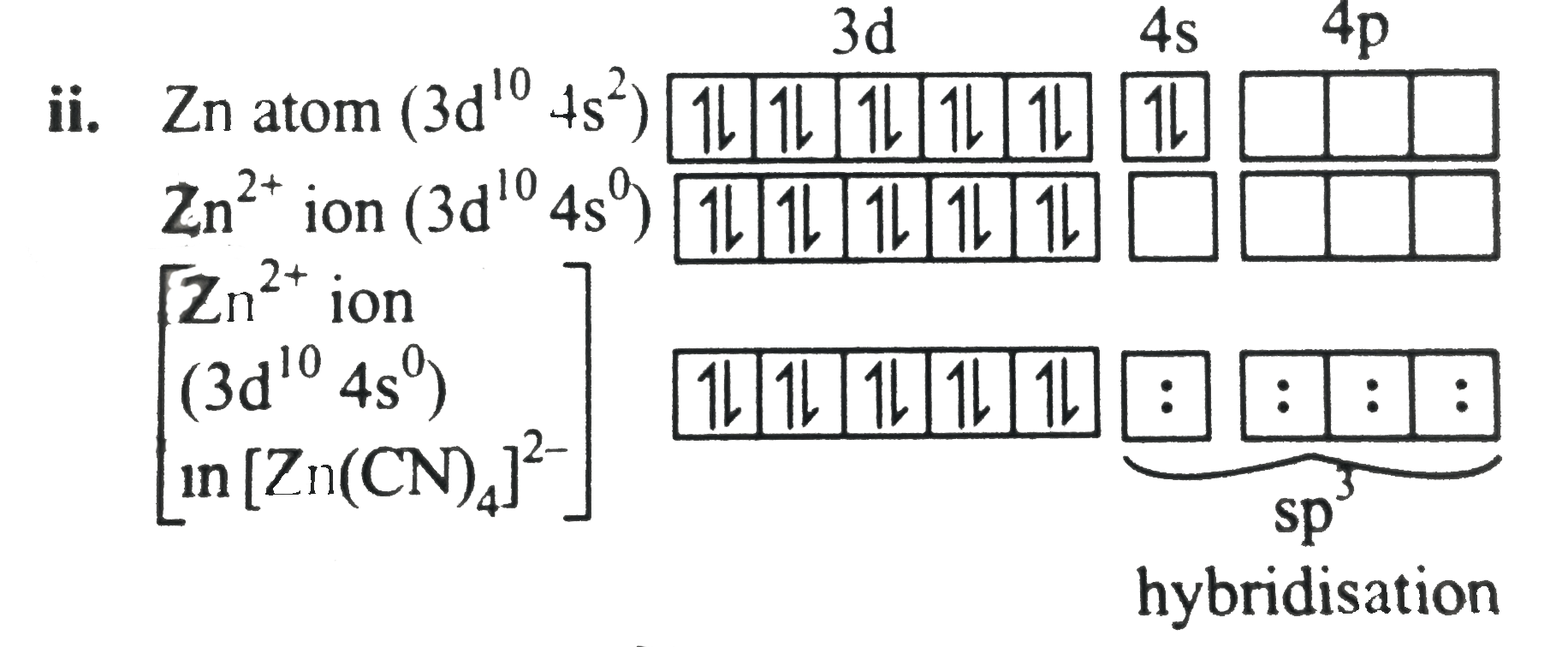
(ii) What type of hybridisation is involved?
(iii) What is the geometry and magnetic behaviour of the complex ion/compound
(iv) Calculate the value of `mu_(spin)` only .

Text Solution

Verified by Experts
Let the oxidation state of `Co` in `[CoBr_(4)]^(2-)` be x
Then `x + (-1) xx 4 = - 2`
`x = - 2 + 4 = + 2`
Therefore oxidation state of Co in `[CoBr_(4)]^(2-)` is `2+`

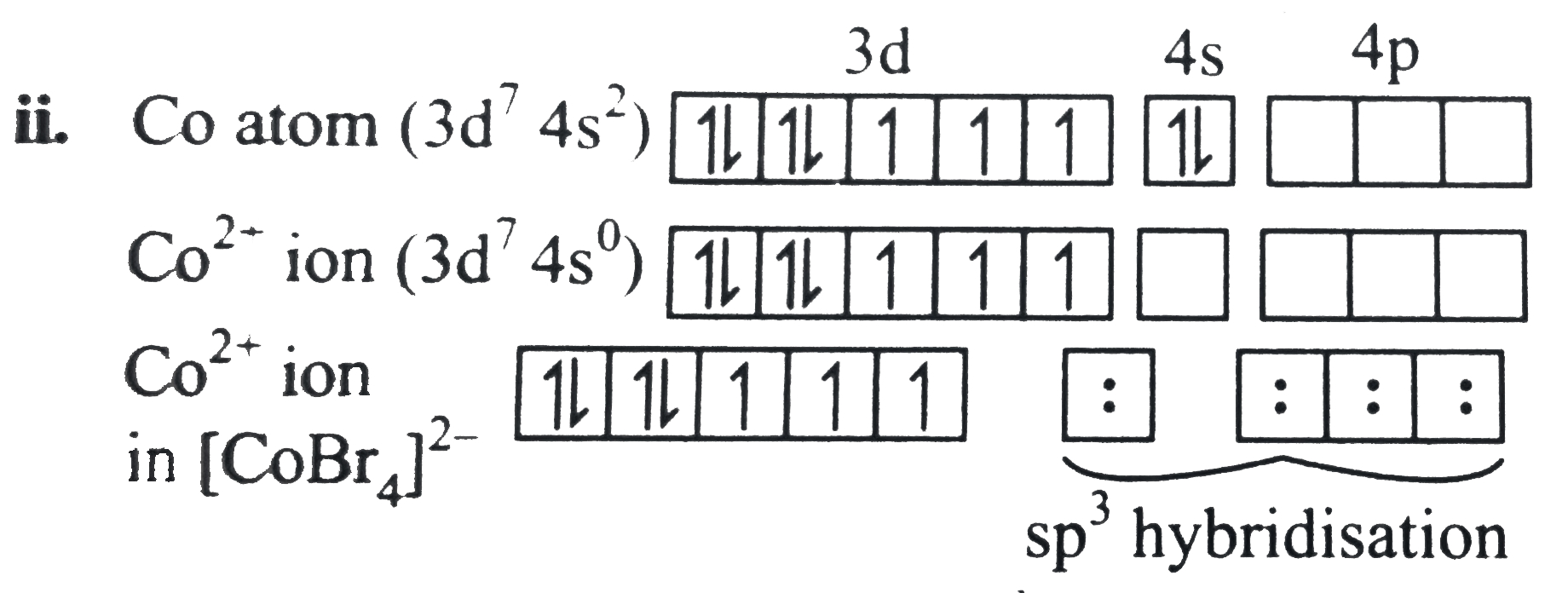
`Br^(Θ)` is a weak ligand so no pairing of `3d` electrons occurs
(iii) Since `Co^(2+)` ion in `[CoBr_(4)]^(2-)` shown `sp^(3)` hybridisation geometry of complex ion is tetrahedral further as evident three unpaired electrons are present so the complex ion is paramagnetic
(iv) `mu_(sp i n) = sqrt(n (n +2)) BM`
`mu_(sp i n) = sqrt(n (n +2)) = sqrt(15 )\:' (n = 3)`
`= 3.87 BM`
(b) `[Zn(CN)_(4)]^(2-)` ion
(i) Let oxidation state of Zn in `[Zn(CN)_(4)]^(2-)` be x
`x + (-1) xx 4 = 2`
`x = + 2`

(iii) As evident `Zn^(2+)` ion in `(Zn(CN)_(4)]^(2-)` is `sp^(3)` hybridised with no unpaired electrons therefore geometry of `[Zn(CN)_(4)]^(2-)` is tetrahedral and it is dimagnetic
(iv) `mu_("spin")` only `= sqrt(n (n + 2)) BM`
`:' n = 0, = mu_("spin")` only = 0
(c ) `[Mn(CI_(4)]^2-)`
Let oxidation state of Mn in `[MnCI_(4)]^(2-)` be x
`x + (-1) xx 4 =2`
`x = + 2`
Threrefore, oxidation state of Mn in `[MnCI_(4)]^(2-)` is +2
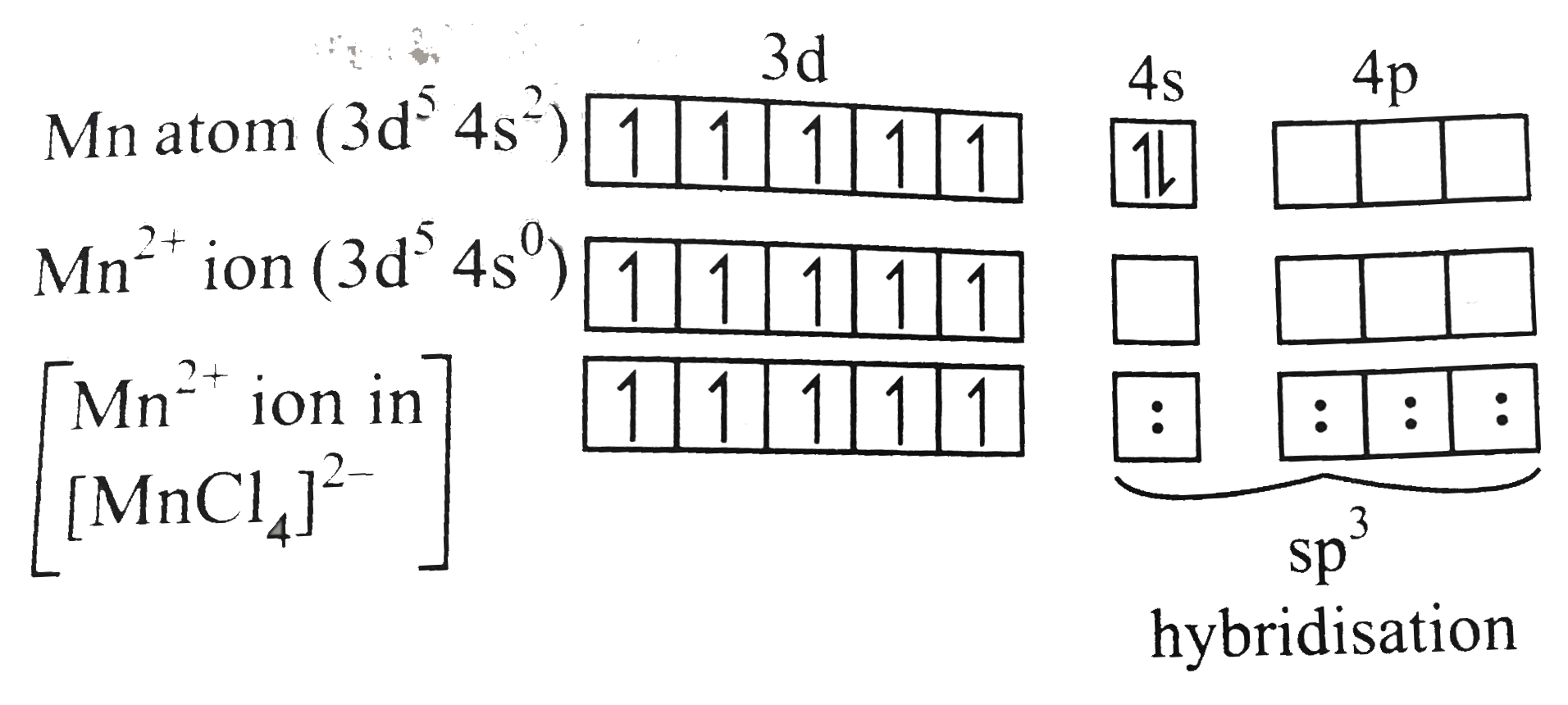
(ii) Electronic configuration of

`CI^(Θ)` is weak ligand so no pairing of `3d` electrons occurs
(iii) Since `Mn^(2+)` ion is `p^(3)` hybridised in `[MnCI_(4)]^(2-)`
geometry of `[MnCI_(4)]^(2-)` is tetrahedral Magnetic behaviour of `[MnCI_(4)]^(2-)` is paramagnetic `(n =5)`
`(iv) mu_("spin") only = sqrt(5(5 +2)) BM = sqrt(35 )BM = 5.91 BM` .
Promotional Banner

Topper's Solved these Questions

  • COORDINATION COMPOUNDS

    CENGAGE CHEMISTRY|Exercise Ex 7.1 Subjective (Terminology)|5 Videos
  • COORDINATION COMPOUNDS

    CENGAGE CHEMISTRY|Exercise Ex 7.1 Subjective (Effective Atomic Number (Ean))|3 Videos
  • COORDINATION COMPOUNDS

    CENGAGE CHEMISTRY|Exercise Archives Subjective|18 Videos
  • CHEMICAL KINETICS

    CENGAGE CHEMISTRY|Exercise Archives Subjective|23 Videos
  • D AND F BLOCK ELEMENTS

    CENGAGE CHEMISTRY|Exercise Archives Subjective|29 Videos

Similar Questions

Explore conceptually related problems

Consider the following complexes : [NiCl_(4)]^(2-), [Ni(CN)_(4)]^(2-), [Ni(CO)_(4)]^(0) What is the similarity in all three complexes ?

Predict the hybridisation and geometry of the following complexes. (a) " " [NiBr_(4)]^(2-) " " (b) [AuCl_(4)]^(-) " " ( c) [Pt(NH_(3))_(4)]^(2+)

With the help of valence bond theory (VBT) , explain hybridisation geometry and magnetic behaviour of (NiCl_4)^(2-) complex .

Give the oxidation states of the central matal in the following complex compounds , (i) K_(3)[Fe(CN)_(6)] (ii) [PtCl_(4)]^(2-) (iii) [Co(en)_(2)Cl_(2)]^(+) .

(i) Draw the geometrical isomer of the complex Pt(NH_3)_(2)Cl_2 (ii) Write the hybridisation and magnetic behaviour of the complex [Ni(CO)_4] .

Give the shape and behaviour of the following complexes: i) [Co(NH_(3))_(6)]^(3+) ii) [Ni(CN)_(4)]^(2-)

CENGAGE CHEMISTRY-COORDINATION COMPOUNDS-Solved Examples
  1. Acomplex of the type [M(A A)(2)X(2)] is known to the optically active ...

    Text Solution

    |

  2. The formula Co(NH(3))(4) CO(3) Br represents three isomers (i) Draw ...

    Text Solution

    |

  3. On the basic VBT answer the following questions for the 4-coordinated ...

    Text Solution

    |

  4. Explain why a knowledge of magnetic suceptilbility of a complex is oft...

    Text Solution

    |

  5. Magetic moment of [CoI(4)]^(2-) is 3.8BM Using valence bond approach p...

    Text Solution

    |

  6. A complex of a certain metal ion has a magnetic moment of 4.90BM Anoth...

    Text Solution

    |

  7. Find out the number of unpaired electrons in strong and weak octahedra...

    Text Solution

    |

  8. Distinguish between the possibillities in complex ions of Delta =0 and...

    Text Solution

    |

  9. Determine the crystal field stabilisation energy of a d^(6) complex ha...

    Text Solution

    |

  10. Give reason for the fact that amongst Ni(CO)(4)[Ni(CN)(4)]^(2-) and Ni...

    Text Solution

    |

  11. One the basic of CFT predict the geometry of the compund K(3)[Mn(CN)(6...

    Text Solution

    |

  12. The enthalpy of hydration of the Fe^(2+) ion is 11.4kcal//mol higher t...

    Text Solution

    |

  13. If a complexing metal of the first transition series has a di configur...

    Text Solution

    |

  14. In terms of CFT explain why a d^(9) octahedral complex with six identi...

    Text Solution

    |

  15. Derive the geometry of the complex compound corresponding to the brown...

    Text Solution

    |

  16. Which of the electronic configuration according to crystal field theor...

    Text Solution

    |

  17. Which of the electronic configuration according to crystal field theor...

    Text Solution

    |

  18. According to crystal field therory the electronic configuration of the...

    Text Solution

    |

  19. According to crystal field theory the electronic configuration of the ...

    Text Solution

    |

  20. According to crystal field theory the electronic configuration of the ...

    Text Solution

    |