Home
Class 11
CHEMISTRY
Explain : (a) An aq. Solution to tropl...

Explain :
(a) An aq. Solution to troplylium bormide `(C_7 H_7Br)` on treatment with `AgNO_3` gives a pale yellow precipitate.
(b) Cycloheptatrienyl cation has a low `pi` -electron energy than its open-chain counterparts.
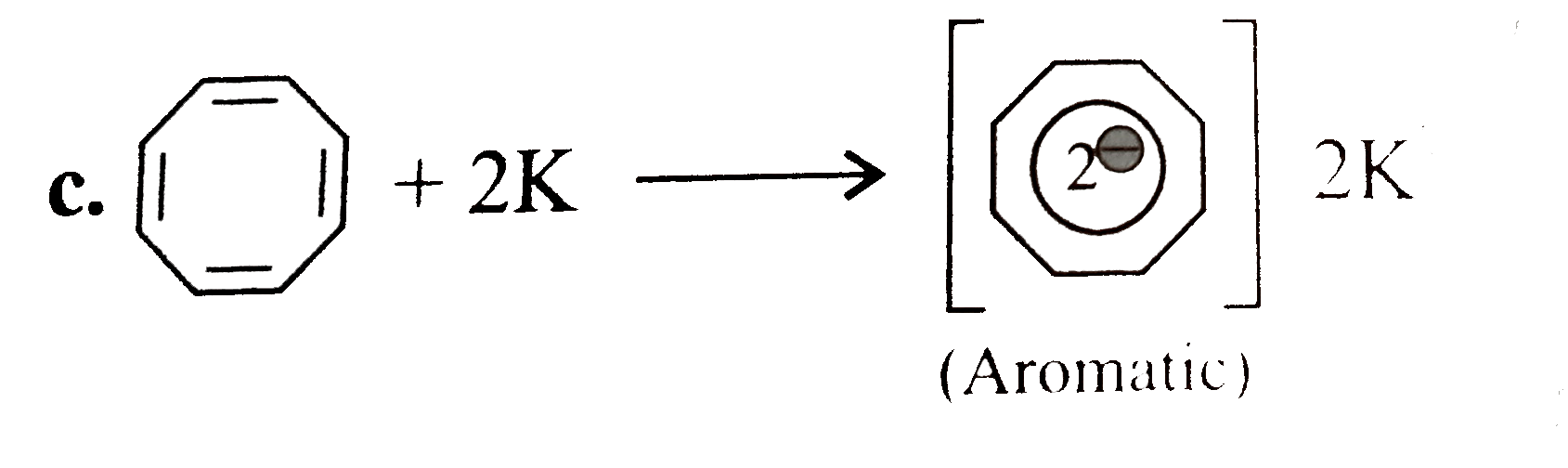
(c) Cyclo-octatetraene reacts with 2 mol of potassium to yield a stable compound.

Text Solution

Verified by Experts
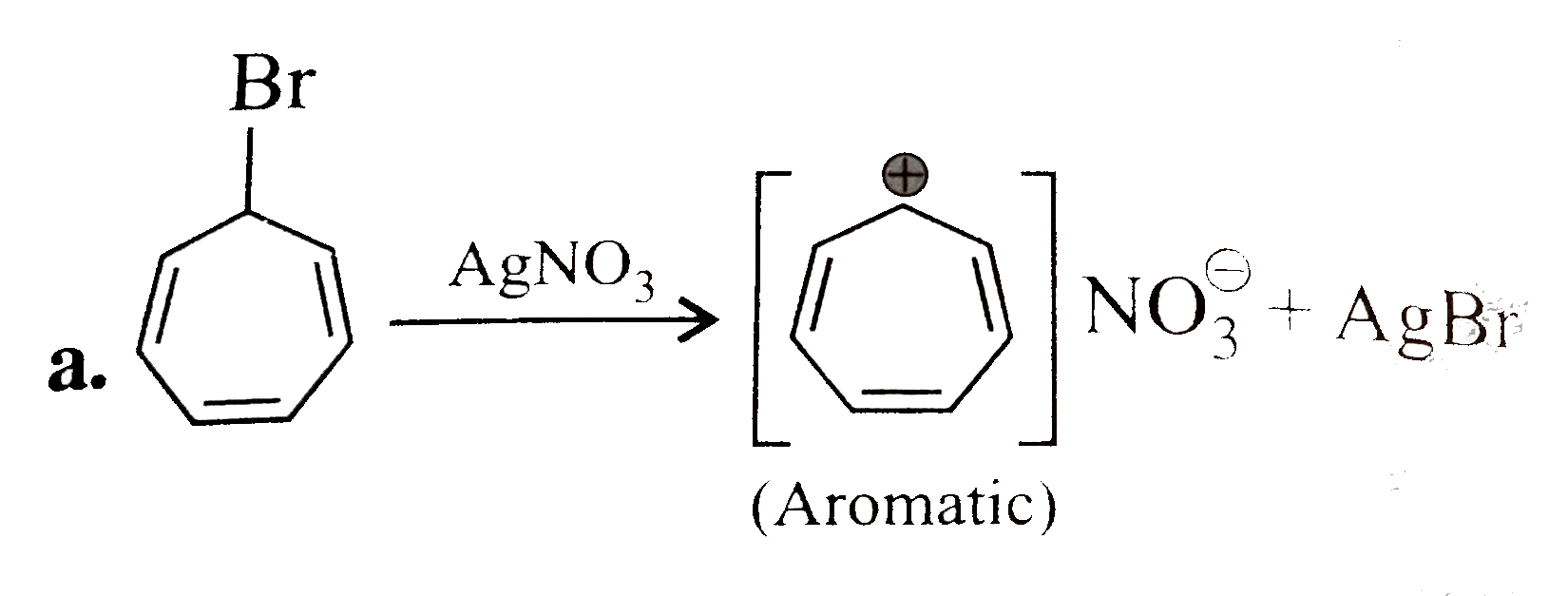
`(a),(b)`, and `(c)` are all examples of aromatic compounds.

(b) It is aromatic compound that is why it has low energy.
(c) .
Promotional Banner

Topper's Solved these Questions

  • ORGANIC REACTION MECHANISM

    CENGAGE CHEMISTRY|Exercise Subjective|19 Videos
  • ORGANIC REACTION MECHANISM

    CENGAGE CHEMISTRY|Exercise Comprehension|36 Videos
  • ORGANIC REACTION MECHANISM

    CENGAGE CHEMISTRY|Exercise Analytical and Descriptive|6 Videos
  • NCERT BASED EXERCISE

    CENGAGE CHEMISTRY|Exercise Chemical Equilibrium|72 Videos
  • P-BLOCK GROUP 13 - BORON FAMILY

    CENGAGE CHEMISTRY|Exercise Exercise Archives (Subjecive)|9 Videos

Similar Questions

Explore conceptually related problems

A compound A (C_(8)H_(10)O) upon treatment with alkaline solution of iodine gives a yellow precipitate. The filtrate on acidification gives a white solid B (C_(7)H_(6)O_(2)) . Write the structures of A and B.

A compound D(C_(8)H_(10)O) upon treatement with alkaline solution of iodine gives a yellow precipitate. The fibtrate on acidification gives a white solid E(C_(7)H_(6)O_(2)) . Write the structures of D,E and explain the formation of E.

(i) A powdered substance (A) on treatment with fusion mixture gives a green coloured compound (B). (ii) The solution of (B) in boiling water on acidification with dilute H_(2)SO_(4) gives a pink coloured compound (C ) . (iii) The aqueous solution of (A) on treatment with NaOH and Br_(2)- water gives a compound (D). (iv) A solution of (D) in conc. HNO_(3) on treatment with lead peroxide at boiling temperature produced a compound (E) which was of the same coloure at that of (C). (v) A solution of (A) on treatment with a solution of barium chloride gave a white precipitate of compound (F) Which was insoluble in conc. HNO_(3) and conc. HCl. The oxidation state of central metal ions of (A), (B) and (C ) compounds are respectively :

(i) A powdered substance (A) on treatment with fusion mixture gives a green coloured compound (B). (ii) The solution of (B) in boiling water on acidification with dilute H_(2)SO_(4) gives a pink coloured compound (C ). (iii) The aqueous solution of (A) on treatment with NaOH and Br_(2)- water gives a compound (D). (iv) A solution of (D) in conc. HNO_(3) on treatment with lead peroxide at boiling temperature produced a compound (E) which was of the same colour at that of (C ) . (v) A solutionof ( A) on treatment with a solution of barium chloride gas a white precipitate of compound (F) which was insoluble in conc. HNO_(3) and conc. HCl. The oxidation state of central metal ions of (A) , (B) and (C) compounds are respectively.

(i) A powdered substance (A) on treatment with fusion mixture gives a green coloured compound (B). (ii) The solution of (B) in boiling water on acidification with dilute H_(2)SO_(4) gives a pink coloured compound (C ) . (iii) The aqueous solution of (A) on treatment with NaOH and Br_(2)- water gives a compound (D). (iv) A solution of (D) in conc. HNO_(3) on treatment with lead peroxide at boiling temperature produced a compound (E) which was of the same coloure at that of (C). (v) A solution of (A) on treatment with a solution of barium chloride gave a white precipitate of compound (F) Which was insoluble in conc. HNO_(3) and conc. HCl. Which of the following is true for compound (C ).

(i) A powdered substance (A) on treatment with fusion mixture gives a green coloured compound (B). (ii) The solution of (B) in boiling water on acidification with dilute H_(2)SO_(4) gives a pink coloured compound (C ). (iii) The aqueous solution of (A) on treatment with NaOH and Br_(2)- water gives a compound (D). (iv) A solution of (D) in conc. HNO_(3) on treatment with lead peroxide at boiling temperature produced a compound (E) which was of the same colour at that of (C ) . (v) A solutionof ( A) on treatment with a solution of barium chloride gas a white precipitate of compound (F) which was insoluble in conc. HNO_(3) and conc. HCl. Which of the following is true for compound (C ).

An optically active compound A (assume dextrorotatory) has the molecular formula C_(7)H_(11)Br . A reacts with hydrogen bromide, in the absence of peroxides to yield isomeric products, B and C, with the molecular formula C_(7)H_(12)Br_(2) . Compound B is optically active, C is not. Treating B with 1 mol of potassium butoxide yields (+)-A . Treating C with 1 mol of potassium tert-butoxide yields (+-)-A . Treating A with potassium tert-butoxide yields D(C_(7)H_(10)) . Subjecting 1 mol of D to ozonolysis followed by treatement with zinc and acetic acid yields 2 moles of formaldehyde and 1 mole of 1,3-cyclopentanedione. The compound 'B' is:

CENGAGE CHEMISTRY-ORGANIC REACTION MECHANISM-Solved Example
  1. Explain .

    Text Solution

    |

  2. When 3-chlorocyclopropene (A) is treated with SbCl5, it gives a stable...

    Text Solution

    |

  3. Explain : (a) An aq. Solution to troplylium bormide (C7 H7Br) on tre...

    Text Solution

    |

  4. Give the order of reactivity towards aqueous HCOOH of the following. ...

    Text Solution

    |

  5. Give the order of hydrolysis in SN^1 process for the following : ...

    Text Solution

    |

  6. Give the order of (a) nucleophilicity (b) basic character, and (c) fug...

    Text Solution

    |

  7. Give the most reactive substrate in each of the following pair with ov...

    Text Solution

    |

  8. Outline the synthesis of following compounds from suitable nucleophile...

    Text Solution

    |

  9. Give a suitable mechanism for the following : .

    Text Solution

    |

  10. Predict the order of reactivity of the following halides with (a) NaI ...

    Text Solution

    |

  11. Explain : (a)ClCH2OCH3 (chloromethyl methyl ether) undergoes SN^1 re...

    Text Solution

    |

  12. Write the products of the following SN reactions. .

    Text Solution

    |

  13. Complete the following reaction

    Text Solution

    |

  14. Bromobenzene can be dehydrobrominated to benzyne by three possible rou...

    Text Solution

    |

  15. Classify the following reactions as addition, elimination, substitutio...

    Text Solution

    |

  16. From the following elimination reactions, predict which one is Hofman...

    Text Solution

    |

  17. Which one is more reactive towards acidcatalysed hydration ? Predict t...

    Text Solution

    |

  18. Which one hydrolyses at a faster rate by SN^1 mechanism ? .

    Text Solution

    |

  19. Explain :

    Text Solution

    |

  20. What are the products of addition of D2 to trans-2-pentene.

    Text Solution

    |