Text Solution
Verified by Experts
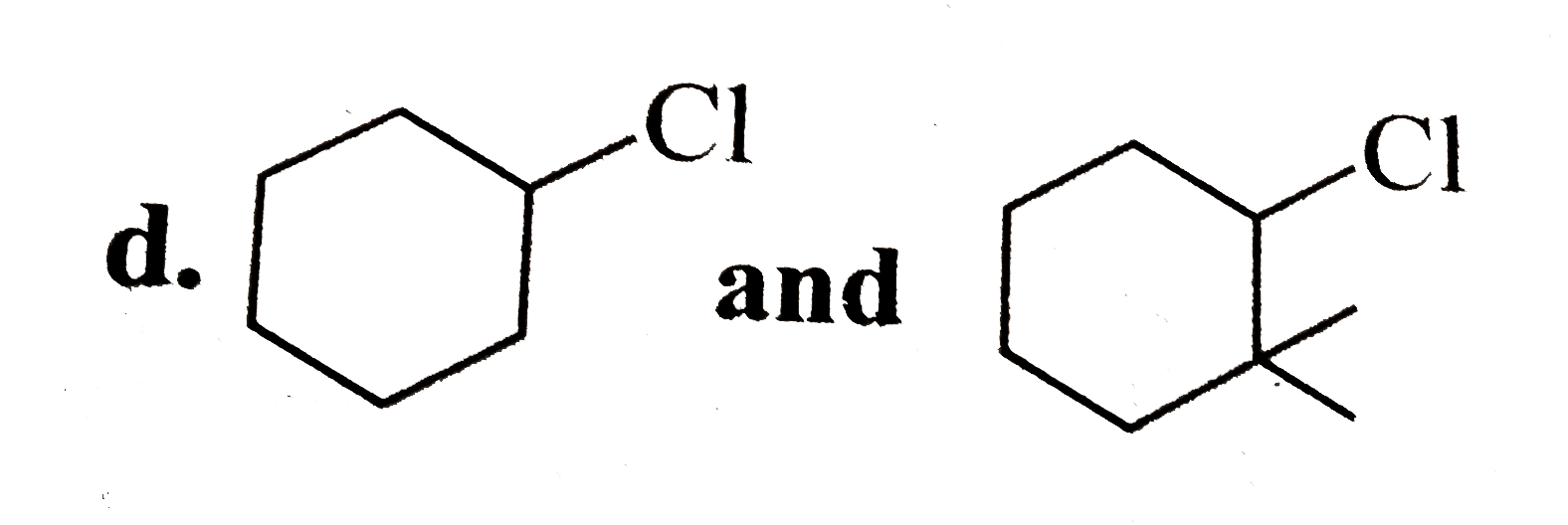
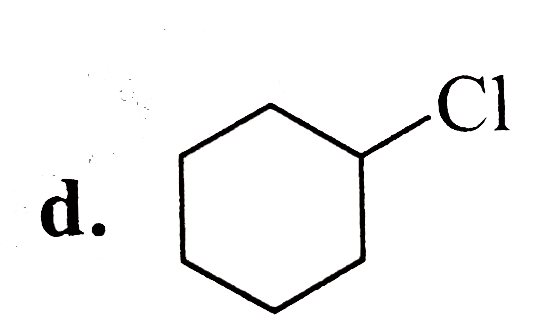 (`Cl` can be removed easily, no resonance stabilisation). But in
 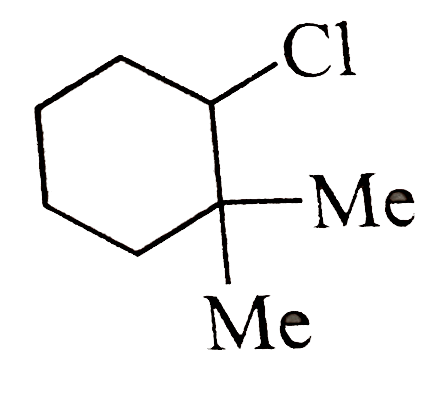 Cl is difficult to remove due to the steric hindrance of two methyl groups.


Topper's Solved these Questions
ORGANIC REACTION MECHANISM
CENGAGE CHEMISTRY|Exercise Subjective|19 VideosORGANIC REACTION MECHANISM
CENGAGE CHEMISTRY|Exercise Comprehension|36 VideosORGANIC REACTION MECHANISM
CENGAGE CHEMISTRY|Exercise Analytical and Descriptive|6 VideosNCERT BASED EXERCISE
CENGAGE CHEMISTRY|Exercise Chemical Equilibrium|72 VideosP-BLOCK GROUP 13 - BORON FAMILY
CENGAGE CHEMISTRY|Exercise Exercise Archives (Subjecive)|9 Videos
Similar Questions
Explore conceptually related problems
CENGAGE CHEMISTRY-ORGANIC REACTION MECHANISM-Solved Example
- Give the order of hydrolysis in SN^1 process for the following : ...
Text Solution
|
- Give the order of (a) nucleophilicity (b) basic character, and (c) fug...
Text Solution
|
- Give the most reactive substrate in each of the following pair with ov...
Text Solution
|
- Outline the synthesis of following compounds from suitable nucleophile...
Text Solution
|
- Give a suitable mechanism for the following : .
Text Solution
|
- Predict the order of reactivity of the following halides with (a) NaI ...
Text Solution
|
- Explain : (a)ClCH2OCH3 (chloromethyl methyl ether) undergoes SN^1 re...
Text Solution
|
- Write the products of the following SN reactions. .
Text Solution
|
- Complete the following reaction
Text Solution
|
- Bromobenzene can be dehydrobrominated to benzyne by three possible rou...
Text Solution
|
- Classify the following reactions as addition, elimination, substitutio...
Text Solution
|
- From the following elimination reactions, predict which one is Hofman...
Text Solution
|
- Which one is more reactive towards acidcatalysed hydration ? Predict t...
Text Solution
|
- Which one hydrolyses at a faster rate by SN^1 mechanism ? .
Text Solution
|
- Explain :
Text Solution
|
- What are the products of addition of D2 to trans-2-pentene.
Text Solution
|
- Meso-2,3-dibromobutane reacts with iodide ion more rapidly than does (...
Text Solution
|
- Mustard gas (ClCH2CH2)2-S hydrolysed by water to Cl(CH2)2 S(Ch2)2 OH m...
Text Solution
|
- Give the product, indicating stereo-chemistry of cyclohexene with : ...
Text Solution
|
- 1,2-Dimethylcyclohexene undergoes only trans-addition with HBr in non-...
Text Solution
|