Home
Class 11
CHEMISTRY
Identify (A) and (D). a. b. What wo...

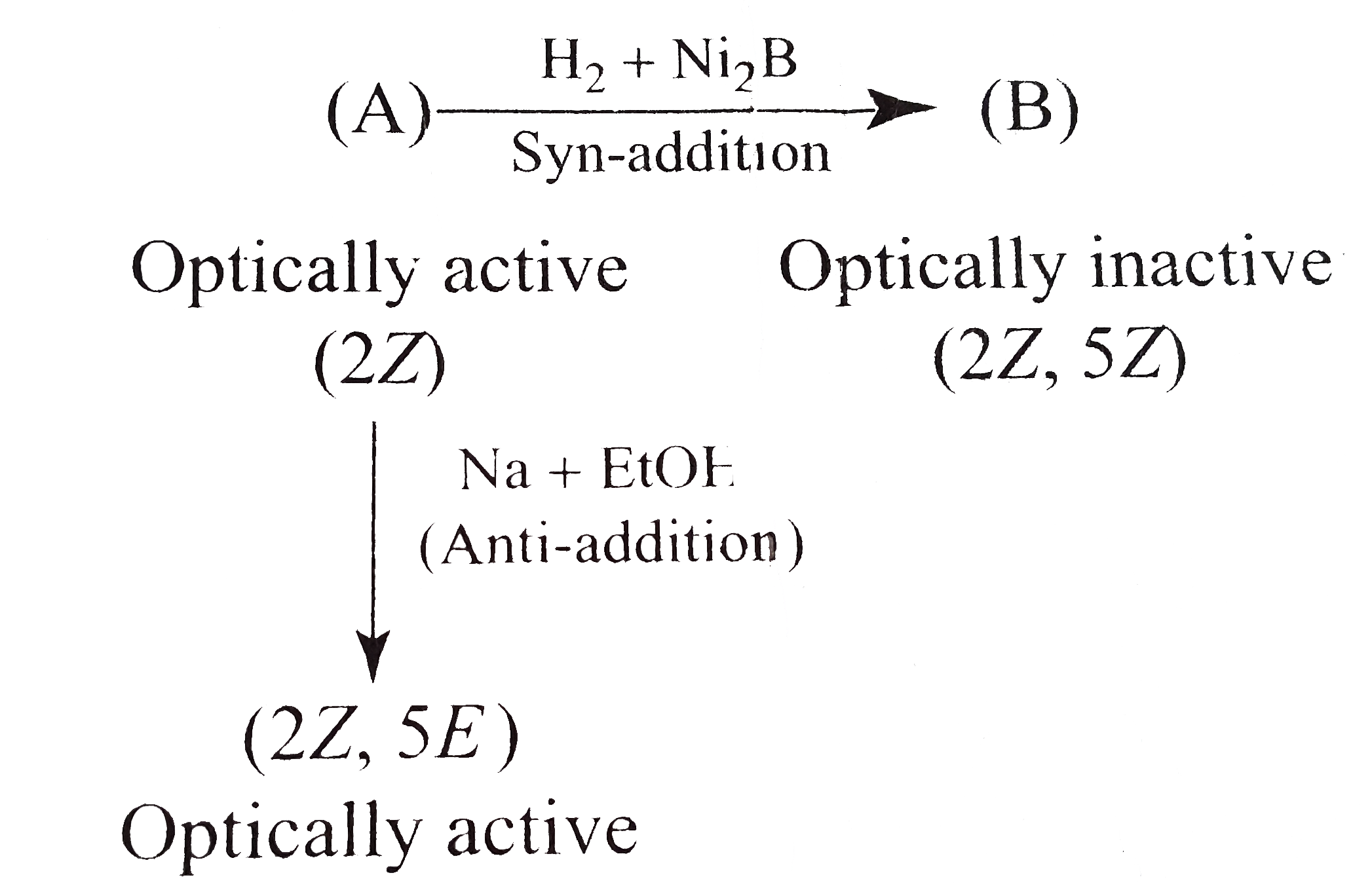
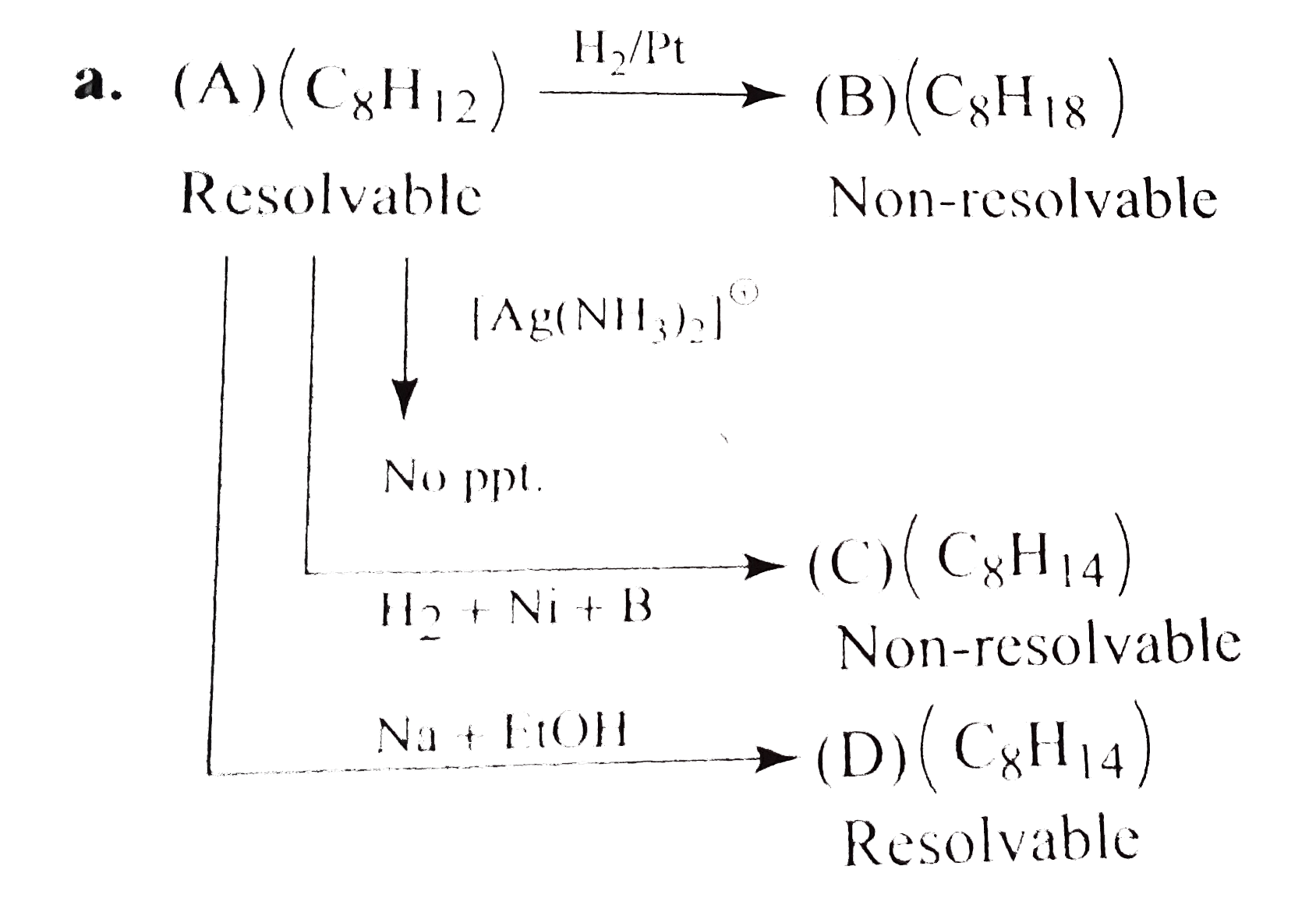
Identify (A) and (D).
a.
b. What would be the structure of (A), if on reaction with `(Na+EtOH)` or `(H_2+Ni_2B)`, it gives an optically active compound?

Text Solution

Verified by Experts
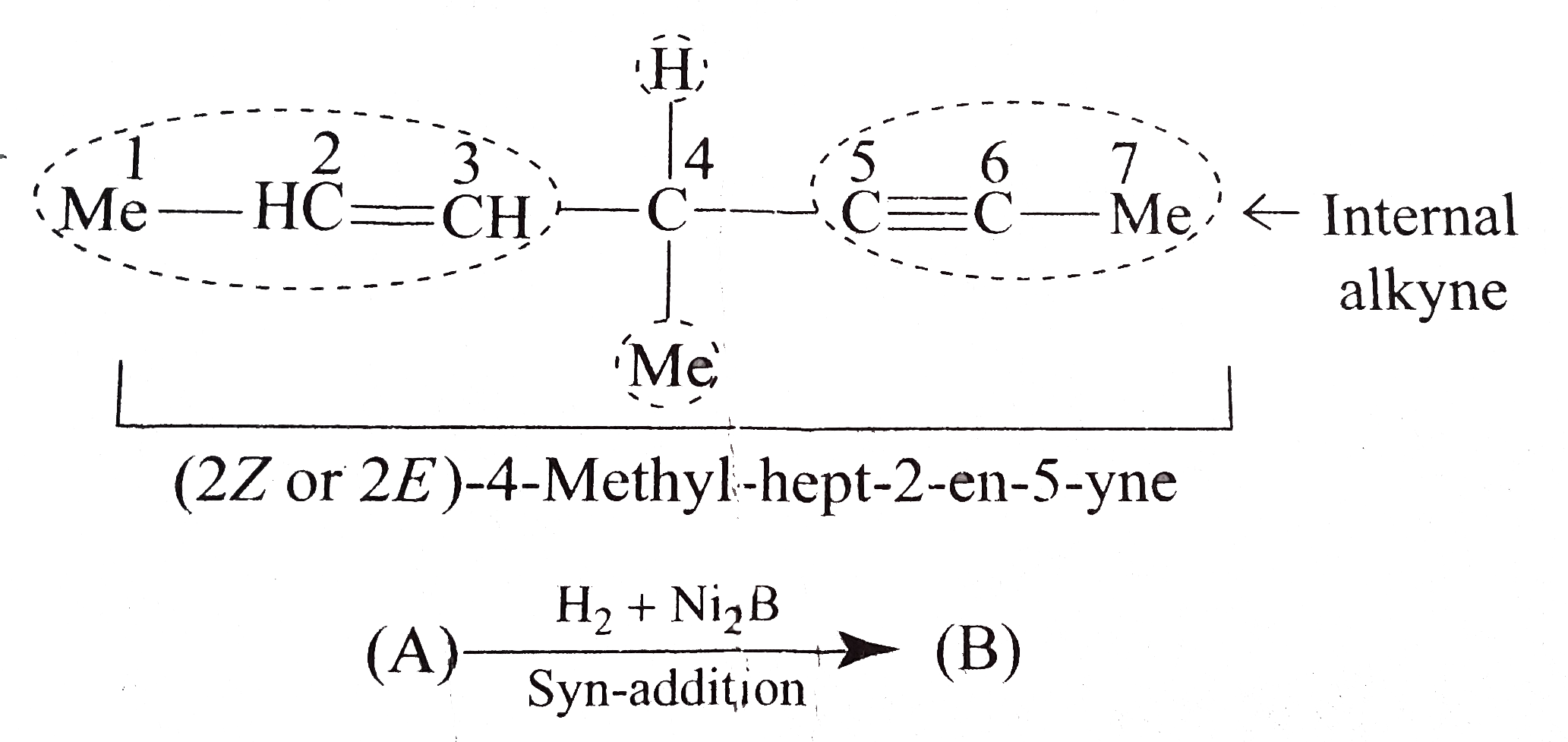
a. DU in (A)`=((2xx8+2)-12)/(2)=3^@`
DU in (B)`=((2xx8+2)-18)/(2)=0^@`
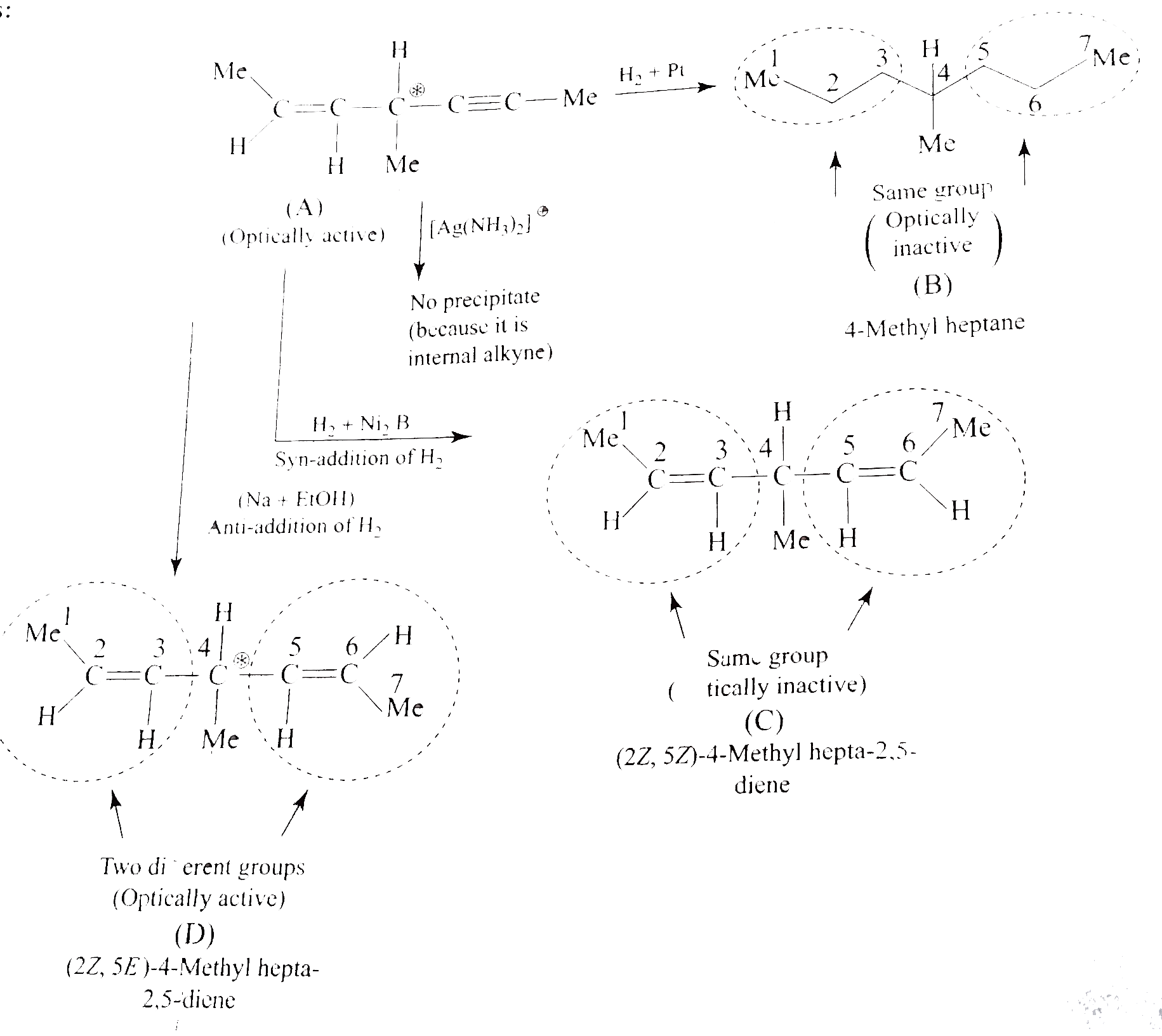
Reaction of (A) with `(H_2+Ni+B)` shows that it has `(-C-=C-)` bond, and it is internal alkyne because (A) does not react with `[Ag(NH_3)_2]^(o+)` (shows the absence of terminal alkyne).
Zero degree of unsaturation in (B) suggests that there is no ring in (A) or (B).
Therefore in (A), there is one `(C-=C)` bond (2 DU) and one `(C=C)` (1 DU).
(A) is optically active, containing one internal alkyne group, one `(C=C)` group, one H and one Me group, also, it is a compound with total eight C atoms.
Possibility of (A):


Therefore, (A) is `2Z-4`-Methylhept-2-en-5-yne.
Reactions:

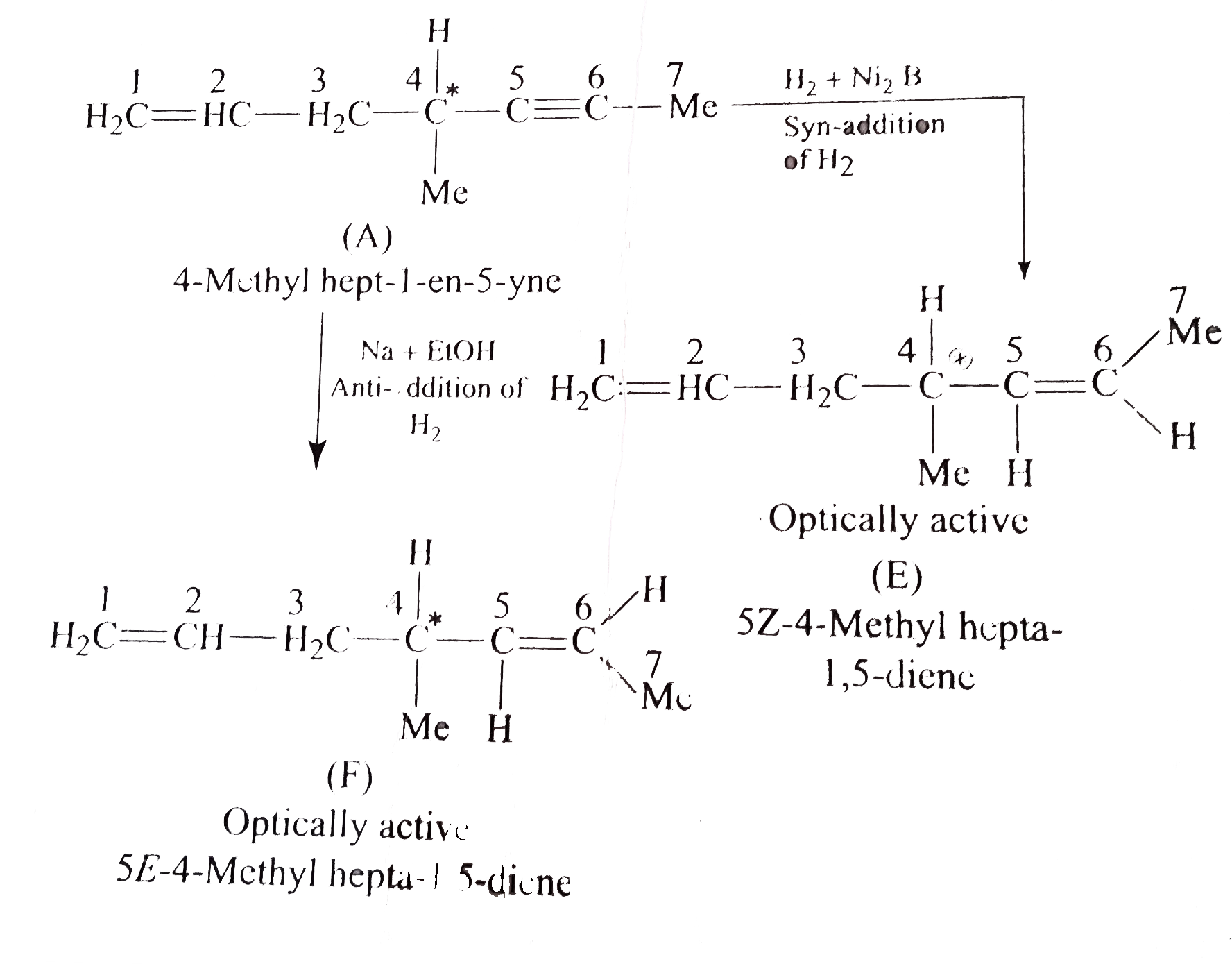
b. In order to get an optically active compound, regardless of the method of reducing `(C-=C)` bond (syn- or anti-addition, either by `Na+EtOH` or by `H_2+Ni_2B`), position of `(C=C)` should be the terminal one.
The possibility of A:
Promotional Banner

Topper's Solved these Questions

  • ALKYNES

    CENGAGE CHEMISTRY|Exercise Solved Examples|24 Videos
  • ALKYNES

    CENGAGE CHEMISTRY|Exercise Exercises (Subjective Type)|31 Videos
  • ALKENES AND ALKADIENES

    CENGAGE CHEMISTRY|Exercise Single correct Answer|14 Videos
  • APPENDIX - INORGANIC VOLUME 1

    CENGAGE CHEMISTRY|Exercise chapter-7 Single correct answer|1 Videos

Similar Questions

Explore conceptually related problems

Optically active isomer (A) of (C_(5)H_(9)Cl) on treatment with one mole of H_(2) gives an optically inactive compound (B) compound (A) will be :

Give the structure of an optically active alkene (A) having the lowest molecular mass, which on catalytic hydrogenation gives an optically inactive compound (B) .

Give the structure of an optically active alkyne (A) having the lowest molecular mass, which on hydrogenatio with Lindlar's catalyst and Birch reduction gives the same lowest molecular mass optically active alkene. Also explain why. ltbr. But alkyne (A) on hydrogenation with D2 , with Lindlar's catalyst, and reduction with Na+ liq. ND_(3)+EtOH gives a different optically active alkene. Explain.