Home
Class 12
CHEMISTRY
C(7)H(14) (A) decolourises Br(2) in CCI(...

`C_(7)H_(14)` (A) decolourises `Br_(2)` in `CCI_(4)` and reacts with `Hg(Oac)_(2)` in THF `H_(2)O` following by reduction with `NaBH_(4)` to produce a resolvable compounds (B). (A) undergoes reductive ozonolysis to give the same compound (C) obtained by oxidation of hexan-3-ol with `KMnO_(4)` . Identify (A), (B), and (C).

Text Solution

Verified by Experts
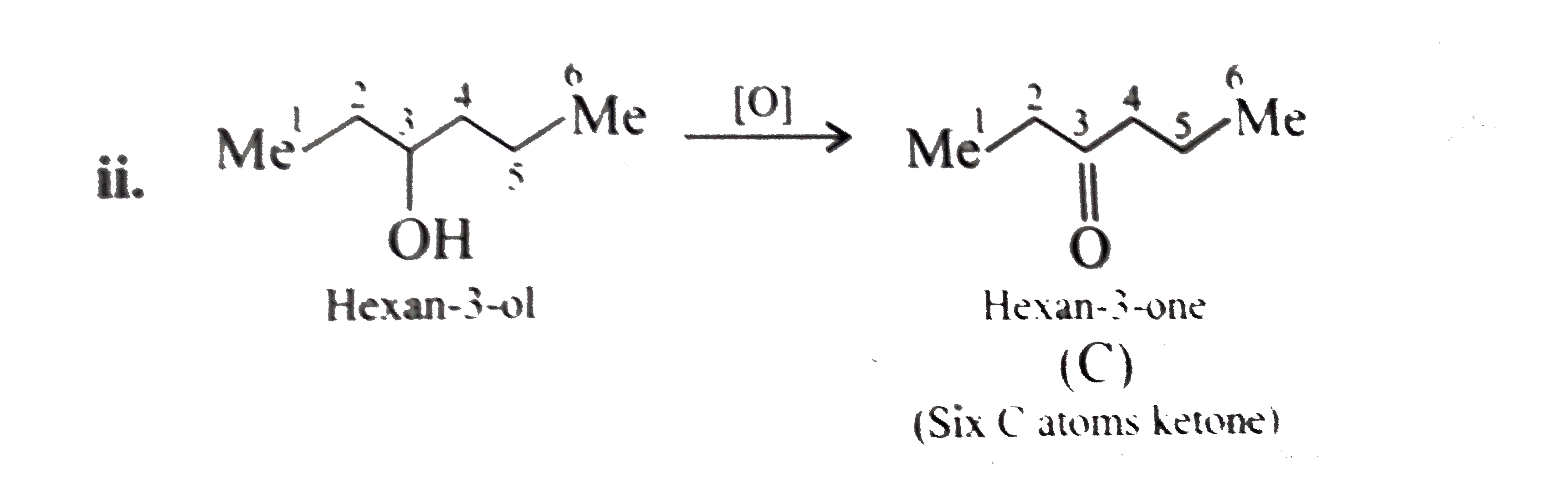
i. One DU in (A) and reaction with `Br_(2)//CCI_(4)` suggest `(C=C)` group in (A).
ii.
iii. The formation of (C) suggests that (A) has same skeleton as in (C) with `(CH_(2)=)` group replacing O.
Possible structure of A, B, and (C) are:
i.
ii.
iii.
Promotional Banner

Topper's Solved these Questions

  • ALCOHOL,PHENOL AND ETHERS

    CENGAGE CHEMISTRY|Exercise Exercises Concept Application|33 Videos
  • ALCOHOL,PHENOL AND ETHERS

    CENGAGE CHEMISTRY|Exercise Exercises Linked Comprehension|60 Videos
  • ALCOHOL,PHENOL AND ETHERS

    CENGAGE CHEMISTRY|Exercise Solved Examples|17 Videos
  • ALIPHATIC AND AROMATIC ALDEHYDES AND KETONES

    CENGAGE CHEMISTRY|Exercise Archives Subjective|29 Videos

Similar Questions

Explore conceptually related problems

An organic compound C_(4)H_(6) on reductive ozonolysis gives HCHO,CO_(2) and CH_(3)C=CH-CH=CH_(2) Find structure of compound.

C_(11)H_(16) (A) reacts with two equivalent of H_(2) and on reductive ozonolysis gives two equivalent formaldeyde and (B) of the following structure. Identify structure of (A).

Deduct the structural formul of a compound (A) (C_(10)H_(16)) the gives (B) as the only compound on oxidation with acidic KMnO_(4) .

Compound (A) C_(12)H_(20) discharges the colour of Br_(2)-H_(2)O and cold KMnO_(4) . On reduction with H_(2) /Pt it gives compound (B) C_(12)H_(22) . A on ozonolysis give cyclohexanone . Find structure of A :

(A) (C_(9)H_(12)O)underset(Hot KMnO_(4))overset([O])(rarr) PhCOOH i. (A) does not decolourise Br_(2) in C Cl_(4) , reacts with Na to give a colourless and odourless gas (B). ii. (A) does not give iodoform test. iii. (A) is a chiral compound and oxidation of (A) with CrO_(3)//Py gives a chiral compound (C ). iv. The colour of Cr_(2)O_(7)^(2-) change to blue-green when added to compound (A). The compound (C ) is:

(A) (C_(9)H_(12)O)underset(Hot KMnO_(4))overset([O])(rarr) PhCOOH i. (A) does not decolourise Br_(2) in C Cl_(4) , reacts with Na to give a colourless and odourless gas (B). ii. (A) does not give iodoform test. iii. (A) is a chiral compound and oxidation of (A) with CrO_(3)//Py gives a chiral compound (C ). iv. The colour of Cr_(2)O_(7)^(2-) change to blue-green when added to compound (A). The colourless and odourless gas (B) is:

(A) (C_(9)H_(12)O)underset(Hot KMnO_(4))overset([O])(rarr) PhCOOH i. (A) does not decolourise Br_(2) in C Cl_(4) , reacts with Na to give a colourless and odourless gas (B). ii. (A) does not give iodoform test. iii. (A) is a chiral compound and oxidation of (A) with CrO_(3)//Py gives a chiral compound (C ). iv. The colour of Cr_(2)O_(7)^(2-) change to blue-green when added to compound (A). The structure of compound (A) is:

CENGAGE CHEMISTRY-ALCOHOL,PHENOL AND ETHERS-Exercises Subjective
  1. Identify A, B, and C, i. Isomeric alcohols (A), (B), and (C) (C(5)H...

    Text Solution

    |

  2. Identify (A)

    Text Solution

    |

  3. C(7)H(14) (A) decolourises Br(2) in CCI(4) and reacts with Hg(Oac)(2) ...

    Text Solution

    |

  4. Compound (D), an isomer of (A) in Problem 4, reacts with BH(3). THF an...

    Text Solution

    |

  5. Compound (A), C(8)H(6)NOBr, is optically active. Reduction of (A) give...

    Text Solution

    |

  6. Identify A to E.

    Text Solution

    |

  7. An organic compound (A) (C(8)H(8)O(3)) was insoluble in water, dilute ...

    Text Solution

    |

  8. Neutralisation of 30 gm of a mixture of acetic acid and phenol solutio...

    Text Solution

    |

  9. Find the structure of (A), C(10)H(10)O(2), a sweet-smelling liquid tha...

    Text Solution

    |

  10. a. Isomers (A) and (B), C(10)H(12)O, are isolated form the oil of bay...

    Text Solution

    |

  11. An aromatic compound (A), C(7)H(5)NO(2)CI(2) on reduction with Sn//HCI...

    Text Solution

    |

  12. An organic compound (A) gives opsitive Liebermann reaction and on trea...

    Text Solution

    |

  13. Two isomeric compounds, (A) and (B), have the same formula, C(11)H(13)...

    Text Solution

    |

  14. Nitrobezene is formed as the major product along with a minor product ...

    Text Solution

    |

  15. Identify A, B, and C, in the following reaction.

    Text Solution

    |

  16. Provide a mechanism for the products (A) and (B). Which one will be th...

    Text Solution

    |

  17. Identify the substances (A) through (D) in a sequence. Comment on...

    Text Solution

    |

  18. Identify each of the following glucose derivative. a. A+5HIO(4)rarr...

    Text Solution

    |

  19. If is treated with alkaline NaN(3) and followed by reduction with H(2...

    Text Solution

    |

  20. Converst

    Text Solution

    |