Home
Class 12
CHEMISTRY
Explain the following : (a) The (C-Cl)...

Explain the following :
(a) The `(C-Cl)` bond length in `CH_3 COCl` is nearly same as in `CH_3 CH_2 Cl` but longer than that in `Ch_2 = CH - Cl`.
(b) Account for the observed `(C-G)` bond lengths in `nm` :
`|{:(G,NH_(2),OCH_(3),F,CI),(CH_(3)-G,0.147,0.141,0.138,0.178),(CH_(3)-overset(O)overset(||)(C)-G,0.138,0.136,0.137,0.179):}|`
(c ) Why is `(C-O)` bond length shorter in ester than in anhydride ?
(d) Why have esters lower boiling points than ketones and acids of comparable molecular masses ?
( e) The boiling points of the following amides in the decreasing order are :
`MeCONH_2 (I) gt MeCONHMe (II) gt MeCONMe_2 (III)`.
(f) Why is `DMF` (dimethyl formamide) a useful solvent ?
(g) Why is formyl chloride unstable ?

Text Solution

Verified by Experts
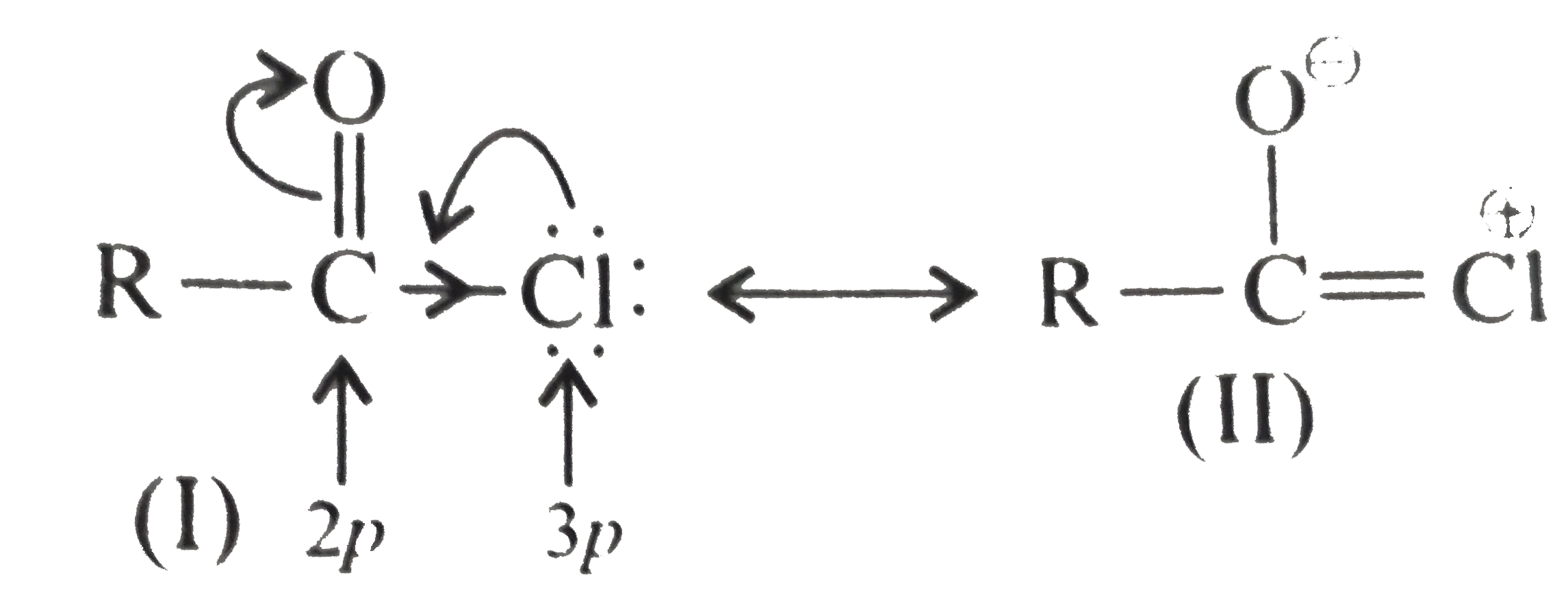
(a) Nearly te same `(C-Cl)` bond length in `(R-overset(O)overset(||)(C)-CI)` and `(R-Cl)` suggests that the extent of delocalisation by `Cl` in `(R-overset(O)overset(||)(C)-CI)` is very small or non-existent `[(-I)` and `(+R)` effects of `Cl, (+R)` effect or `pi-bond` overlap is not effective because of `2p` of `C` and `3p` of `Cl` overlap]. So, the contribution of resonance hybrid structure `(II)` is very small or non-existent.

(b) The relative importance of delocalisation decreases in the order `RCONH_2 gt RCOOR' gt RCOX`. as the `EN` (electronegativity) of `G` increases in the same period (i.e., `(-I)` effect increase, from `N gt O gt X`.
The `(C-Cl)` bond is longer than the `(C-F)` bond, although `EN` of `F` is greater than `Cl`. However, `(+R)` effect is not effective in `(C-Cl)` but effective in `(C-F)` because of the effective overlap of `2p` of `C` with `2p` of `F`.
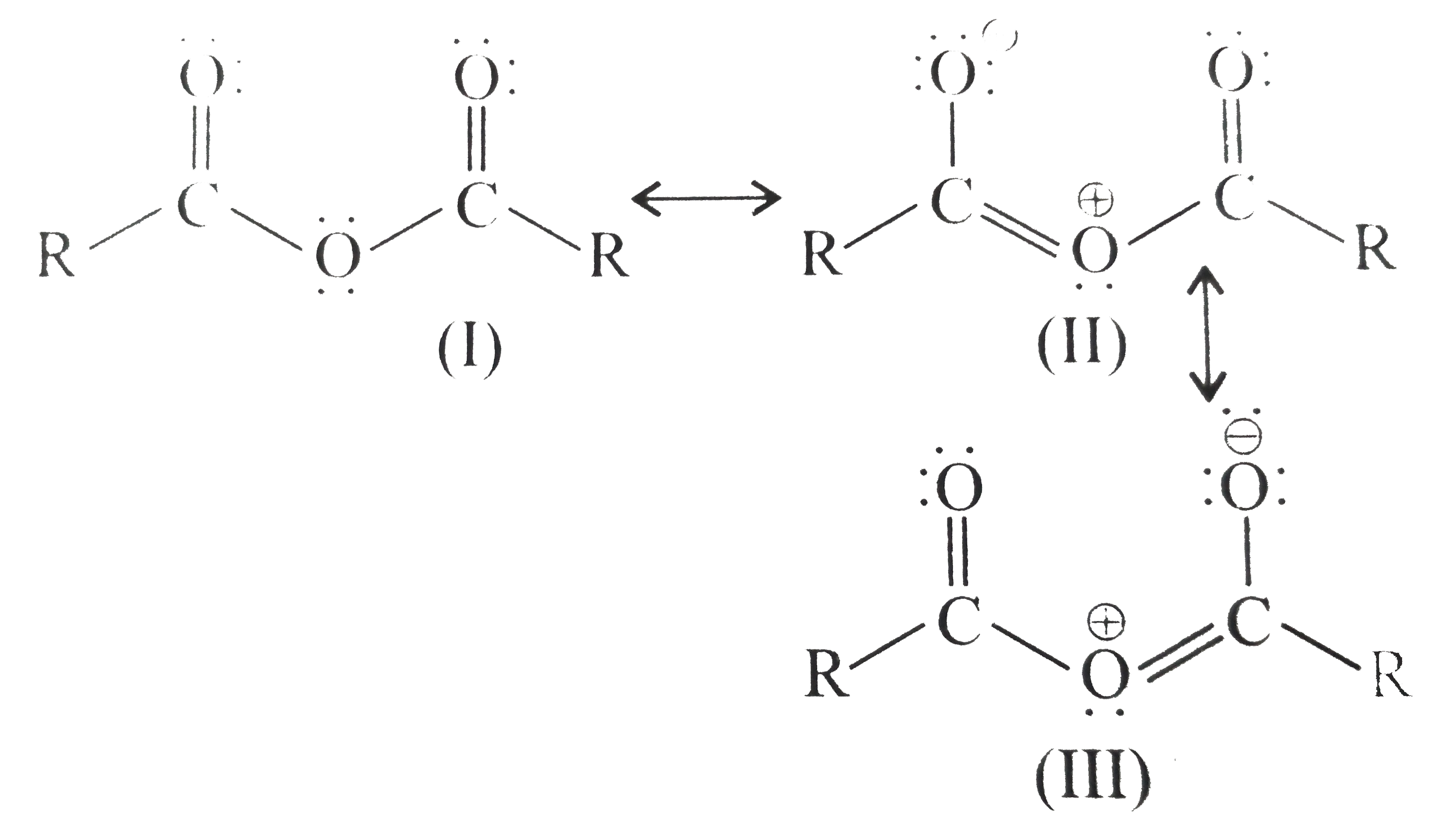
( c) Resonance structure of anhydride.

Cross conjugation in the resonance structures of anhydride decreases the delocalisation of each `O` of `(C=O)` group and gives `(C-O) sigma-bond` less double-bond characte. Thus, the `(C-O)` bond length is longer in anhydrides than in esters.
(d) Resonance structure of esters :

Due to delocalisation of `overline e^, s` in esters, the positive charge on `C` of the `(C=O)` group is more spread out. This results in a smaller dipole moment and weater dipole-dipole attraction in esters than in ketones. So, esters have low boiling in ester points than ketones.
Acids have strong intermolecular `H-`bonding, while esters do not have. So the boiling points of esters are lower than those of acids.
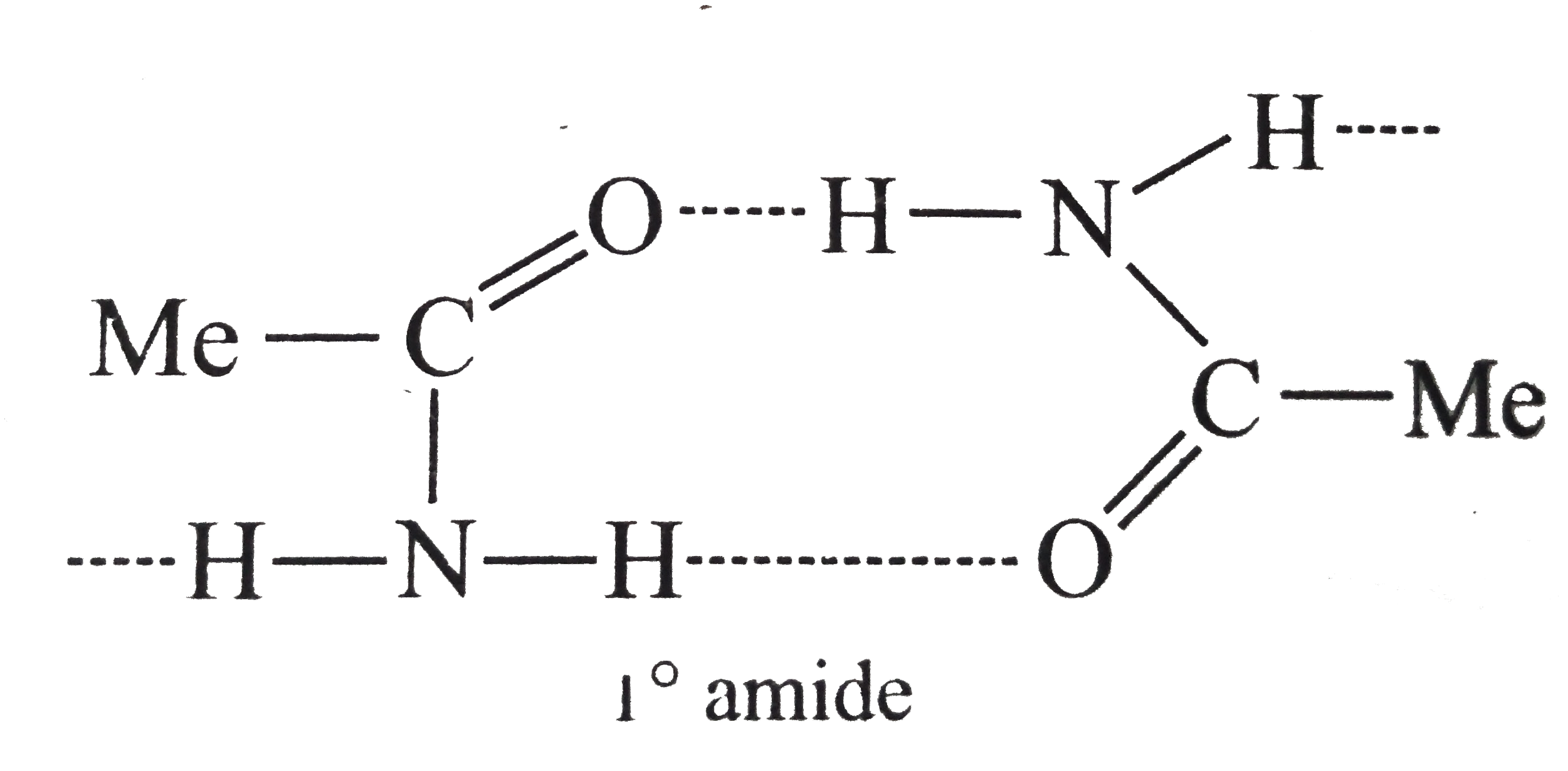
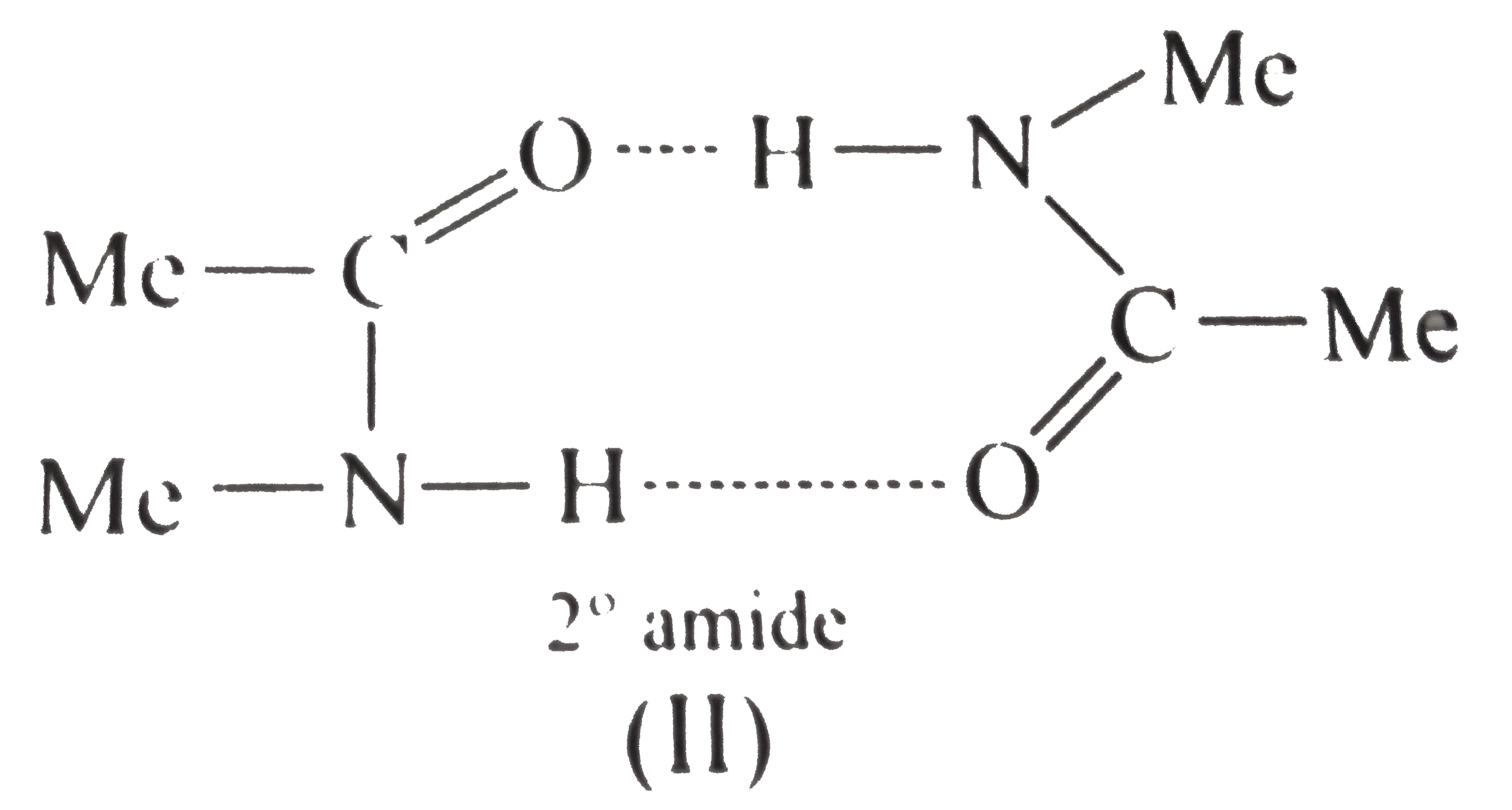
( e) `1^@` and `2^@` amides exist as dimer in the solid and pure liquid state through intermolecular `H-`bonding. `1^@` amides have two `H` atoms. While `2^@` amides have one `H` atom. So intermolecular `H-`bonding is more in `1^@` amide than in `2^@` amides. `3^@` amdies lack `H` atoms and thus do not have `H-`bonding.
So, the boinling points of `1^@ amide (I) gt 2^@ amide (II) gt 3^@ amide (III)`.

(f) `DMF, (H-overset(O)overset(||)(C)-underset(Me)underset(|)(N)-Me)` , is an aprotic solvent, i.e., it has no `H` atom for `H-bonding` and has a high dipole moment. So `DMF` does not form `H-bonds` with anions although it dissolves many ionic compounds. The salts are dissolved through solvation of the cation by the attraction towards the end of the `(C-O)` dipole. The positive end of the dipole shielded within the molecule and solvates anion very weakly.

(g) `(H-overset(O)overset(||)(C)-CIoverset(Delta)rarr C-=O +HX)`
The decomposition reaction is favoured since the `Delta H_(f)^(@)` of `CO` is high (more negative) which indicates the stability of `(C -= O)` bond. Formyl chloride is unstable above `213 K(-60^@ C)`.
Promotional Banner

Topper's Solved these Questions

  • CARBOXYLIC ACIDS AND THEIR DERIVATIVES

    CENGAGE CHEMISTRY|Exercise Solved Examples|17 Videos
  • CARBOXYLIC ACIDS AND THEIR DERIVATIVES

    CENGAGE CHEMISTRY|Exercise Exercises (Subjective)|19 Videos
  • BIOMOLECULES, POLYMERS AND CHEMISTRY IN EVERYDAY LIFE

    CENGAGE CHEMISTRY|Exercise QUESTION BANK|8 Videos
  • CHEMICAL KINETICS

    CENGAGE CHEMISTRY|Exercise Archives Subjective|23 Videos

Similar Questions

Explore conceptually related problems

CH_(3)OCH_(2)CH_(2)overset(OH)overset(|)(CH)CH_(2 )Cl

CH_(3)-overset(Cl)overset(|)(CH)-overset(O)overset(||)(C)-CH_(3)

CH_(3)-CH_(2)-CH_(2)-O-CH_(3) and CH_(3)-overset(CH_(3))overset(|)(C )H-O-CH_(3) are

CH_(3)CH_(2)CH_(2)-overset(O)overset(||)(C)-H+CH_(3)-C-=CH overset(Na,NH_(3)(l))to

(A) The dipole moment of CH_(3)F is greater than CH_(3)CI . (R) C-F bond is more polar than C-CI bond.

(CH_(3))_(2)overset(Cl)overset(|)C-CH_(2)CH_(3)overset("aic" XOH)rarr ?

Which of the following have larger C-O bond length than C-O bond length of CH_(3)-overset(O)overset(||)C-CH_(3) ?

For the compounds, CH_(3)Cl, CH_(3)I, CH_(3)Br and which of the following is the correct order of C-halogen bond length?

CENGAGE CHEMISTRY-CARBOXYLIC ACIDS AND THEIR DERIVATIVES-Exercises Archives (Analytical And Descriptive)
  1. Explain the following : (a) The (C-Cl) bond length in CH3 COCl is ne...

    Text Solution

    |

  2. Write the chemical eqution to show what happens when 'Ethyl acetate is...

    Text Solution

    |

  3. State with balanced equation what happens when 'Acetic anhydride react...

    Text Solution

    |

  4. Give reasons for the following in one or two sentences. 'Acetic acid...

    Text Solution

    |

  5. Write down the reactions involved in the preparation of the following ...

    Text Solution

    |

  6. A certain hydrocarbon (A) was found to contain 85.7 % carbon and 14.3 ...

    Text Solution

    |

  7. Give reason in one or two sentences for the following : 'Formic acid i...

    Text Solution

    |

  8. Arrange the following in order of their increasing ease of hydrolysis ...

    Text Solution

    |

  9. Complete the following with appropriate structures : (CH(3) CO)(2) O...

    Text Solution

    |

  10. A liquid (X) having a molecular formula C(6) H(12) O(2) is hydrolysed ...

    Text Solution

    |

  11. Write the balanced equations for the following reaction : 'Acetamide...

    Text Solution

    |

  12. An organic compound (A) on treatment with acetic acid in the presence ...

    Text Solution

    |

  13. Give reasons for the following : 'Carbon-oxygen bond lengths in form...

    Text Solution

    |

  14. How will you bring about the following conversion ? 'Ethanoic acid t...

    Text Solution

    |

  15. The sodium salt of a carboxylic acid (A) was produced by passing a gas...

    Text Solution

    |

  16. In the following, identify the compounds/reaction conditions represent...

    Text Solution

    |

  17. Arrange the following as stated : 'Increasing order of acidic streng...

    Text Solution

    |

  18. In the following identify the compounds/reaction conditions represente...

    Text Solution

    |

  19. Complete the following sequence of the reactions with approprite struc...

    Text Solution

    |

  20. Identify the major product in the following reactions : (i) (ii) ...

    Text Solution

    |

  21. In the following reactions, identify the compounds A, B, C and D. (i...

    Text Solution

    |