Home
Class 12
CHEMISTRY
Three isomeric tetracarboxylic acids (I)...

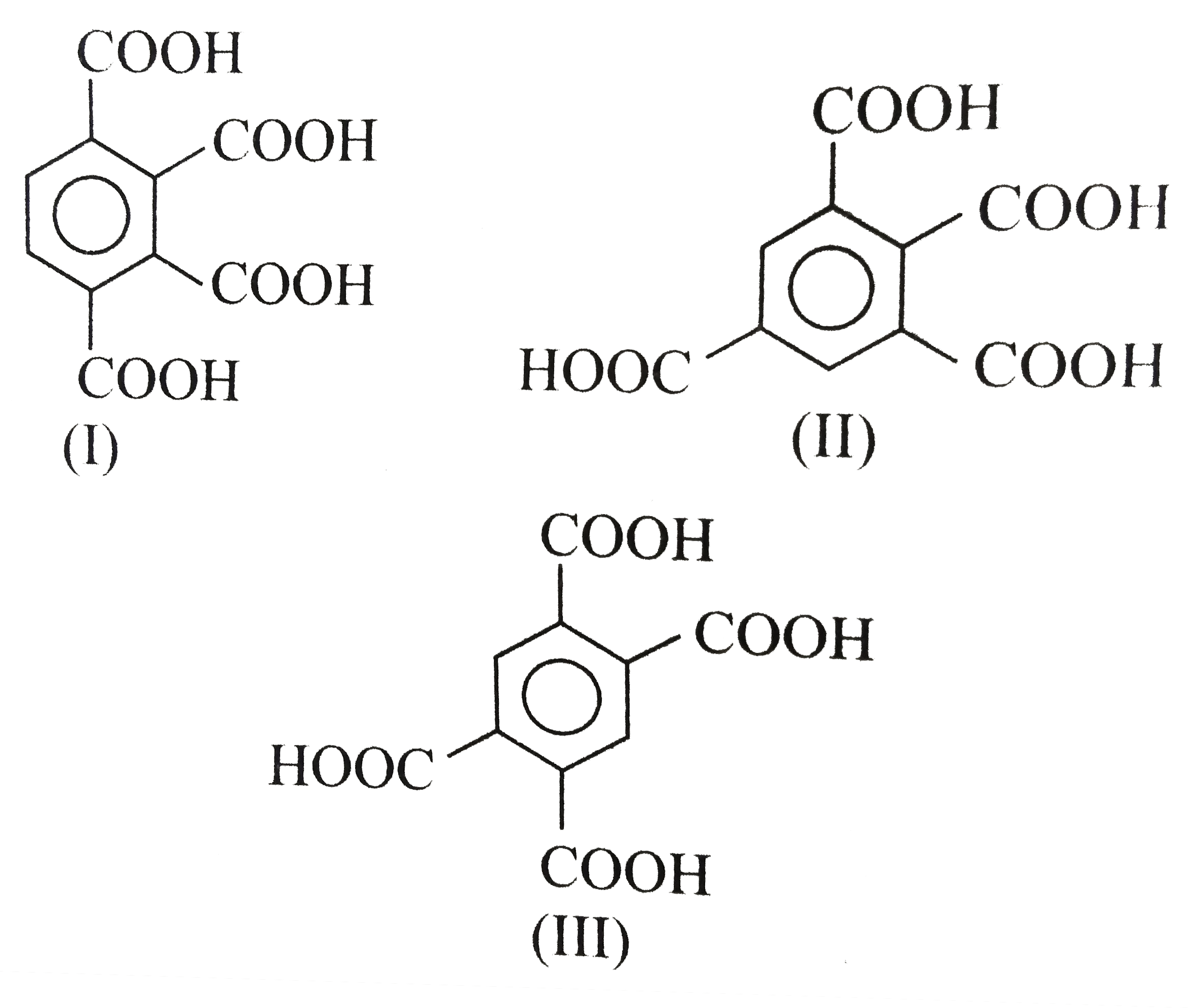
Three isomeric tetracarboxylic acids `(I),(II)`, and `(III)` are given.

They can be distinguised by anhydride formation by treating with one equivalent and two equivalents of `SOCl_2`.
Which tetracarboxylic acid on reaction with one equivalent of `SOCl_2` gives two isomeric monoanhydrides ?

A

`(I)`

B

`(II)`

C

`(III)`

D

All

Text Solution

Verified by Experts

The correct Answer is:
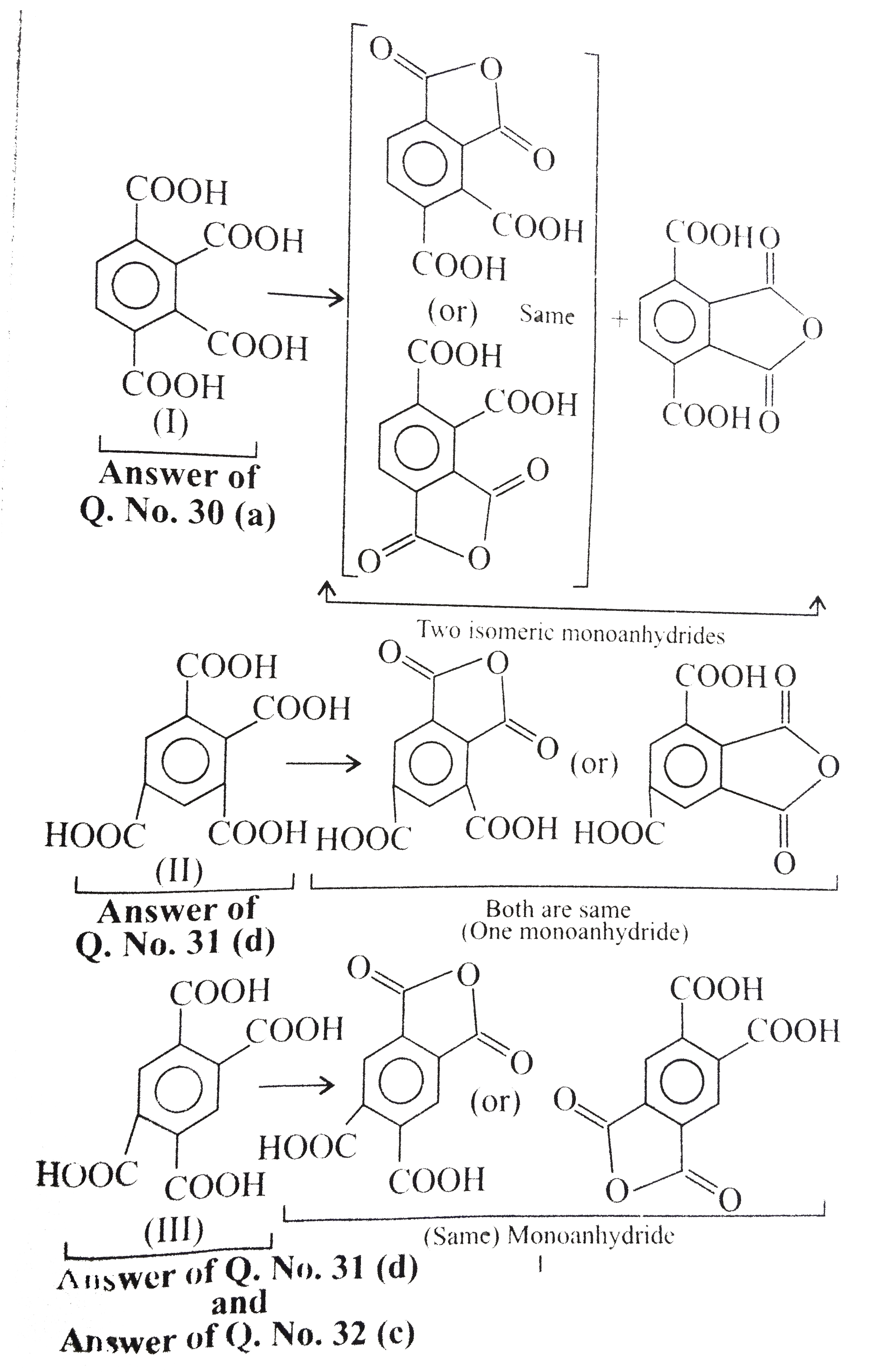
A

(a) .
Promotional Banner

Topper's Solved these Questions

  • CARBOXYLIC ACIDS AND THEIR DERIVATIVES

    CENGAGE CHEMISTRY|Exercise Exercises (Multiple Correct)|35 Videos
  • CARBOXYLIC ACIDS AND THEIR DERIVATIVES

    CENGAGE CHEMISTRY|Exercise Exercises (Singlecorrect)|64 Videos
  • CARBOXYLIC ACIDS AND THEIR DERIVATIVES

    CENGAGE CHEMISTRY|Exercise Exercises (Subjective)|19 Videos
  • BIOMOLECULES, POLYMERS AND CHEMISTRY IN EVERYDAY LIFE

    CENGAGE CHEMISTRY|Exercise QUESTION BANK|8 Videos
  • CHEMICAL KINETICS

    CENGAGE CHEMISTRY|Exercise Archives Subjective|23 Videos

Similar Questions

Explore conceptually related problems

Three isomeric tetracarboxylic acids (I),(II) , and (III) are given. They can be distinguised by anhydride formation by treating with one equivalent and two equivalents of SOCl_2 . Which tetracarboxylic acid on reaction with one equivalent of SOCl_2 gives only one monoaanhydride ?

Three isomeric tetracarboxylic acids (I),(II) , and (III) are given. They can be distinguised by anhydride formation by treating with one equivalent and two equivalents of SOCl_2 . Which tetracarboxylic acid on reaction with second equivalent of SOCl_2 to the monoanhydride of (I), (II) , and (III) gives a dianhydride ?

The reaction of one equivalent of HBr with CH_(2)=CH-C-=CH gives

An n-p-n transistor can be considered to be equivalent to two diodes, connected. Which of the following figures is the correct one ?

Amides undergo hydrolysis to yield carboxylic acid plus amine on heating in either aqueous acid or aqueous base. The conditions required for amide hydrolysis are more severe than those required for the hydrolysis of esters, anhydrides or acid chlorides, but the mechanism is similar (nucleophilic acyl substitution). Nucleophilic acyl substitutions involve a tetrahedral intermediate, hence these are quite different from alkyl substitution (RCH_(2)Broverset(NaCN)to RCH_(2)CN) which involves a pentavalent intermediate or transition state. One of the important reactions of esters is their reaction with two equivalent of Grignard reagent to give tertiary alcohols. When is treated with two equivalent of methyl magnesium iodide and the product acidified the final product will be

Two solutions X and Y have pH=4 and pH=8, respectively. Which solution will give alkaline reaction and which one acidic?

CENGAGE CHEMISTRY-CARBOXYLIC ACIDS AND THEIR DERIVATIVES-Exercises (Linked Comprehension)
  1. Four isomeric optically active compounds overset (NaHCO3) rarr CO2 (g)...

    Text Solution

    |

  2. (i) Carboxylic acid (ii) Compound (D) is prepard by carbonation(Mg/...

    Text Solution

    |

  3. (i) Carboxylic acid (ii) Compound (D) is prepard by carbonation(Mg/...

    Text Solution

    |

  4. (i) Carboxylic acid (ii) Compound (D) is prepard by carbonation(Mg/...

    Text Solution

    |

  5. (i) Carboxylic acid (ii) Compound (D) is prepard by carbonation(Mg/...

    Text Solution

    |

  6. Compound (B) is :

    Text Solution

    |

  7. Compound ( C) is :

    Text Solution

    |

  8. Compound ( E) is :

    Text Solution

    |

  9. Compound (F) is :

    Text Solution

    |

  10. Compound (F) is used as an artificial sweetner and is known as sacchar...

    Text Solution

    |

  11. Compound (B) is :

    Text Solution

    |

  12. In the formation of ( C) from (A) and (B), which statements (s) is //a...

    Text Solution

    |

  13. Which statement (s) is //are correct about the formation of (D) ?

    Text Solution

    |

  14. Which statements is//are correct about the formation of ( E) from (D) ...

    Text Solution

    |

  15. Product ( E) is :

    Text Solution

    |

  16. Three isomeric tetracarboxylic acids (I),(II), and (III) are given. ...

    Text Solution

    |

  17. Three isomeric tetracarboxylic acids (I),(II), and (III) are given. ...

    Text Solution

    |

  18. Three isomeric tetracarboxylic acids (I),(II), and (III) are given. ...

    Text Solution

    |

  19. Four rearrangement reactions are given : Which statement (s) is/...

    Text Solution

    |

  20. Four rearrangement reactions are given : Which statement (s) is/...

    Text Solution

    |

