Home
Class 12
CHEMISTRY
3-Phenol propanic acid (B) can be prepar...

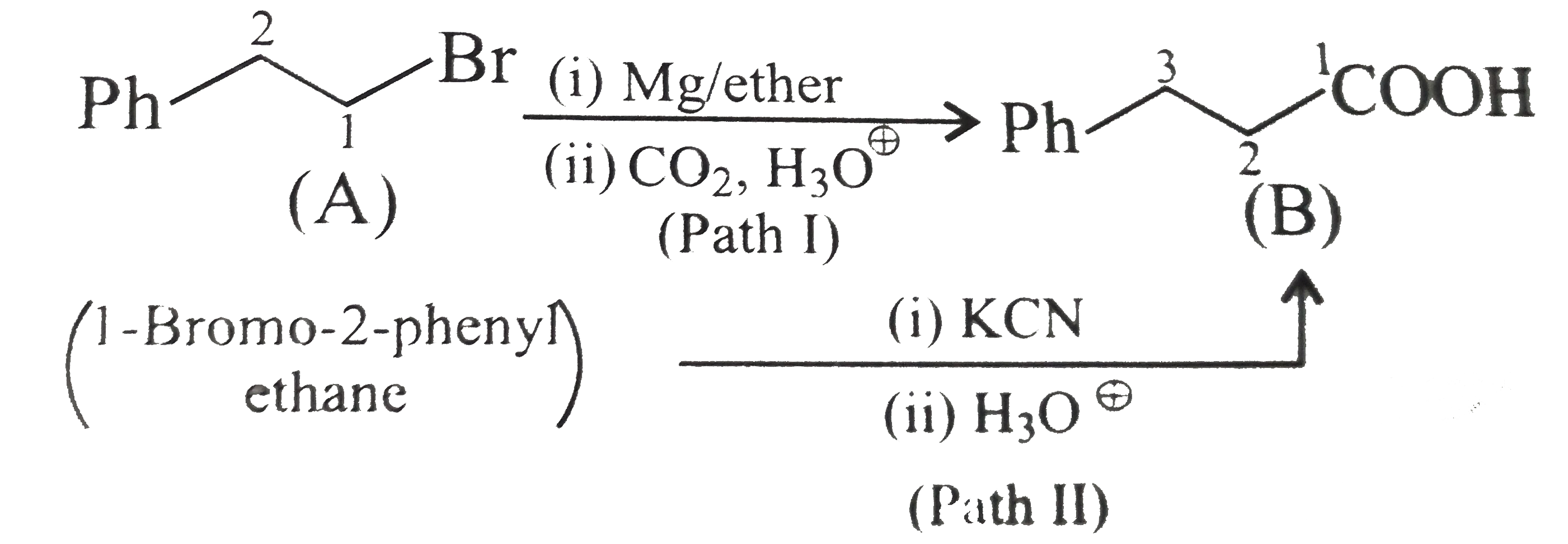
`3-Phenol` propanic acid `(B)` can be prepared by both nitrile and carbonation method as shown.

Path `I` gives a good yield of `(B)`.
`overset (Ө) C N` initiates elimination reaction.

A

If both `(A)` are `( R)` are true and `( R)` is the correct explanation of `(A)`.

B

If both `(A)` and `( R)` are true but `( R)` is not the correct explanation of `(A)`.

C

If `(A)` is true but `( R)` is false.

D

If `(A)` is false but `( R)` is true.

Text Solution

Verified by Experts

The correct Answer is:

A

Since `3-phenol` propanoic acid is `1^@ RX`, preparation by both methods can occur.
Promotional Banner

Topper's Solved these Questions

  • CARBOXYLIC ACIDS AND THEIR DERIVATIVES

    CENGAGE CHEMISTRY|Exercise Exercises Archives (Single Correct)|10 Videos
  • CARBOXYLIC ACIDS AND THEIR DERIVATIVES

    CENGAGE CHEMISTRY|Exercise Exercises Archives (Assertion-Reasoning)|2 Videos
  • CARBOXYLIC ACIDS AND THEIR DERIVATIVES

    CENGAGE CHEMISTRY|Exercise Exercises (Singlecorrect)|64 Videos
  • BIOMOLECULES, POLYMERS AND CHEMISTRY IN EVERYDAY LIFE

    CENGAGE CHEMISTRY|Exercise QUESTION BANK|8 Videos
  • CHEMICAL KINETICS

    CENGAGE CHEMISTRY|Exercise Archives Subjective|23 Videos

Similar Questions

Explore conceptually related problems

Succinic acid (B) can be prepared by both nitrile and carbonation method as shown. Both paths give good yields of (B) . (A) with Mg would lead to the loss of vicinal Br atoms to give alkene and MgBr_2 .

(a) Give the compounds from which isobutanoic acid (A) (Me_2 CHCOOH) can be prepared in a better way also describe the method. (b) Convert 1-chlorobutane (A) to valeric acid (B) . ( c) Convert benzene to adipic acid. (d) Complete the following reactions. (i) (ii) .

An alkane A on ozobolysis yields acetone and an aldeyde. The aldehyde is easily oxidised to an acid B. When B is treated with bromine in presence of yields a compound C which on hydrolysis gives a hydroxyle acid D. This acid can also be obatined from acetone by the reaction with hydrogen cyanide followed by hydrolysis. Identify the compounds A, B C and D.

Read the passage given below and answer the following questions: Aldehydes, ketones and carboxylic acids are few of the major classes of organic compounds containing carbonyl group. Aldehydes are prepared by dehydrogenation or controlled oxidation of primary alcohols and controlled or selective reduction of acyl halides. Ketones are prepared by oxidation of secondary alcohols and hydration of alkynes. Carboxylic acids are prepared by the oxidation of primary alcohols, aldehydes and alkenes by hydrolysis of nitriles and by treatment of Grignard reagents with carbon dioxide. Name the main compounds A and B formed in the following reaction: CH_3CN underset((ii) H_2O^(+) ) overset( (i) CH_3MgBr) to A overset( Zn( Hg) //conc. HCl) to B

Read the passage given below and answer the following questions: Aldehydes, ketones and carboxylic acids are few of the major classes of organic compounds containing carbonyl group. Aldehydes are prepared by dehydrogenation or controlled oxidation of primary alcohols and controlled or selective reduction of acyl halides. Ketones are prepared by oxidation of secondary alcohols and hydration of alkynes. Carboxylic acids are prepared by the oxidation of primary alcohols, aldehydes and alkenes by hydrolysis of nitriles and by treatment of Grignard reagents with carbon dioxide. Name a method by which both aldehydes and ketones can be prepared.

Alcohols are converted to tosylates by treatment with p-toluence sulfonyl chloride (TsCl) in the presence of pyridine. This overall process converts a poor leaving group (overset(Ө)H) into good one (overset(Ө)Ts) . A tosylate is a good leaving group its conjugates acid p-touence sulfonic acid is strong acid. Beacuse alkyl tosylates have food leaving groups, they undergo both nucleophilic substitution and beta-"elimination" . Find the major product of the following reaction:

Alcohols are converted to tosylates by treatment with p-toluence sulfonyl chloride (TsCl) in the presence of pyridine. This overall process converts a poor leaving group (overset(Ө)H) into good one (overset(Ө)Ts) . A tosylate is a good leaving group its conjugates acid p-touence sulfonic acid is strong acid. Beacuse alkyl tosylates have food leaving groups, they undergo both nucleophilic substitution and beta-"elimination" . What would be the major product of the following reactions?

Alcohols are converted to tosylates by treatment with p-toluence sulfonyl chloride (TsCl) in the presence of pyridine. This overall process converts a poor leaving group (overset(Ө)H) into good one (overset(Ө)Ts) . A tosylate is a good leaving group its conjugates acid p-touence sulfonic acid is strong acid. Beacuse alkyl tosylates have food leaving groups, they undergo both nucleophilic substitution and beta-"elimination" . Idetify the final product of the following sequences of reactions:

Explain the effect of SN^2 rates for the following reactions : (a) Increasing the polarity of solvent. (b) Show the T.S with all partial charges for each reaction type. (I) Me_2 overset (oplus) S - Me + NH_3 rarr Me overset (oplus)N H_3 + Me_2 S (II) Me I + NH_3 rarr Me overset (oplus)N H_3 + I^(Ө) (III) Me I + overset (Ө) O H rarr Me OH + I^(Ө) (IV) Me_2 S^(oplus) - Me + overset (Ө) OH rarr Me OH + Me_2 S .
