Home
Class 12
CHEMISTRY
a. Write the structure of histidine when...

a. Write the structure of histidine when `pHlt1.82 and pHgt1.82.`
b. What is the `pH` range of neutral `A A` at the isoelectric point?
c. The `pH` range in cellular fluid is `6` to `7`. In what form (dipolar,cation, or anion) do the amino acids in each class predomiate in the cell?

Text Solution

Verified by Experts
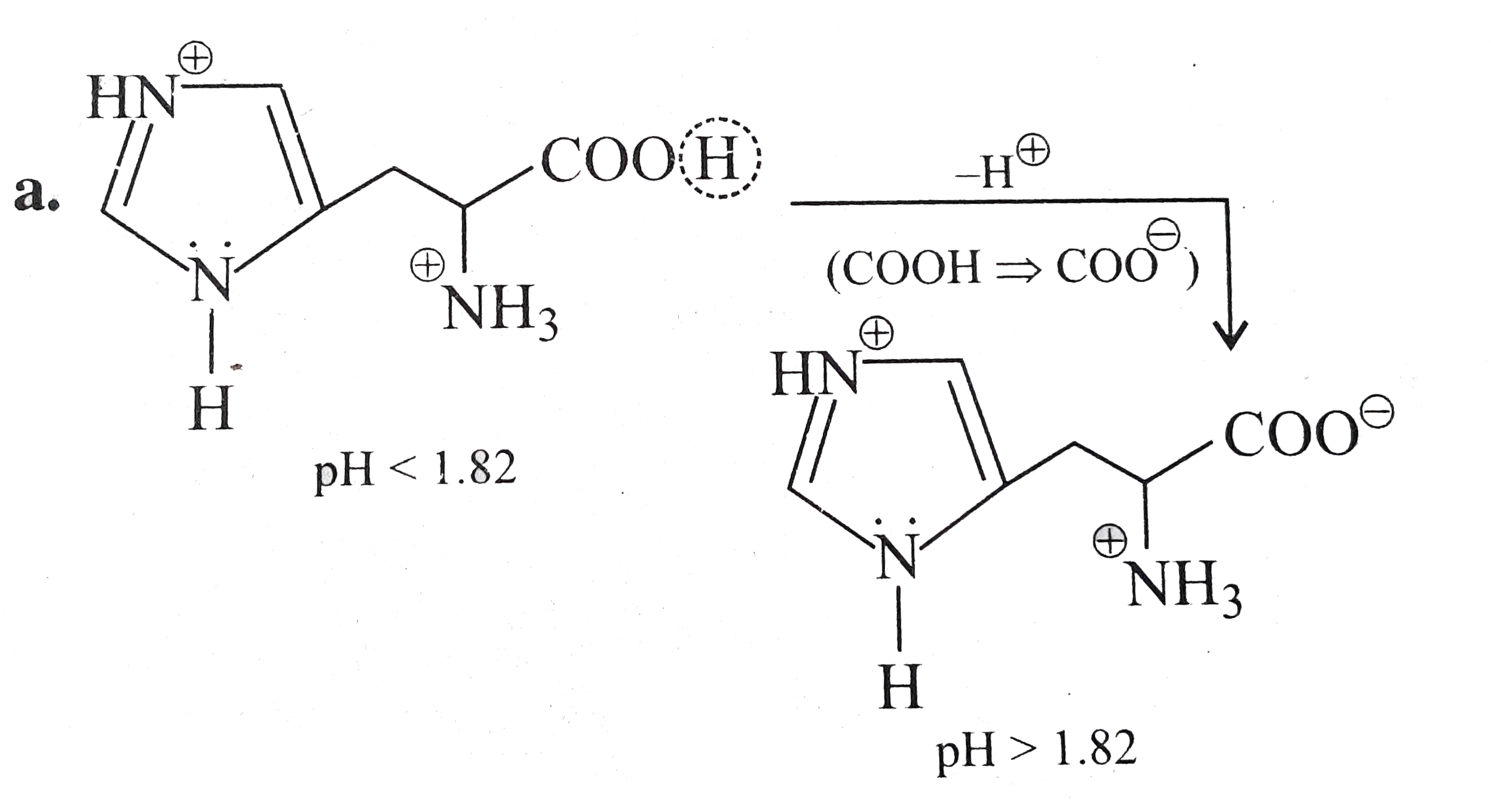
a.
b. All those amino acids with neutral `(R )` groups (e.g., hydrocarbon, alcohol, and amide) have `pl` in the same range `5.5-6.3.`
c. The amino acids are in the dipolar form because the cellular `pH` is very close to their `pI's`.
i. `pl` for acidic `A A's` are in the acidic range `(pH=6-7)`. they act as acids and exist mainly as anions.
ii. `pI` for basic A A's are in the basic range `(pH=6.7)`. they accept `H^(o+)` in the cell and exist mainly as cations.
iii. `pI` for very weakly acidic `A A'a` e.g., cysteine (with its `SH`) and tyrosine (with its phenolic `OH`), are in the acidic range `(pH=5-6)`. they are classified with neutral `A A's`
Promotional Banner

Topper's Solved these Questions

  • BIOMOLECULES

    CENGAGE CHEMISTRY|Exercise Exercises (Concept Application)|25 Videos
  • BIOMOLECULES

    CENGAGE CHEMISTRY|Exercise Exercises (Linked Comprehension)|38 Videos
  • BIOMOLECULES

    CENGAGE CHEMISTRY|Exercise Exercises Archives (Analytical And Descriptive)|8 Videos
  • AROMATIC COMPOUNDS AND ALKYL AND ARYL HALIDES

    CENGAGE CHEMISTRY|Exercise Archives Subjective|18 Videos
  • BIOMOLECULES, POLYMERS AND CHEMISTRY IN EVERYDAY LIFE

    CENGAGE CHEMISTRY|Exercise QUESTION BANK|8 Videos

Similar Questions

Explore conceptually related problems

During neutralisation of an acid by a base, the end point refers for the completion of reaction. The detection of end point in acid -base neutralisation is usually made by an acid-base indicator. An acid-base indicator is itself a weak acid (Phenolphthlein) or a weak base (Mrthyl orange). At about 50% ionisation which depends on the medium, the anion furnished by an indicator (acid) or cation furnished by indicator (basic) imparts its characteristic colour to solution at point. For example phenolphthalein, the dissociation is underset("Colourless")(H In hArr H^(+))+underset("Pink")(In^(-)), K_(H In)= ([H^(+)][In^(-)])/([H In]) favoured in presence of alkali and pink colour of phenolphalein ion is noticed as soon as the medium changes to alkaline nature. The end point of acid-base neutralisation not necessarily coincides with equivalent point but it is closer and closer to equivalence point. Also at equivalence point of acid-base neutralisation pH is not necessarliy equal to 7. The dissociation constant of an acid-base indicator which furnished coloured anion is 1xx10^(-5) . The pH of solution at which indicator is 80% in dissociated form is:

Early crystallographers had trouble solving the structures of inorganic solids using X-ray diffraction because some of the mathematical tools for analyzing the data had not yet been developed. Once a trial structure was proposed, it was relatively easy to calculate the diffraction pattern, but it was difficult to go the other way (from the diffraction pattern to the structure) if nothing was known a priori about the arrangement of atoms in the unit cell. It was important to develop some guidelines for guessing the coordination numbers and bonding geometries of atoms in crystals. The first such rules were proposed by Linus Pauling, who considered how one might pack together oppositely charged spheres of different radii. Pauling proposed from geometric considerations that the quality of the "fit" depended on the radius ratio of the anion and the cation. If the anion is considered as the packing atom in the crystal, then the smaller catin fills interstitial sites ("holes"). Cations will find arrangements in which they can contact the largest number of anions. If the cation can touch all of its nearest neighbour anions then the fit is good. If the cation is too small for a given site, that coordination number will be unstable and it will prefer a lower coordination structure. The table below gives the ranges of cation/anion radius ratios that give the best fit for a given coordination geometry. {:("Coordiantion number","Geometry",rho =(r_("cation"))/(r_("amion"))),(2,"linear",0-0.155),(3,"triangular",0.155 - 0.225),(4,"tetrahedral",0.225 - 0.414),(4,"square planar",0.414 - 0.732),(6,"octahedral",0.414 - 0.732),(8,"cubic",0.732 - 1.0),(12,"cuboctahedral",1.0):} (Source : Ionic Radii and Radius Ratios. (2021, June 8). Retrieved June 29, 2021, from https://chem.ibretexts.org/@go/page/183346) A solid AB has square planar structure. If the radius of cation A^(+) is 120 pm, calculate the maximum possible value of anion B^(-) .

a. MgO has the structure of NaCl and TICI has the structure of CsCl . What are the coordiantion number of the ions in MgO and TICI ? If the closed-packed cations in an XY -type solid have a raidus of 73.2 pm, what would be the maximum and minimum sizes of the anions filling voids? c. Fe_(2)O_(3) (haematite) forms ccp arrangement of O^(2-) ions with Fe_(3+) ions occupying initerstitial positions. Predict whether fe^(3+) ions are in the OV or TV . Given r_(Fe^(3+)) = 0.7 Å and r_(O^(2-)) = 1.4 Å d. A solid XY has CsCl -type structure. The edge length of the unit cell is 400 pm Calculate the distance of closest approach between X^(o+) and Y^(ɵ) ions.

The figure shows a potentiometer using a cell E of emf 2.0 V and internal resistance 0.40 Omega connected to a resistor wire AB . A standard cell of constant emf of 1.02 V gives a balance point a t 67.3 cm length of the wire. A very high resistance R = 100 k Omega is put in with the standard cell. This resistance is shorted by inserting switch S when close to the balance point. The standard cell is then replaced by a cell of unknown emf E and the null point turns out to be 82.3 cm length of the wire. (a) What is the value of E ? (b) What is the purpose of using the high resistance R ? ( c) Is the null point affected by this high resistance ? (d) Is the null point affected by the internal resistance of the cell E ? ( e) Would this method work if (i) the internal resistance of cell E were higher than the resistance of wire AB and (ii) the emf of cell E were 1.0 V instead of 2.0 V ?

