Home
Class 12
PHYSICS
In an elevator a system is arranged as s...


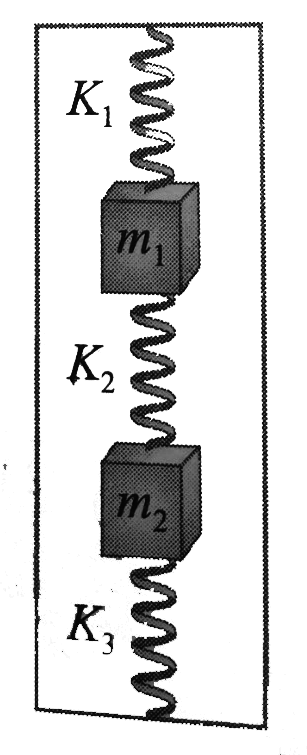
In an elevator a system is arranged as shown in figure. Initially elevator is at rest and the system is in equilibrium with middle spring unstretched. When the elevator accelerated upwards, it was found that for the new equilibrium position (with respect to lift), the further extension i the top spring is 1.5 times that of the further compression in the bottom spring, irrespective of the value of acceleration
(a) Find the value of `(m_1)/(m_2)` in terms of spring constants for this happen.
(b) if `k_1=k_2=k_3=500(N)/(m)` and `m_1=2` kg and acceleration of the elevator is `2.5(m)/(s^2)`, find the tension in the middle spring in the final equilibrium with respect to lift.

Text Solution

Verified by Experts


Let the initial extension in top string be `x_1` and the compression in the botton string be `x_3` respectively.
For equilibrium of `m_1`
`k_1x_1o=m_1g` ..(1)
`For equilibrium of `m_2`
`k_3x_3=m_2g` ..(2)
Let the elevator starts acceleration with an acceleration a in the upward direction. Nowin the position of final equilibrium, let further compression in the bottom string be y.
Further extension i the top string`=1.5y`
`and compression in the middle spring`=0.5y` IN the frame of lift
(a) `m_1(g+a)=k_1(x_1+1.5y)+k_2(0.5y)`
`m_1g=k_1x_1`
`m_1a=y((3)/(2)k_1+(1)/(2)k_2)` ..(3)
`m_2(g+a)=k_3(x_3+y)-k_2(0.5y)`
`m_2g=k_3x_3`
`m_2a=y(k_3-(k_2)/(2))` ..(4)
`(3),(4) we get
`(m_1)/(m_2)=(3k_1+k_2)/(2k_3-k_2)`
(b) `k_1=k_2=k_3=500(N)/(m)`
`m_1=2kg`
`a=2.5(m)/(s)`
using (3)
`y=(2xx2.5)/(2xx500)=(1)/(200)m=0.5cm`
Tension in the middle spring`=k(0.5y)`
`=500xx(1)/(2)xx(1)/(2)xx10^-2`
`T=1.25N`
Promotional Banner

Topper's Solved these Questions

  • CENGAGE PHYSICS DPP

    CENGAGE PHYSICS|Exercise single correct type|14 Videos
  • CAPACITOR AND CAPACITANCE

    CENGAGE PHYSICS|Exercise Integer|5 Videos
  • CENTRE OF MASS CONVERSATION OF MOMENTUM AND COLLISION

    CENGAGE PHYSICS|Exercise Question Bank|38 Videos

Similar Questions

Explore conceptually related problems

All surfaces shown in figure are smooth system is released with the spring unstretched In equilibrium, compression in the spring will be

All surfaces shown in figure are smooth. System is released with the spring instretched. In equilibrium, compression in the spring will be

In the equilibrium conditions shown in the figure all the springs have unstretched length l

Blocks A and B shown in the figure are having equal masses m. The system is released from rest with the spring unstretched. The string between A and ground is cut, when there is maximum extension in the spring. The acceleration of centre of mass of the two blocks at this instant is

If extension in the spring at equilibrium position is 6 cm then acceleration of block if it is released by further stretching 4 cm.

If extension in the spring at equilibrium position is 6 cm then acceleration of block if it is released by further stretching 4 cm.

In an elevator, a spring clock of time period T_(s) (mass attached to a spring) and a pendulum clock of time period T_(p) are kept. If the elevator accelerates upwards

Initially block shown is at rest and the spring is unstretched, when a constant force F begins to act on it neglect friction. Find maximum extension in the spring

CENGAGE PHYSICS-CENGAGE PHYSICS DPP-subjective type
  1. The block of mass m is in equilibrium relative to the smooth wedge of ...

    Text Solution

    |

  2. A force F is applied on block A of mass M so that the tension in light...

    Text Solution

    |

  3. In pulley syste shown in figure, block C is going up at 2(m)/(s) and b...

    Text Solution

    |

  4. System is shown in the figure and man is pulling the rope from both si...

    Text Solution

    |

  5. An ideal speing, with a pointer attached to its end, hangs next to a s...

    Text Solution

    |

  6. In an elevator a system is arranged as shown in figure. Initially elev...

    Text Solution

    |

  7. In the figure shoen calculate the angle of friction . The block dows n...

    Text Solution

    |

  8. A block of 7 kg is placed on a rough horizontal surface and is pulled ...

    Text Solution

    |

  9. The block of mass m(1) is placed on a wedge of an angle theta, as show...

    Text Solution

    |

  10. In the figure shown , the coefficient of static friction between B and...

    Text Solution

    |

  11. Two blocks of mass M and 3M (in kg) are connected by an inextensible l...

    Text Solution

    |

  12. Three blocks are connected as shown in the figure. Valculate the minim...

    Text Solution

    |

  13. The three flat blacks in the figure are positioned on the 37%@ incline...

    Text Solution

    |

  14. 1 kg particle at a height of 4 m has a speed of 2 m/s down a incline m...

    Text Solution

    |

  15. A cone of mass m falls from a height h and penetrates into sand. The r...

    Text Solution

    |

  16. A particle of mass m=1kg lying on x-axis experiences a force given by ...

    Text Solution

    |

  17. A block of mass m is pushed against a spring of spring constant k fixe...

    Text Solution

    |

  18. Consider a one-dimensional motion of a particle with total energy E. T...

    Text Solution

    |

  19. A curved suface is shown in figure. The portion BCD is free of frictio...

    Text Solution

    |

  20. A particle of mass 5kg is free to slide on a smooth ring of radius r=2...

    Text Solution

    |

