Home
Class 12
PHYSICS
A block A of mass m is attached at one e...

A block `A` of mass `m` is attached at one end of a light spring and the other end of the spring is connected to another block `B` of mass `2m` through a light string as shown in the figure. `A ` is held and `B` is in static equilibrium. Now `A` is released. The acceleration of `A` just after that instant is `a` . In the next case, `B` is held and `A` is in static equilibrium. Now when `B` is released, its acceleration immediately after the releas is `b` . The value of `a//b` is (pulley, string and the spring are massless).

A

0

B

undefined

C

2

D

`(1)/(2)`

Text Solution

Verified by Experts

The correct Answer is:
C


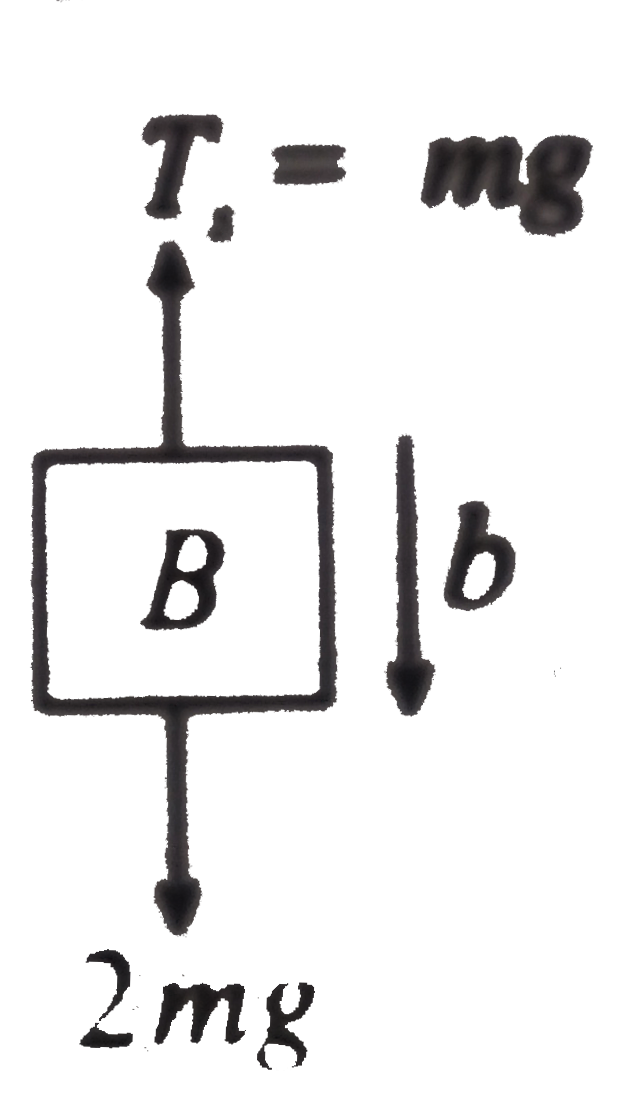
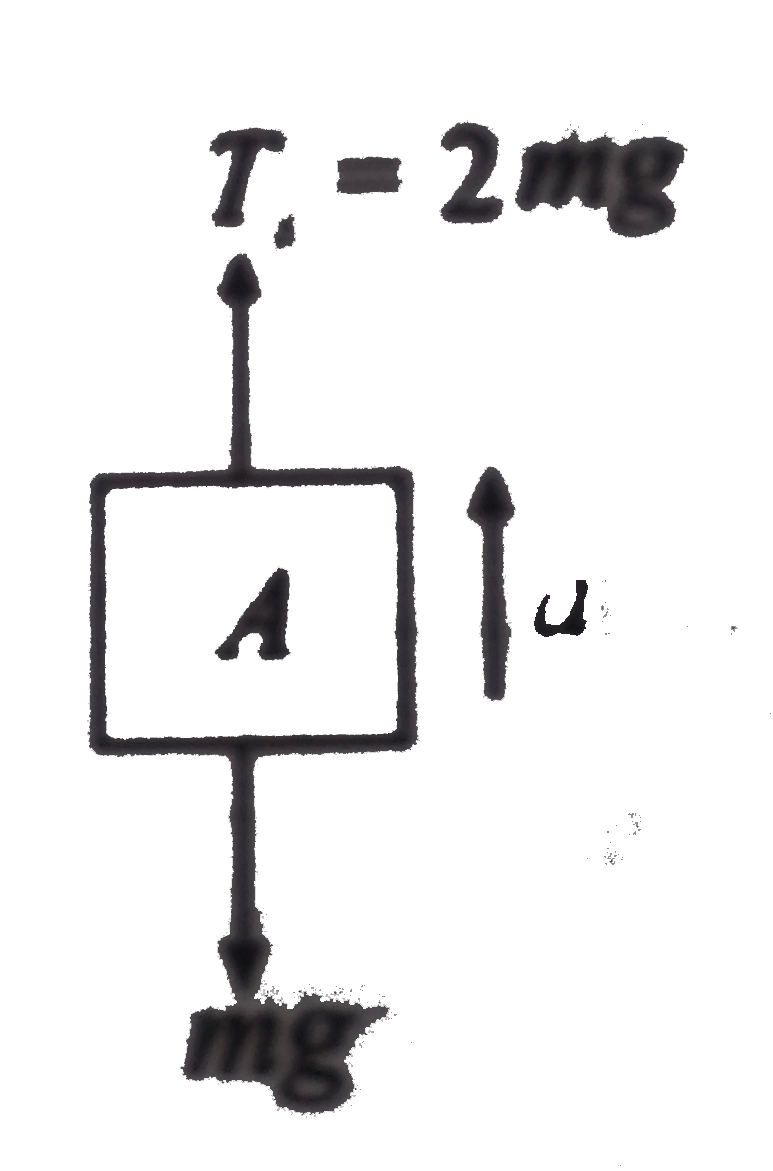
For first case tension in spring will be
`T_s=2mg` just after `A` is released.
`2mg-mg=maimpliesa=g`
In second case `T_S=mg`
`2mg-mg=2mb`
`b=(g)/(2)`
`(a)/(b)=2`
Promotional Banner

Similar Questions

Explore conceptually related problems

A block of mass 'm' is attached to a spring in natural length of spring constant 'k' . The other end A of the spring is moved with a constat velocity v away from the block . Find the maximum extension in the spring.

Two block A and B of mass M & 3M are connected through a light string. One end of the string is connected to the blcok B and its other end is connected to a fixed point S as shown in fig. Now a force F is applied to block B. find the acceleration of block A & B.

A bead of mass m is attached to one end of a spring of natural length R and spring constant K=((sqrt(3)+1)mg)/(R ) . The other end of the spring is fixed at a point A on a smooth vertical ring of radius R as shown in fig. The normal reaction at B just after it is released to move is

Two blocks of masses M and 2M are connected to each other through a light spring as shown in figure . If we push the mass M with a force F which cause acceleration a in mass M. what will the acceleration in 2M?

Two blocks A and B of same mass m attached with a light string are suspended by a spring as shown in fig. Find the acceleration of block A and B just after the string is cut.

Two blocks A and B of same mass m attached with a light spring are suspended by a string as shown in fig. Find the acceleration of block A and B just after the string is cut.

Uniform rod AB is hinged at end A in horizontal position as shown in the figure the other end is connected to a block through a massless string m as shown the pulley is smooth and massless masses of block and rod is same and is equal to m then acceleration of block just after release from this position is

Uniform rod AB is hinged at end A in horizontal position as shown in the figure. The other end is connected to a block through a massless string as shown. The pulley is smooth and massless. Mass of block and rod is same and is equal to m Then acceleration of block just after release from this position is

A bead of mass 'm' is attached to one end of a spring of natural length R & spring constant k = ((sqrt3 + 1))/(R) . The other end of the spring is fixed at point A on a smooth vertical ring of radius R as shown. The normal reaction at B just after it is released to move is