Home
Class 12
PHYSICS
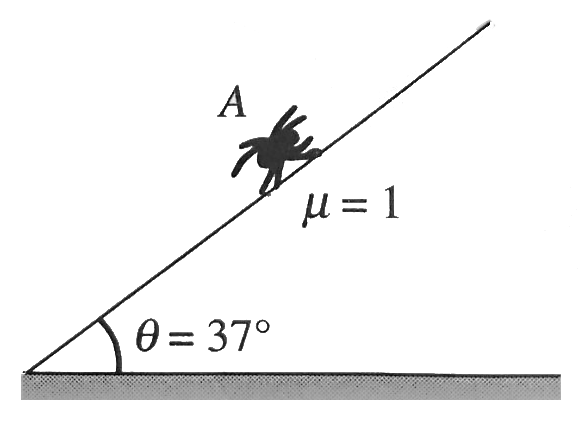
An insect of mass m, starts moving on a ...


An insect of mass m, starts moving on a rough inclined surface from point A. As the surface is vert sticky, the corfficient of fricion between the insect and the incline is `mu=1`. Assume that it can move in any direction, up the incline or down the incline then

A

the maximum possible acceleration of the insect can be `14(m)/(sec^2)`

B

the maximum possible acceleration of the insect can be `1(m)/(sec^2)`

C

the insect can move with a constant velocity

D

the insect cannot move with a constant velocity

Text Solution

Verified by Experts

The correct Answer is:
A, C


`mgsinthetamgcostheta=ma`
`=10[(3)/(5)+(4)/(5)]=14(m)/(sec^2)`
If `f_r=mgsintheta`
`=mgxx(3)/(5)=(3mg)/(5)=f_(rmax)`
`f_rltf_(rmax)`
`(3mg)/(5)lt(4mg)/(5)` hence insect can move with constant velocity.
Promotional Banner

Similar Questions

Explore conceptually related problems

A solid cylinder of mass m and radius r is rolling on a rough inclined plane of inclination theta . The coefficient of friction between the cylinder and incline is mu . Then.

A hollow sphere of mass m and radius R is rolling downdard on a rough inclined plane of inclination theta . If the coefficient of friction between the hollow sphere and incline is mu , then

A block of mass m is placed on a rough inclined plane of inclination theta kept on the floor of the lift. The coefficient of friction between the block and the inclined plane is mu . With what acceleration will the block slide down the inclined plane when the lift falls freely ?

A block of mass m is at rest on a rough inclined plane of angle of inclination theta . If coefficient of friction between the block and the inclined plane is mu , then the minimum value of force along the plane required to move the block on the plane is

A block of mass m sliding down an inclined at constant speed is initial at a height h shown the ground as shown in the figure above . The coefficient of kinetic friction between the mass and the inclined is mu . If the mass constinues to slide down the inclined at a constant speed how much energy is displaced by friction by the time the mass reaches the bottom of the incline?

A given object takes m times as much time to slide down a 45^(@) rough incline as it takes to slide down a perfectly smooth 45^(@) incline. The coefficient friction between the objected and the incline is given by

A block of mass m is being pulled up a rough incline by an agent delivering constant power P. The coefficient of friction between the block and the incline is mu . The maximum speed of the block during the course of ascent is

A block of mass m is placed on a rough plane inclined at an angle theta with the horizontal. The coefficient of friction between the block and inclined plane is mu . If theta lt tan^(-1) (mu) , then net contact force exerted by the plane on the block is :

