Home
Class 12
PHYSICS
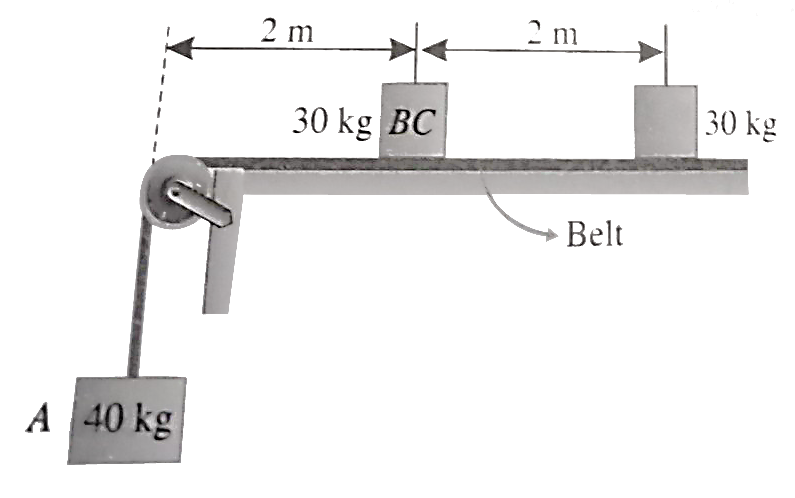
Two 30 kg blocks rest on a massless belt...


Two 30 kg blocks rest on a massless belt which passes over a fixed pulley and is attached to a 40 kg block. If coefficient of friction between the belt and the table as well as between the belt and the blocks B and C is `mu` and the system is released from rest from the position shown, the speed with which the block B falls off the belt is

A

`2sqrt2(m)/(s)` if `mu=0.2`

B

`sqrt2(m)/(s)` if `mu=0.2`

C

`2(m)/(s)` if `mu=0.5`

D

`2.5(m)/(s)` if `mu=0.5`

Text Solution

Verified by Experts

The correct Answer is:
A, C


Maximum possible acceleration of block will be `=mug`
(i) When `mu=0.2` maximum acceleration possible so that blocks does not slip is `2(m)/(s^2)`. Now acceleration of system assuming blocks don't slip is
As `3.8gt2` hence the assumption is wrong and blocks slip on the belt.
Maximum force applicable on block B is `mumg`
Acceleration of block`=2(m)/(s^2)`
Hence velocity of B when it strikes pulley is `V^2=0^2+2xx2xx2`
`V^2=8`
`V=2sqrt2(m)/(s)`
Hence (a).
(ii) When `mu=0.5` maximum acceleration possible so the block dows not slip is `5(m)/(s^2)`
Now acceleration of system assuming blocks don't slip is
`a=(40g-2mumg)/(100)=1(m)/(s^2)`
`mu=0.5`
as `1lt5` hence, blocks do not slip and acceleration of block B is `1(m)/(s^2)`
hence velocity of B when it strikes pulley is
`V^2=0^2+2.1.2`
`V^2=4`
`V=2(m)/(s)`
Hence (c).
Promotional Banner

Similar Questions

Explore conceptually related problems

The coefficient of friction between the block A of mass m & block B of mass 2m is mu . There is no friction between A & B is released from rest & there is no slipping between A & B then:

Two blocks A and B are connected by a light inextensible string passing over a fixed smooth pulley as shown in figureThe coefficient of friction between the block A and B the horizontal table is mu = 0.5 . If the block A is just , find ratio of the masses of the blocks

Two blocks A & B are connected by a light inextensible string passing over a fixed smooth pulley as shown in the figure. The coefficient of friction between the block A and the horizontal table is mu=0.2 . If the block A is just to slip, find the ratio of the masses of the blocks.

The coefficient of friction between the block A of mass m & block B of mass 2m is mu . There is no friction between block B & the inclined plane. If the system of blocks A & B is released from rest & there is no slipping between A & B then :

consider the situation shown in figure in which a block 'A' of mass 2 kg is placed over a biock.'B' of mass 4 kg. The combination of the blocks are placed on a inclined plane of inclination 37^(@) with horizontal. The coefficient of friction between block B and inclined plane is mu_(2) and in between the two, blocks is mu_(1) . The system is released from rest. ("Take "g=10m//sec^(2)) In the previous question the frictional force between block B and plane is :

consider the situation shown in figure in which a block 'A' of mass 2 kg is placed over a biock.'B' of mass 4 kg. The combination of the blocks are placed on a inclined plane of inclination 37^(@) with horizontal. The coefficient of friction between block B and inclined plane is mu_(2) and in between the two, blocks is mu_(1) . The system is released from rest. ("Take "g=10m//sec^(2)) The frictional force acting between the two blocks in the previous question is :

consider the situation shown in figure in which a block 'A' of mass 2 kg is placed over a biock.'B' of mass 4 kg. The combination of the blocks are placed on a inclined plane of inclination 37^(@) with horizontal. The coefficient of friction between block B and inclined plane is mu_(2) and in between the two, blocks is mu_(1) . The system is released from rest. ("Take "g=10m//sec^(2)) The frictional force acting between the blocks in the previous case will be:

consider the situation shown in figure in which a block 'A' of mass 2 kg is placed over a biock.'B' of mass 4 kg. The combination of the blocks are placed on a inclined plane of inclination 37^(@) with horizontal. The coefficient of friction between block B and inclined plane is mu_(2) and in between the two, blocks is mu_(1) . The system is released from rest. ("Take "g=10m//sec^(2)) The frictional force acting between the blocks in the previous case :

Consider the situation shown in figure in which a book 'A' of mass 2 kg is placed over a block 'B' of mass 4 kg . The combination of the placed on a inclined plane of inclination 37 ^(@) with horizontal. The coefficient of friction between blocks B and inclined plane is mu_(2) and in between the two bolcks is mu_(1) , The system is released from rest. ( Take g=10m//sec^(2)) In the previous question the frictional force between block B and plane is:

Consider the system shown in the figure. Coefficient of friction between the block and table is mu=0.5. The system is released from rest. Find the work done by friction, when the speed of block is 10 m/s (m=1kg)

