Home
Class 12
PHYSICS
A ring of mass m can slide over a smoot...

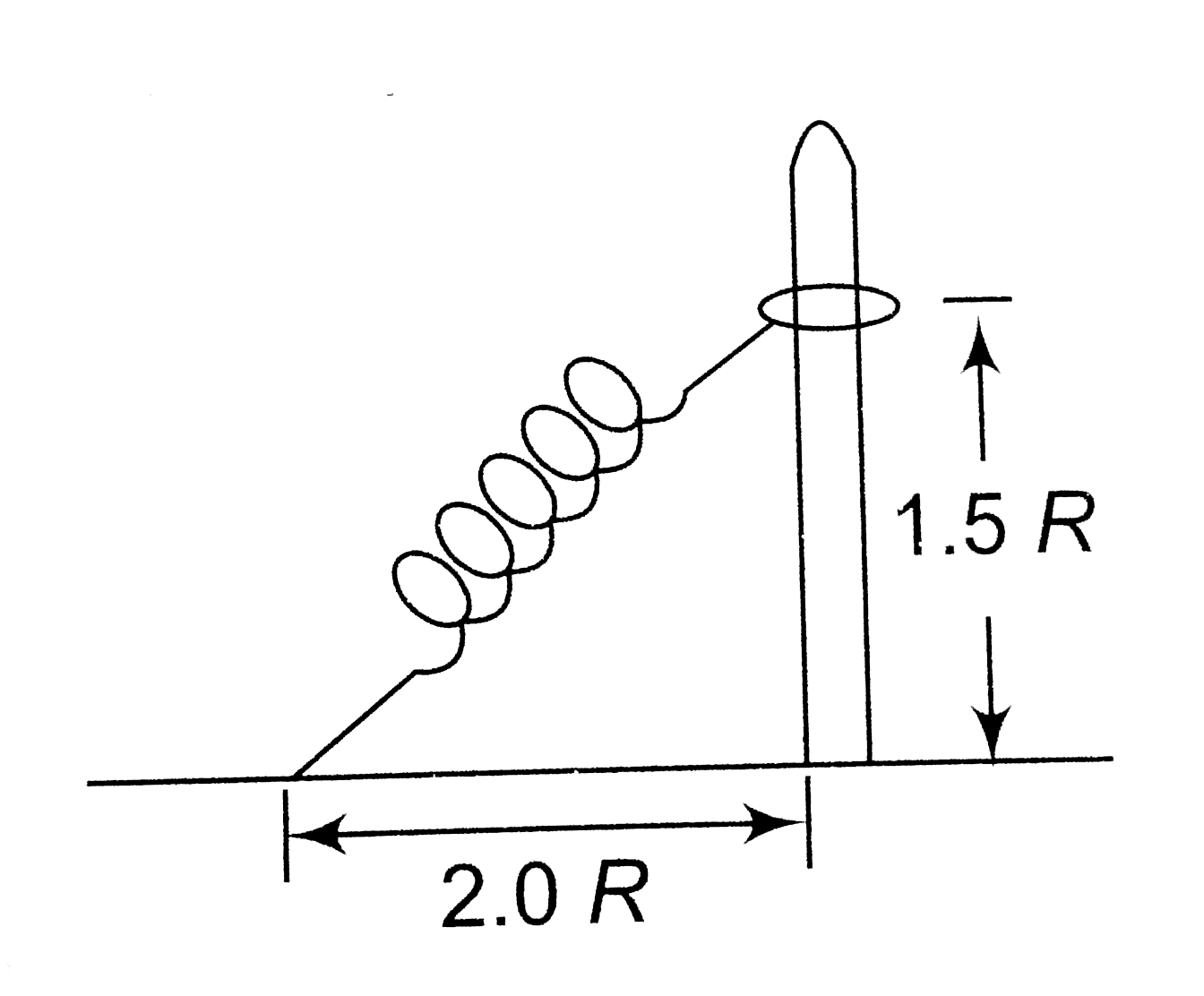
A ring of mass `m` can slide over a smooth vertical rod as shown in figure. The ring is connected to a spring of force constant `k = 4 mg//R`, where `2R` is the natural length of the spring . The other end of spring is fixed to the ground at a horizontal distance `2R` from base of the rod . If the mass is released at a height `1.5 J` then the velocity of the ring as it reaches the ground is

A

`2sqrt(gR)`

B

`sqrt(gR)`

C

`(sqrt(gR))/(2)`

D

`(3sqrt(gR))/(2)`

Text Solution

Verified by Experts

The correct Answer is:

A

Let v be velocity of the ring as it reaches the ground. From work energy theorem,
`W_(gravity)+W_(spring)=triangleK`
`impliesmg((3R)/(2))+(1)/(2)kx^2=(1)/(2)mv^2`
`implies(3mgR)/(2)+(mgR)/(2)=(1)/(2)mv^2`
`impliesv=2sqrt(gR)`
Promotional Banner

Similar Questions

Explore conceptually related problems

A ring of mass m can slide over a smooth vertical rod. The ring is connected to a spring of force constant K=(4mg)/R where 2R is the natural length of the spring. The other end spring is fixed to the ground at a horizontal distance 2R from the base of the rod. the mass is released at a height of 1.5 R from ground.

A ring of mass m is attached to a horizontal spring of spring constant k and natural length l_0 . The other end of the spring is fixed and the ring can slide on a horizontal rod as shown. Now the ring is shifted to position B and released Find the speed of the ring when the spring attains its natural length.

A ring of mass m=10kg can slide through a vertical rod with friction. It is connected with a spring of force constant k=100Nm^-1 . The relaxed length of spring is 4m . The ring is displaced 3m as shown in the figure and released. Find velocity of ring when spring becomes horizontal.

A bead of mass m can slide without friction on a fixed circular horizontal ring of radius 3R having a centre at the point C. The bead is attached to one of the ends of spring of spring constant k. Natural length of spring is R and the other end of the spring is R and the other end of the spring is fixed at point O as shown in the figure. If the bead is released from position A, then the kinetic energy of the bead when it reaches point B is

A bead of mass m can slide without friction along a vertical ring of radius R. One end of a spring of force constant k=(3mg)/(R ) is connected to the bead and the other end is fixed at the centre of the ring. Initially, the bead is at the point A and due to a small push it starts sliding down the ring. If the bead momentarily loses contact with the ring at the instant when the spring makes an angle 60^(@) with the vertical, then the natural length of the spring is

A block of mass M is tied to a spring of force constant k and placed on a smooth horizontal surface. The natural length of the spring is L. P is a point on the spring at a distance (L)/(4) from its fixed end. The block is set in oscillations with amplitude A. Find the maximum speed of point P on the spring.

In the figure shown a block of masss m is atteched at ends of two spring The other ends of the spring are fixed The mass m is released in the vertical plane when the spring are released The velocity of the block is maximum when

A smooth ring A of mass 4 kg can slide on a fixed smooth horizontal rod. A string tied to the ring passes over a fixed pulley and carries a block B of mass 2 kg as shown in the figure. At the initial instant, the string attached to the ring makes an angle 60° with the horizontal rod. If the system is released from rest, the initial acceleration of the ring is?

A ring of mass m can freely slide on a smooth vertical rod. The ring is symmetrically attached with two springs, as shown, each of stiffness k . Ring is displaced such that each spring makes an angle theta with the horizontal. If the ring is slightly displaced vertically, then time period is.......
