Home
Class 12
PHYSICS
The force acting on a body moving along ...

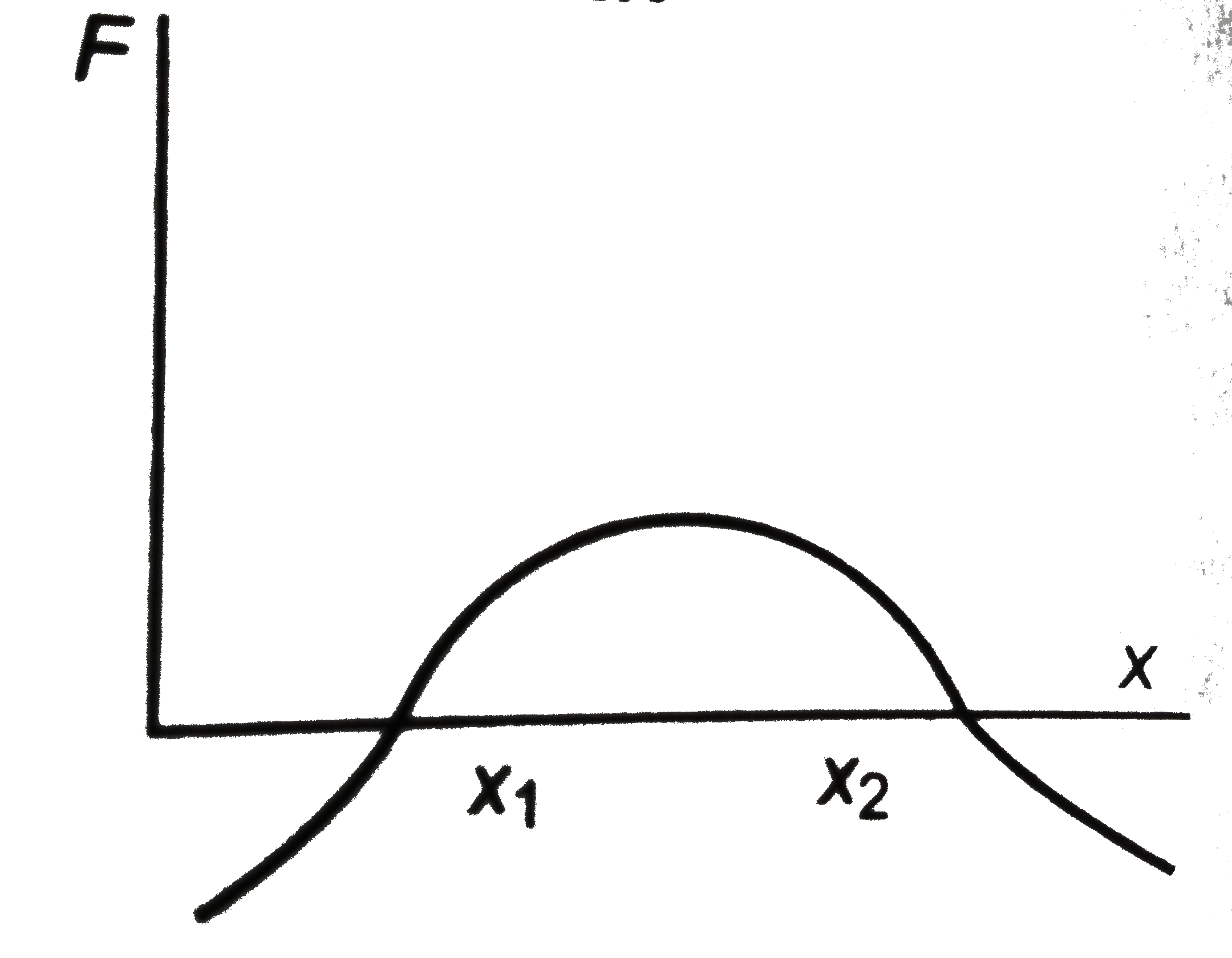
The force acting on a body moving along x-axis varitian of the particle particle shown in the figure. The body is in stable equlilbrium at
.

A

`x=x_1`

B

`x=x_2`

C

both `x_1` and `x_2`

D

neither `x_1` nor `x_2`

Text Solution

Verified by Experts

The correct Answer is:

B

When particle moves aways from the origin then at position `x=x_1` force is zero and at `xgtx_1`, force is positive (repulsive in nature) so particle moves further and does not return back to original position. i.e. the equilibrium is not stable. Similarly at position `x=x_2` force is zero and at `xgtx_2`, force is negative (attractive in nature) So particle returns back to original position i.e. The equilibrium is stable.
Promotional Banner

Similar Questions

Explore conceptually related problems

The force acting on a body moving along x-axis varies with the position of the particle shown in the figure. The body is in stable equilibrium at .

The force acting on a body moving along x -axis varies with the position of the particle as shown in the fig. The body is in stable equilibrium at.

The force acting on a body moving along X-axis varies as shown.Its stable equilibrium position is :

The variation of potential energy U of a body moving along x - axis varies with its position (x) as shown in figure The body is in equilibrium state at

The variation of potential energy U of a body moving along x - axis varies with its position (x) as shown in figure The body is in equilibrium state at

The kinetic energy of a body moving along a straight line varies with time as shown in figure. The force acting on the body:

The magnitude of force acting on a particle moving along x-axis varies with time (t) as shown in figure. If at t = 0 the velocity of particle is v_(0) , then its velocity at t=T_(0) will be

If v is the velocity of a body moving along x-axis, then acceleration of body is
