Home
Class 12
PHYSICS
In the figure the variation of potential...


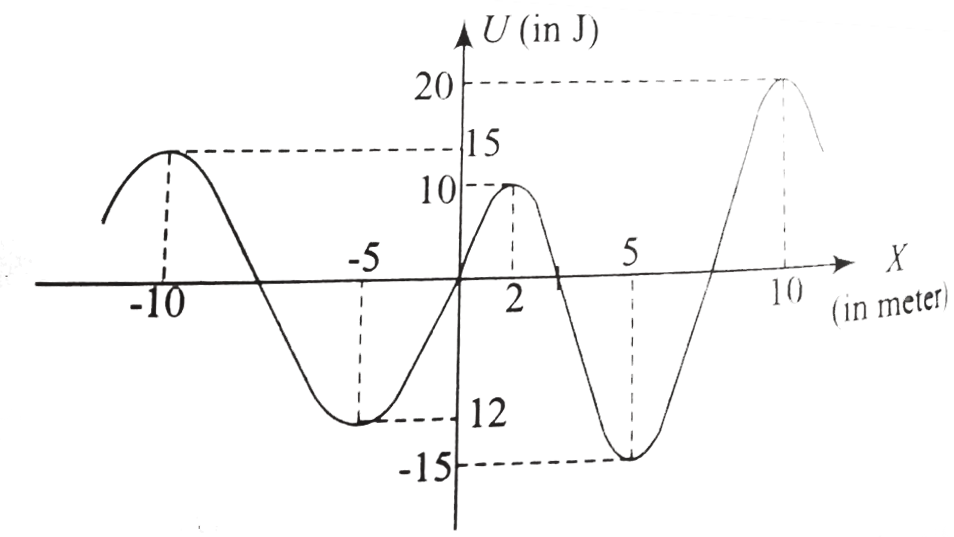
In the figure the variation of potential energy of a particle of mass `m=2kg` is represented w.r.t. its x-coordinate. The particle moves under the effect of this conservative force along the x-axis. Which of the following statements are correct about the particle:

A

If it is released at the origin it will move in negative x-axis

B

If it is released at `x=2+triangle` where `trianglerarr0` then its maximum speed will be `5(m)/(s)` and it will perform oscillatory motion

C

If initially `x=-10m` and `vecu=sqrt(6)hati(m)/(s)` then it will cross `x=10m`

D

`x=-5m` and `x=+5` m are unstable equilibrium positions of the particle.

Text Solution

Verified by Experts

The correct Answer is:

A, B, C

If the particle is released at the origin, it will try to go in the direction of force. Here `(du)/(dx)` is positive and hence force is negative, as a result it will move towards`-ve`x-axis.
When the particle is released at `x=2+triangle`, it will reach the point of least possible potential energy `(-15J)` where it will have maximum kinetic energy.
`(1)/(2)mv_(max)^2=25impliesv_(max)=5(m)/(s)`
The particle will now perform oscillatory motion between `-15JleUle15J`, because reaching `U=+15J`, the kinetic energy and hence speed becomes zero.
`-15JleUle15J`,`U=+15J`,
In (C ), `E_i=U_i+k_i=15+6=21J`
At `x=10m` , `U_f=20JimpliesK_f=1Jne0impliesx=10m`
`implies` the particle cross `x=10m`.
Promotional Banner

Similar Questions

Explore conceptually related problems

In figure, the variation of potential energy of a particle of mass m=2kg is represented w.r.t its x-coordinate. The particle moves under the effect of the conservative force along the x-axis. Which of the following statements is incorrect about the particle?

In the figure the variation of potential energy of a particle of mass m = 2kg is represented w.r.t. its x-coordinate. The particle moves under the effect of this conservative force along the x-axis. If the particle is released at the origin then

In the figure, the variation of potential energy of a particle of mass m = 2kg is represented with respect to its x-coordinate. The particle moves under the effect of this conservative force along the X-axis. If the particle is released at the origin, then

In the figure the variation of potential energy of a particle of mass m = 2kg is represented w.r.t. its x-coordinate. The particle moves under the effect of this conservative force along the x-axis. x = - 5m and x = 10 m position of the particle are respectively of

In the figure, the variation of potential energy of a particle of mass m = 2kg is represented with respect to its x-coordinate. The particle moves under the effect of this conservative force along the X-axis. If the particle is released at x = 2 + Delta where Delta rarr 0 (it is positive), then its maximum speed in subsequent motion will be

Figure shows a plot of the potential energy as a function of x for a particle moving along the x-axis. Which of the following statement(s) is/are true?

For a particle moving along the x-axis, mark the correct statement(s).

A particle moves along x-axis as x=4(t-2)+a(t-2)^2 Which of the following is true?

In the figure shown the potential energy U of a particle is plotted its position 'x' from origin. Then which of the following statement is correct A particle at :
