Home
Class 12
PHYSICS
A small block slides with velocity v0=0....


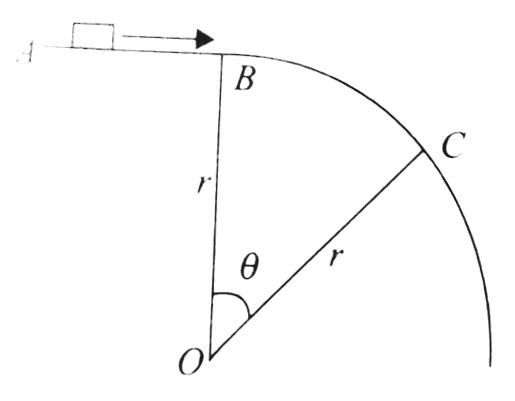
A small block slides with velocity `v_0=0.5sqrt(gr)` on the horizontal frictiohnless surface as shown in the fig. the block leaves the surface at point C. The angle `theta` in the figure is:

A

`cos^(-1)(4)/(9)`

B

`cos^(-1)(3)/(4)`

C

`cos^(-1)(1)/(4)`

D

`cos^(-1)(4)/(5)`

Text Solution

Verified by Experts

Promotional Banner

Similar Questions

Explore conceptually related problems

A small block slides with velocity 0.5sqrt(gr) on the horizontal frictionless surface as shown in the figure. The block leaves the surface at point C . Calculate angle theta in the figure.

A block of mass sqrt(3) kg rests on a horizontal frictionless surface. What will be the acceleration of the block if it is subjected to two forces as shown in the figure.

Two forces act on a 4.5 kg block resting on a frictionless surface as shown in the given figure. What is the magnitude of the horizontal acceleration of the block ?

A small block of mass M moves on a frictionless surface of an inclined plane, as shown in the figure. The angle of the incline suddenly changes from 60^(@) to 30^(@) at point B . The block is many at rest at A . Assume that collisions between the block id the incline are totally inelastic. The speed of the block at point C , immediately before it leaves the second incline

A block of mass m moving with velocity v_(0) on a smooth horizontal surface hits the spring of constant k as shown. Two maximum compression in spring is

Two blocks A and B are connected to each other by a string and a spring , the string passes over a frictionless pulley as shown in the figure. Block B slides over the horizontal top surface of a stationary block C and the block A slides along the vertical side of C , both with the same uniform speed. The coefficient of friction between the surface and blocks is 0.5 K = 2000 N//m . If mass of A is 2 kg calculate mass of B . .

A block of mass m slides down along the surface of the bowl from the rim to the bottom as shown in fig. The velocity of the block at the bottom will be-

