

Home
Class 12
PHYSICS
A narrow beam of singley charged carbon ...

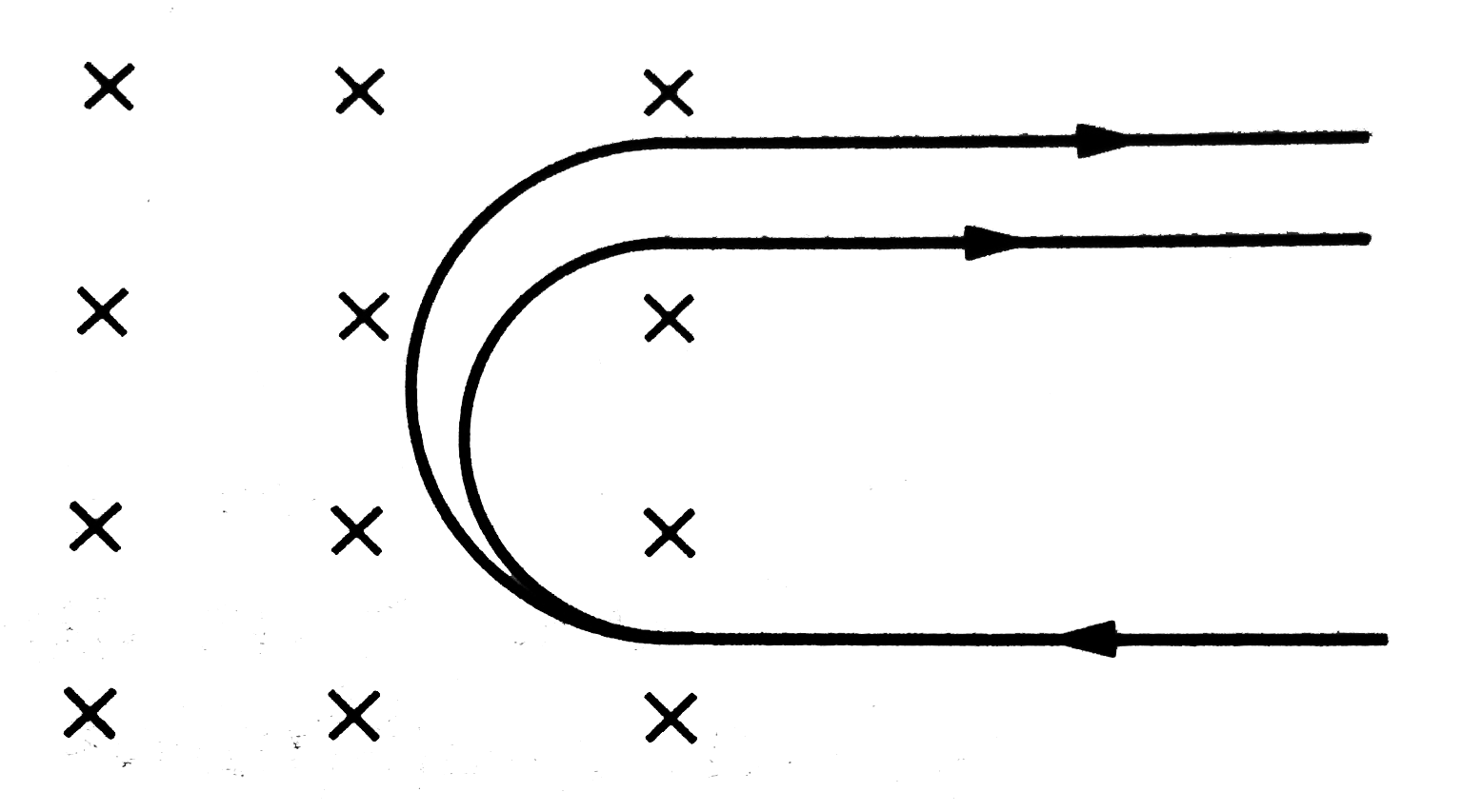
A narrow beam of singley charged carbon ions, moving at a constant velocity of `6.0 X10^4 ms^(-1),` is sent perpendicularly in a rectangular region having uniform magnetic field B=0.5 T . It is found that two beams emerge from the field in the backward derection, the separations from the incident beam being 3.0 cm and 3.5cm. Identify the isotopes persent in the ion beam. Take the mass of an ion = `A(1.6 X10^(-27)` kg, where A is the mass number.

Promotional Banner

Similar Questions

Explore conceptually related problems

Two types of particles having same charge equal to +2e but different masses are moving with a constant velocity of 6 xx 10^(4) m/s in the form of a beam. These particles suddenly encounter a perpendicular magnetic field in a rectangular region having intensity equal to 0.5 T. It is found that particles emerge from the field in the backward direction from two different points. These points are at a distance 3 cm and 3.5 cm from the incident beam. Find the ratio of their masses.

A narrow beam of singly charged potassium ions of kinetic energy 32keV is injected into a region of width 1.00 cm having a magnetic field of strength 0.500 T as shown in . The ions are collected at a screen 95.5cm away from the field region. If the beam contains isotopes of atomic weights 39 and 41, find the separation between the points where these isotopes strike the screen. Take the mass of a potassium ion= A (1.6 X 10^(-27) ) kg where A is the mass number.

A beam of protons with a velocity of 4 X 10 ^5 ms^(-1) enters a uniform magnetic field of 0.3 T. The velocity makes an angle of 60^@ with the magnetic field. Find the radius of the helicla path taken by the proton beam and the pitch of the helix.

A beam of protons with a velocity of 4 X 10 ^5 ms^(-1) enters a uniform magnetic field of 0.3 T. The velocity makes an angle of 60^@ with the magnetic field. Find the radius of the helicla path taken by the proton beam and the pitch of the helix.

A beam of protons with a velocity of 4 X 10 ^5 ms^(-1) enters a uniform magnetic field of 0.3 T. The velocity makes an angle of 60^@ with the magnetic field. Find the radius of the helicla path taken by the proton beam and the pitch of the helix.

A beam of protons with a velocity of 4 X 10 ^5 ms^(-1) enters a uniform magnetic field of 0.3 T. The velocity makes an angle of 60^@ with the magnetic field. Find the radius of the helicla path taken by the proton beam and the pitch of the helix.

A light beam passes from medium 1 to medium 2. Show that the emerging beam is parallel to the incident beam.

A light beam passes from medium 1 to medium 2. Show that the emerging beam is parallel to the incident beam.

A beam of protons with a velocity of 4 X 10 ^5 ms^(-1) enters a uniform magnetic field of 0.3 T. The velocity makes an angle of 60^@ with the magnetic field. Find the radius of the helical path taken by the proton beam.