

Home
Class 11
PHYSICS
A long conveyer belt moves with a consta...

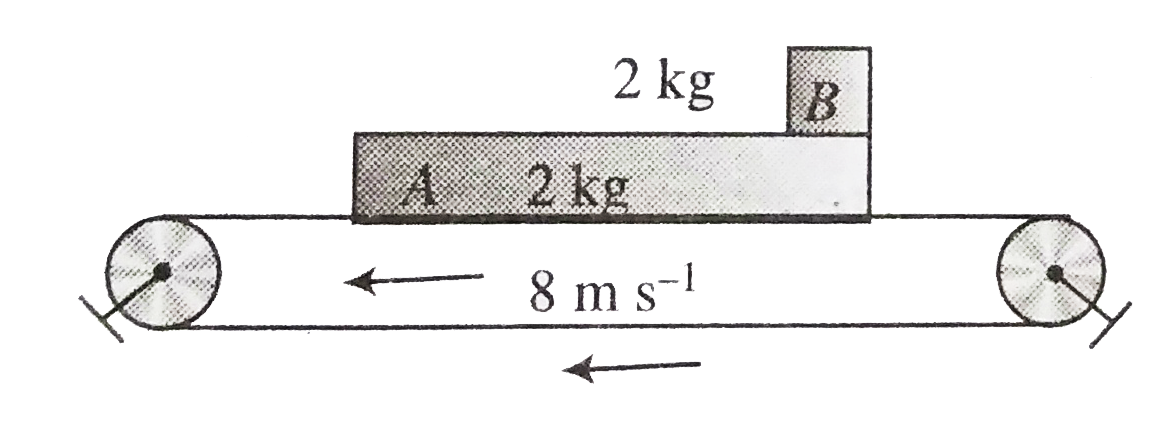
A long conveyer belt moves with a constant velocity of `8 ms^(-1)`.Two blockA and B each of mass `2kg` are placed gently on the belt with B on A, initail velocity of block is zero Coefficient of friction between A and belt is `0.1` There is no friction between A and B length of A is `4m`

Find the velocity of A when B falls off A

Promotional Banner

Similar Questions

Explore conceptually related problems

A long conveyer belt moves with a constant velocity of 8 ms^(-1) .Two blockA and B each of mass 2kg are placed gently on the belt with B on A, initail velocity of block is zero Coefficient of friction between A and belt is 0.1 There is no friction between A and B length of A is 4m Find the time when A falls off A initially ,B is no the right and of A lgnore the dimensions of B

A long conveyer belt moves with a constant velocity of 8 ms^(-1) .Two blockA and B each of mass 2kg are placed gently on the belt with B on A, initail velocity of block is zero Coefficient of friction between A and belt is 0.1 There is no friction between A and B length of A is 4m Find the time when A falls off A initially ,B is no the right and of A lgnore the dimensions of B

A long conveyer belt moves with a constant velocity of 8 ms^(-1) .Two blockA and B each of mass 2kg are placed gently on the belt with B on A, initail velocity of block is zero Coefficient of friction between A and belt is 0.1 There is no friction between A and B length of A is 4m If the coefficient of friction between the block B and belt is 0.4 Find the separation between the two block when B come to rest w.r.t. belt

In the show arrangement mass of A=1 kg, mass of B= 2kg. Coefficient of friction between A and B =0.2 There is no friction between B and ground. The frictional force exerted by A on B equals.

In the show arrangement mass of A=1 kg, mass of B= 2kg. Coefficient of friction between A and B =0.2 There is no friction between B and ground. The frictional force exerted by A on B equals.

A block of mass 2kg lying on ice when given a velocity of 6ms^(-1) is stopped by friction in 5s. The coefficient of friction between the block and ice is (g=10 ms^(-2) )

Two blocks A and B of masses m_(A) and m_(B) have velocity v and 2v respectively at a given instant A horizontal force F acts on the block A There is no friction between ground and block B and coefficient of friction between A and B is mu The friction