Home
Class 11
PHYSICS
Forces X,Y and Z have magnitudes 10N, 5(...

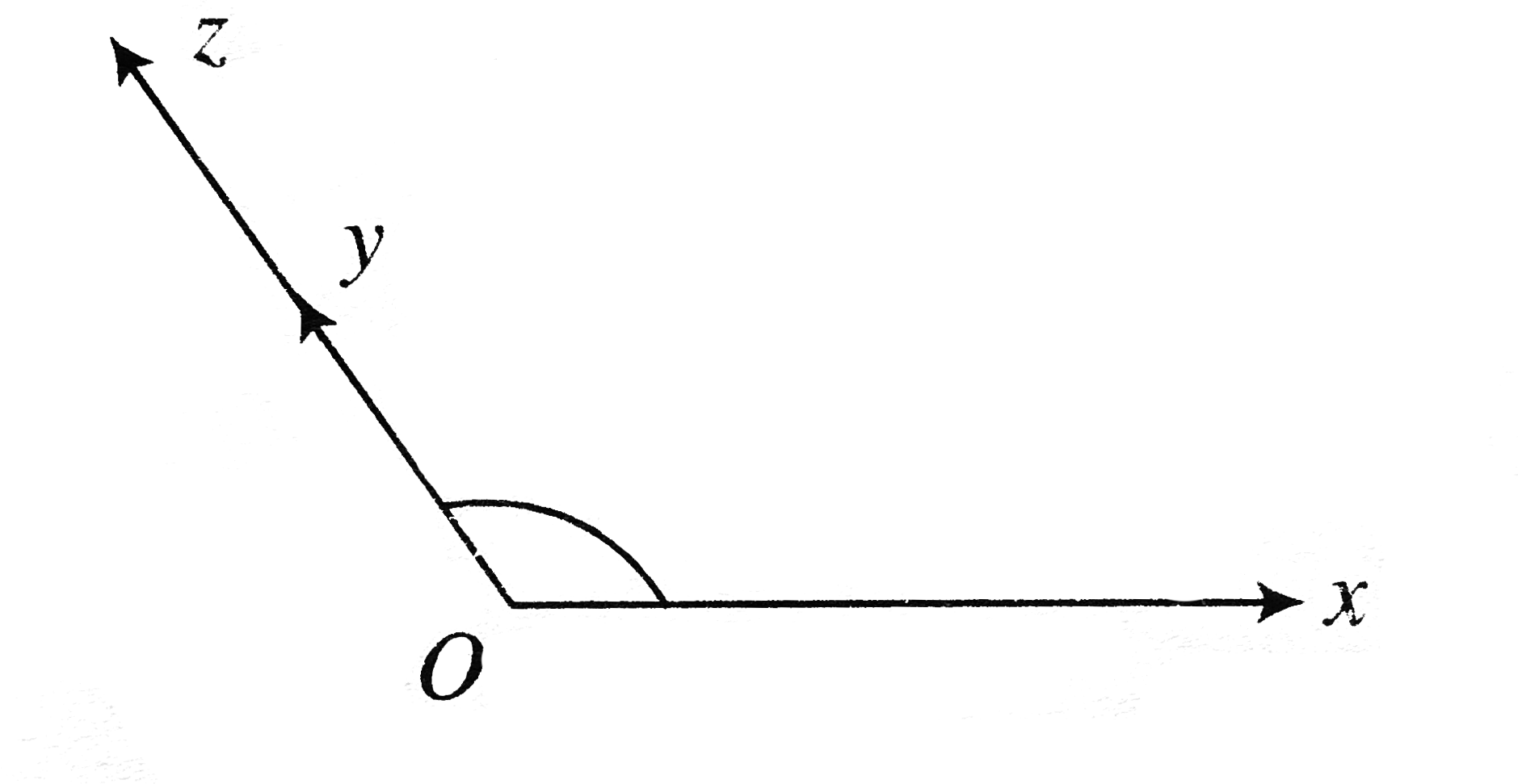
Forces X,Y and Z have magnitudes `10N`, `5(sqrt(3)-1) N` and `5(sqrt(3)+1) N`, respectively. The forces Y and Z act in the same direction as shown in figure. The resultant of X and Y and the resultant of X and Z have the same magnitudes. Find `theta`, the angle between X and Y.

A

`150^(@)`

B

`135^(@)`

C

`120^(@)`

D

`105^(@)`

Text Solution

Verified by Experts

The correct Answer is:

A

Resultant of `vec(X)+vec(Y)= vec(X)+vec(Z)`
`(10)^(2)+(5sqrt(3)-1)^(2)+2.10.(5sqrt(3)-1) cos theta`
`=(10)^(2)+(5sqrt(3)+1)^(2)+2.10.(2sqrt(3)+1)cos theta`
or
`(5sqrt(3)-1)^(2)-(5sqrt(3)+1)^(2)`
`=2.10 cos theta[(5sqrt(3)+1)-(5sqrt(3)-1)](2.5.sqrt(3))(-2)= 2.10 cos theta[2]`
`(-5)/(10)sqrt(3)= cos theta = (-sqrt(3))/2`
`= cos thetaimplies theta= 150^(@)`
Promotional Banner

Topper's Solved these Questions

Similar Questions

Explore conceptually related problems

Three forces are acting on a particle as shown in the figure. To have the resultant force only along the Y-direction, the magnitude of the maximum additional force needed is

Two forces acting in opposite direction have resultant 10 N and when acting perpendicularly have resultant 50 N . Find the magnitude of forces.

Two forces of magnitude 1 N and 13 N resultant of magnitude 6sqrt(5)N, then that is the angle between two forces.

Three froces acting on a body are shown in the figure. To have the resultant force only along the y-direction, the magnitude of the minimum additional force needed is

The two forces 2sqrt2N and xN are acting at a point their resultant is perpendicular to hatxN and having magnitude of sqrt6N .The angle between the two forces and magnitude of x are.

If two forces of 5 N each are acting along X and Y axes, then the magnitude and direction of resultant is

The resultant of 2 forces of magnitude 1N and 13N is 6sqrt(5)N . Find the tangent of the angle made by resultant with 1N force.

Two horizontal forces of magnitudes of 10N and P N act on a particle. The force of magnitude 10N acts due west and the force of magnitude P N acts on a bearing of 30^(@) east of north as shown in (figure) The resultant of these two force acts due north. Find the magnitude of the resultant.

The magnitudes of two forces X and Y are in the ratio 2:3 . If the resultant of two forces is 25N and angle between them 60^(@) , find the magnitude of each force close to one place of decimal .

Three ants 1, 2 and 3 are pulling a grain with forces of magnitudes 2Nsqrt(3)N and sqrt(2)N and as shown in the figure. Find the resultant force acting on the grain.

A2Z-VECTORS-Problems Based On Mixed Concepts
  1. Consider east as positive x-axis, north as positive y-axis. A girl wal...

    Text Solution

    |

  2. A car moving on a straight road due north with a uniform speed of 50 k...

    Text Solution

    |

  3. What is the angle between (vec(P)+vec(Q)) and (vec(P)xxvecQ)?

    Text Solution

    |

  4. In x-y plane, a force 10 N acts at an angle 30^(@) to the positive dir...

    Text Solution

    |

  5. A sail boat sails 2km due east, 5km 37^(@) south of east, and finally ...

    Text Solution

    |

  6. Vectors vecA and vecB include an angle theta between them. If (vecA + ...

    Text Solution

    |

  7. The position vectors of two balls are given by vec(r )(1)=2 (m)i+7(m...

    Text Solution

    |

  8. A particle whose speed is 50ms^(-1) moves along the line from A(2,1) t...

    Text Solution

    |

  9. A particle travels with speed 50ms^(-1) from the point (3,-7) in a dir...

    Text Solution

    |

  10. A particle has an initial velocity of 3hat(i) + 4 hat(j) and an accele...

    Text Solution

    |

  11. Forces X,Y and Z have magnitudes 10N, 5(sqrt(3)-1) N and 5(sqrt(3)+1) ...

    Text Solution

    |

  12. A car going due North at 10sqrt(2) ms^(-1) turns right through an angl...

    Text Solution

    |

  13. If the particle of mass m is moving with constant velocity v parallel ...

    Text Solution

    |

  14. If vec(A)xxvec(B)=vec(C ), then which of the following statements is w...

    Text Solution

    |

  15. The linear velocity of a rotating body is given by vec(v)= vec(omega)x...

    Text Solution

    |

  16. If vec(A)xxvec(B)= vec(C )+vec(D), then select the correct alternative...

    Text Solution

    |

  17. |vec(A)xxvec(B)|^(2)+|vec(A).vec(B)|^(2)=

    Text Solution

    |

  18. Unit vector hat(P) and hat(Q) are inclined at an angle theta. Prove th...

    Text Solution

    |

  19. If vec(A) and vec(B) are two vectors, which of the following is not co...

    Text Solution

    |

  20. The angle between the vector vec(A) and vec(B) is theta. Find the valu...

    Text Solution

    |
