Home
Class 11
PHYSICS
In the figure shown the force with which...

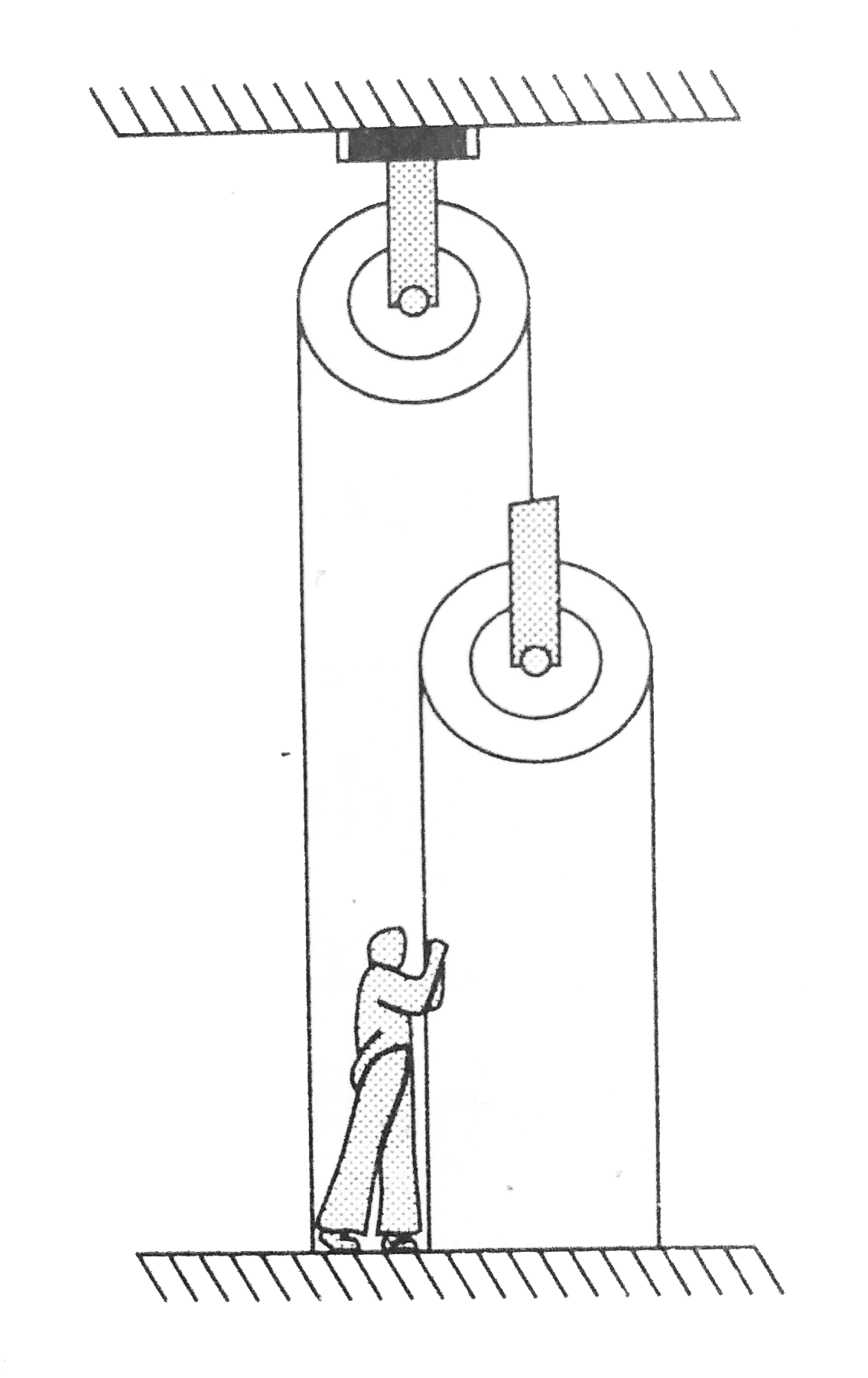
In the figure shown the force with which the man should pull the rope to hold the plank in position is `F` . If weight of the man is `60kgf` , the plank and pulleys have negligible masses, then.

A

`F=150N`

B

`F=300N`

C

`F=600N`

D

`F=1200N`

Text Solution

Verified by Experts

The correct Answer is:
A

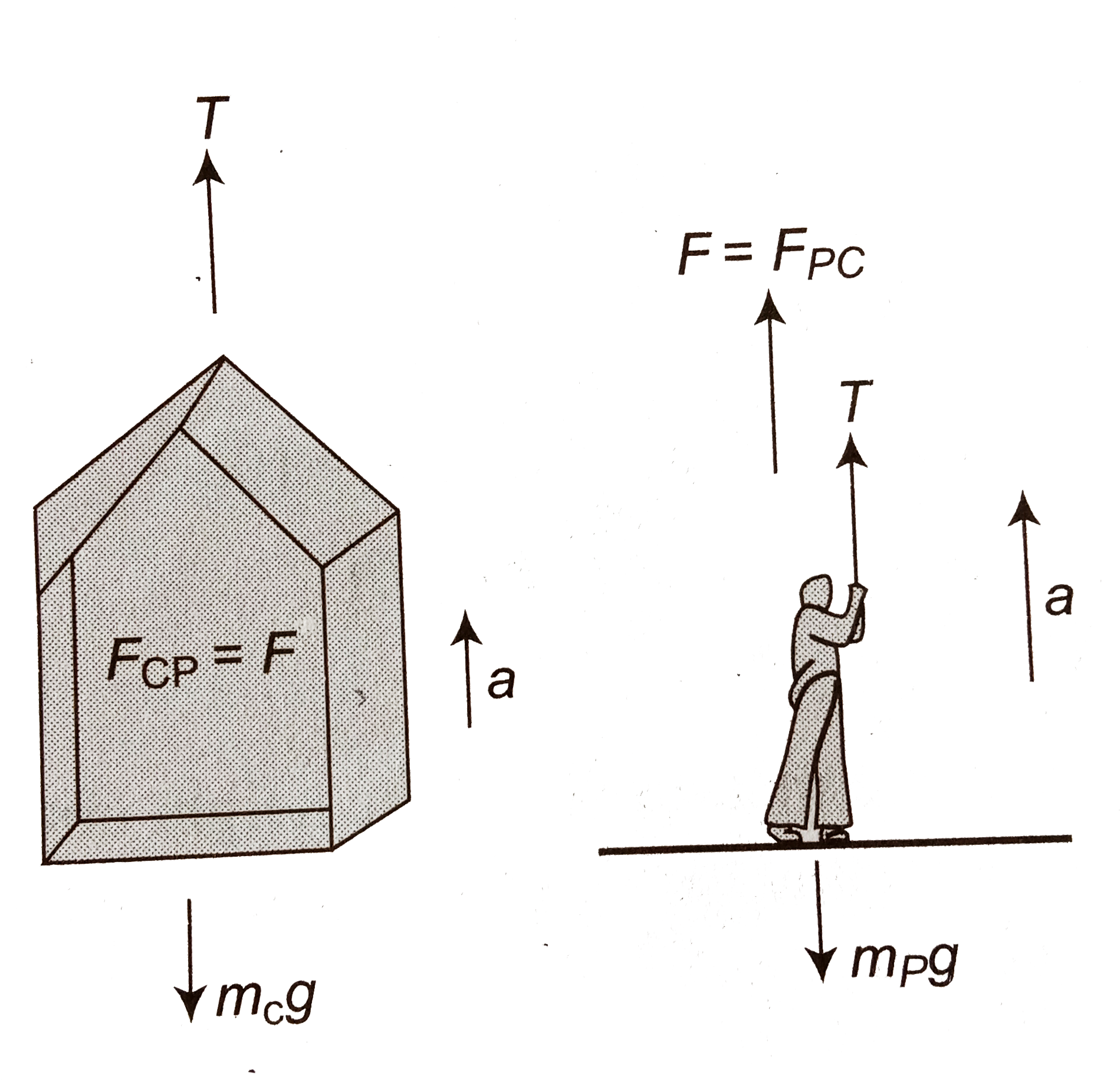
(For printer) `T+F-m_(p)g=m_(p)a` (i)
(For crater) `T-Fm_(c)g=m_(c)a` (ii)
Subtracting (ii)form (i), we get
`2F+(m_(c)-m_(p))g=(m_(p)-m_(c))a`
`900+(25-100)(10)=75a`
`900-750=75a`
`A=2ms^(-2)` .
Promotional Banner

Topper's Solved these Questions

  • NEWTONS LAWS OF MOTION

    A2Z|Exercise AIIMS Questions|26 Videos
  • MOTION IN TWO DIMENSION

    A2Z|Exercise Chapter Test|29 Videos
  • OSCILLATION AND SIMPLE HARMONIC MOTION

    A2Z|Exercise Chapter Test|29 Videos

Similar Questions

Explore conceptually related problems

In the given diagram, with what force must the man pull the rope to hold the plank in position? Weight of the man is 60 kg. Neglect the weight of plank, rope and pulley.

In the given diagram, with what force must the man pull the rope to hold the plank in position? Mass of the man is 80kg. Neglect the weights of plank, rope and pulley. Take.

System is shown in the figure and man is pulling the rope from both sides with constant speed u find the speed of the block.

In fig. the man and the platform together weight 950N. The pulley can be treated as frictionless. Determine how hard the man has to pull on the rope to lift himself upward above the ground with constant velocity. If the weight of man is 550 N, what is the normal reaction between them?

A block of mass M is tied to one end of a massless rope the other end of the rope is in the hands of a man of mass 2M as shown in the figure the block and the man are resting on a rough plank of mass M as shown in the figure the whole system is resting on a smooth horizontal surface the man pulls the rope pulley is massless and friction what is the displacement of the plank when the block meets the pulley ( Man does not leave his position on plank during the pull)

The period of the free oscillations of the system shown here if mass m_(1) is pulled down a little and force constant of the spring is k and masses of the fixed pulleys are negligible, is

A man of mass M stands on a.box of mass m as shown in the Fig. 2E. l (a). A rope attached to 'the box and passing over an overhead pulley allows the man to raise himself and the box by , pulling the rope downward. (i) With what minimum force should the ' man pull the rope so as to prevent himself , from falling down. (ii) If the man pulls the rope with a force F greater than the minimum force, then determine the acceleration of the (man + box) system. (iii) Determine. the normal reaction between the man and the trolley.

In the figure shown, the light thread is tightly wrapped on the cylinder and masses of plank and cylinder are same each equal to m . An external agent begins to pull the plank to the right with a constant force F. The friction between the plank and the cylinder is large enough to prevent slipping. Assume that the length of the plank is quite large and the cylinder does not fall off it for the time duration concerned. (a) Find the acceleration of the cylinder. (Hint : don’t write any equations) (b) Find the kinetic energy of the system after time t .

A plank of mass M is placed on a rough horizontal force F is applied on it A man of mass m rens on the plank find the acceleration of the man so that the plank does not move on the surface . The coefficent of friction between the plank and the surface is mu Assume that the man does not slip on the plank

A solid cylinder of mass M and radius 2R is rolled up on an incline with the help of a plank of mass 2M as shown in the figure. A constant force F is acting on the plank parallel to the incline. There is no slipping at any of the contact. The friction force between the plank and cylinder is given by:

A2Z-NEWTONS LAWS OF MOTION-Chapter Test
  1. Beads A and B each of mass m , are connected by a light inextensible c...

    Text Solution

    |

  2. Two masses are connected by a string which passes over a pulley accele...

    Text Solution

    |

  3. In the figure shown the force with which the man should pull the rope ...

    Text Solution

    |

  4. A mass M is hung with a light inextensible string. Tension in horizont...

    Text Solution

    |

  5. Two masses rest on smooth surface as shown in the figure. Force exerte...

    Text Solution

    |

  6. There blocks of masses m(1) , m(2) and m(3) are connected by may less ...

    Text Solution

    |

  7. A body, under the action of a force vec(F)=6hati -8hatj+10hatk , acqui...

    Text Solution

    |

  8. Three light rods from a right angled triangle. The tension in the rod ...

    Text Solution

    |

  9. A light string of 70cm has its two ends tied at the same level 50cm a...

    Text Solution

    |

  10. A person holds a spring balance with a mass m hanging from it goes up ...

    Text Solution

    |

  11. Two equal masses are kept on the pans of a simple balance in a lift ac...

    Text Solution

    |

  12. The force required to just move a body up an inclined plane is double ...

    Text Solution

    |

  13. A mass of 4kg is suspended by a rope of length 4m from a ceiling. A fo...

    Text Solution

    |

  14. In the figure, a block of weight 60N is placed on a rough surface. Th...

    Text Solution

    |

  15. A rocket is going upward with acceleration motion. A man sitting in it...

    Text Solution

    |

  16. A body is moving under the action of two force vec(F(1))=2hati-5hatj ,...

    Text Solution

    |

  17. A body of mass 10kg is acted upon by two perpendicular force, 6N . The...

    Text Solution

    |

  18. A monkey of mass 20kg is holding a vertical rope. The rope will not br...

    Text Solution

    |

  19. A body mass 2kg has an initial velocity of 3 metre//sec along OE and i...

    Text Solution

    |

  20. A force of 100N need to be applied parallel to a smooth inclined plane...

    Text Solution

    |

