Home
Class 11
PHYSICS
Two pendulum each of length l are initia...

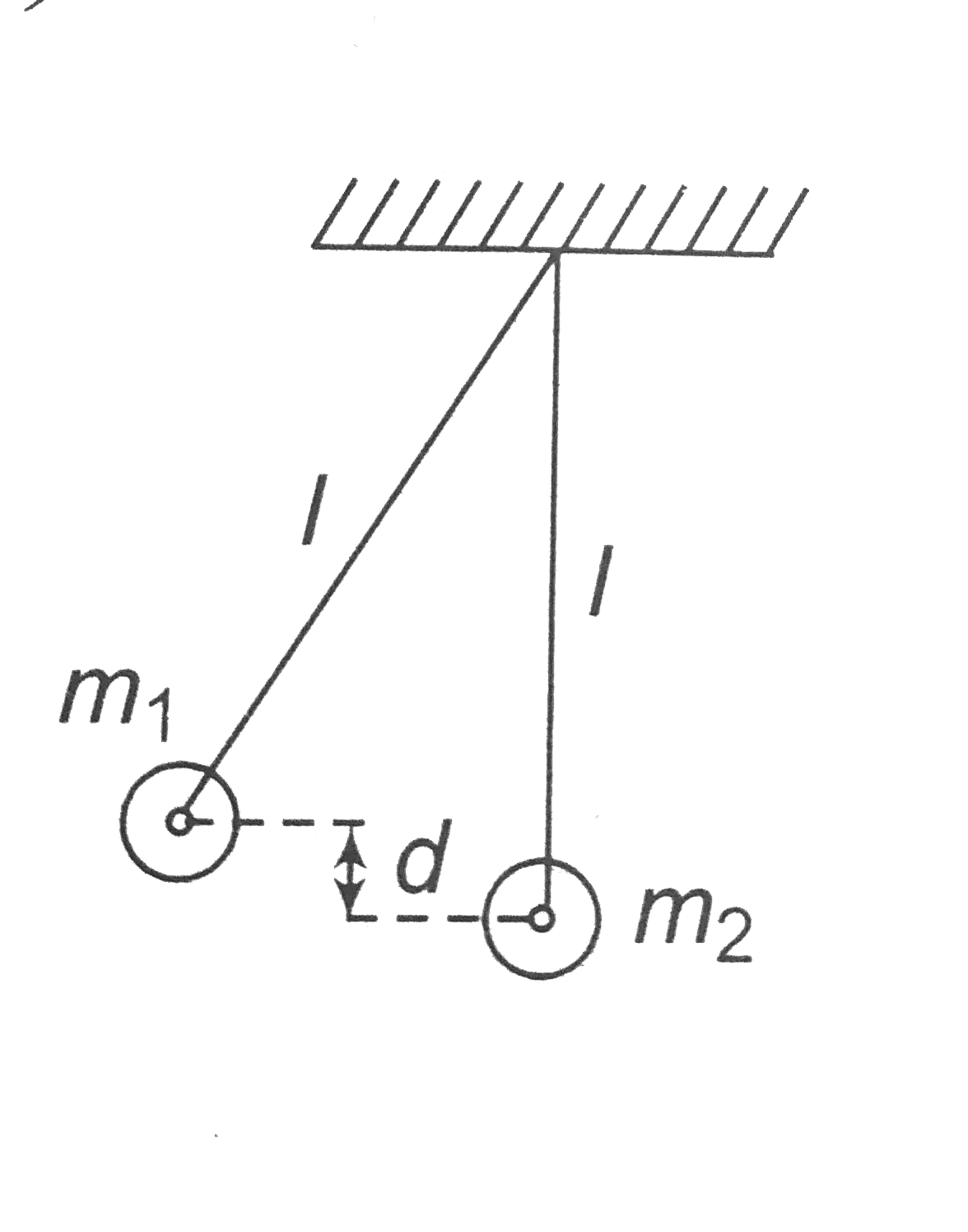
Two pendulum each of length `l` are initial situated as shown in figure. The first pendulum is released and strikes the second . Assume that the collision is completely inelastic and neglect the mass of the string and any frictional effects. How high does the center of mass rise after the collision?

A

`d [(m_(1))/((m_(1) + m_(2)))]^(2)`

B

`d [(m_(1))/((m_(1) + m_(2)))]`

C

`(d(m_(1) + m_(2))^(2))/(m_(2))`

D

`d [(m_(2))/((m_(1) + m_(2)))]^(2)`

Text Solution

Verified by Experts

The correct Answer is:

A

Applying the law of conservationof momentum
`m_(1) v_(1) = (m_(1) + (m_(2))V`
`v_(1) = sqrt(5gl)` is the velocity with which `m_(1)` collides with `m_(2)`. We get `V = (m_(1))/((m_(1) + m_(2))) sqrt(2gd)`
Now , let the center of mass rise through a height `h` after collision. In this case, the kinetic energy of `(m_(1) + m_(2))` system is converted into potential energy at maximum height `h`
`(1)/(2) (m_(1) + m_(2)) V^(2) = (m_(1) + m_(2)) gh`
`(1)/(2) (m_(1) + m_(2)) {(m_(1))/(m_(1) + m_(2))} ^(2) . 2 gd = (m_(1) + m_(2)) gh`
`h = d {(m_(1))/(m_(1) + m_(2))} ^(2)`
Promotional Banner

Topper's Solved these Questions

  • WORK, ENERGY, POWER AND COLLISION

    A2Z|Exercise Problems Based On Mixed Concepts|32 Videos
  • WORK, ENERGY, POWER AND COLLISION

    A2Z|Exercise Assertion Reasoning|17 Videos
  • WORK, ENERGY, POWER AND COLLISION

    A2Z|Exercise Circular Motion In Vertical Plane|21 Videos
  • WAVES AND ACOUSTICS

    A2Z|Exercise Chapter Test|30 Videos

Similar Questions

Explore conceptually related problems

Two pendulums each of length l are initially situated as shown in Fig. The first pendulum is released and strikes the second. Assume that the collision is completely inelastic and neglect the mass of the string and any frictional effects. How high does the centre of mass rise after the collision?

Two pendulums each of lengh l are initially situated as shown in figure. The first pendulum is released and strikes the second. Assume that the collision is completely inelastic and neglect the mass of the string and frictional effects. How high does the centre of mass rise after the collision ?

Two balls having masses m and 2m are fastened to two light strings of same length l figure. The other ends of the strings ar fixed at O. The strings are kept in the same horizontal line and the system is released from rest. The collision between the balls is elastic. a. Find velocities of the balls just after their collision. b. How high will the balls rise after the collision.

A ball of mass m moving horizontally at a speed v collides with the bob of a simple pendulum at rest. The mass of the bob is also m. If the collision is perfectly inelastic and both balls sticks, the height to which the two balls rise after the collision will be given by:

A particle of mass m strikes a disc of radius R and mass m with a speed u as shown in the figure. What is the speed of the particle just after the collision if the collision is perfectly inelastic ?

Two massless string of length 5 m hang from the ceiling very near to each other as shown in the figure. Two balls A and B of masses 0.25kg and 0.5kg are attached to the string. The ball A is released from rest at a height 0.45m as shown in the figure. The collision between two balls is completely elastic. Immediately after the collision, the kinetic energy of ball B is 1 J The velocity of ball A just after the collision is

The bob A of a pendulum released from horizontal to the vertical hits another bob B of the same mass at rest on a table as shown in figure. If the length of the pendulum is 1m, calculate (a) the height to which bob A will rise after collision. (b) the speed with which bob B starts moving. Neglect the size of the bobs and assume the collision to be elastic.

A large number of small identical blocks, each of mass m, are placed on a smooth horizontal surface with distance between two successive blocks being d. A constant force F is applied on the first block as shown in the figure (a) If the collisions are elastic, plot the variation of speed of block 1 with time. (b) Assuming the collisions to be perfectly inelastic, find the speed of the moving blocks after n collisions. To what value does this speed tend to if n is very large.

A2Z-WORK, ENERGY, POWER AND COLLISION-Collision
  1. A body is allowed to fall on the ground from a height h(1). If it is r...

    Text Solution

    |

  2. A ball is let fall from a height h(0). There are n collisions with the...

    Text Solution

    |

  3. A body X with a momentum p collides with another identical stationary ...

    Text Solution

    |

  4. A pendulum consists of a wooden bob of mass m and of length L. A bulle...

    Text Solution

    |

  5. Two pendulum each of length l are initial situated as shown in figure....

    Text Solution

    |

  6. A mass 'm' moves with a velocity 'v' and collides inelastieally with a...

    Text Solution

    |

  7. A ball is projected vertically down with an initial velocity from a h...

    Text Solution

    |

  8. A partical falls from a height h upon a fixed horizontal plane and re...

    Text Solution

    |

  9. The bob A of a simple pendulum is released when the string makes an a...

    Text Solution

    |

  10. Two particle moving in the same direction with speeds 4 m//s and 2m//s...

    Text Solution

    |

  11. Body A of mass m and B of mass 3m move towards each other with velocit...

    Text Solution

    |

  12. A ball of mass m is moving normally towards a walll of mass M(gt gt m)...

    Text Solution

    |

  13. The velocity vector of a sphere after it hits a vertical wall which i...

    Text Solution

    |

  14. A partical of mass m(1) collides head on with a stationary partical o...

    Text Solution

    |

  15. A ball of mass 1 kg strikes a heavy platform, elastically, moving upwa...

    Text Solution

    |

  16. The sphere A of mass m(1) moves with velocity V on a frictionless hori...

    Text Solution

    |

  17. A sphere A of mass m moving with a velocity hits another stationary s...

    Text Solution

    |

  18. A ball strickes a horizontal floor at 45^(@). 25% of its kinetic energ...

    Text Solution

    |

  19. N identical balls are placed on a smooth horizontal surface. An anothe...

    Text Solution

    |

  20. A plank of mass m moving with a velocity v along a frictionless horizo...

    Text Solution

    |
