Home
Class 11
PHYSICS
A mass 'm' moves with a velocity 'v' and...

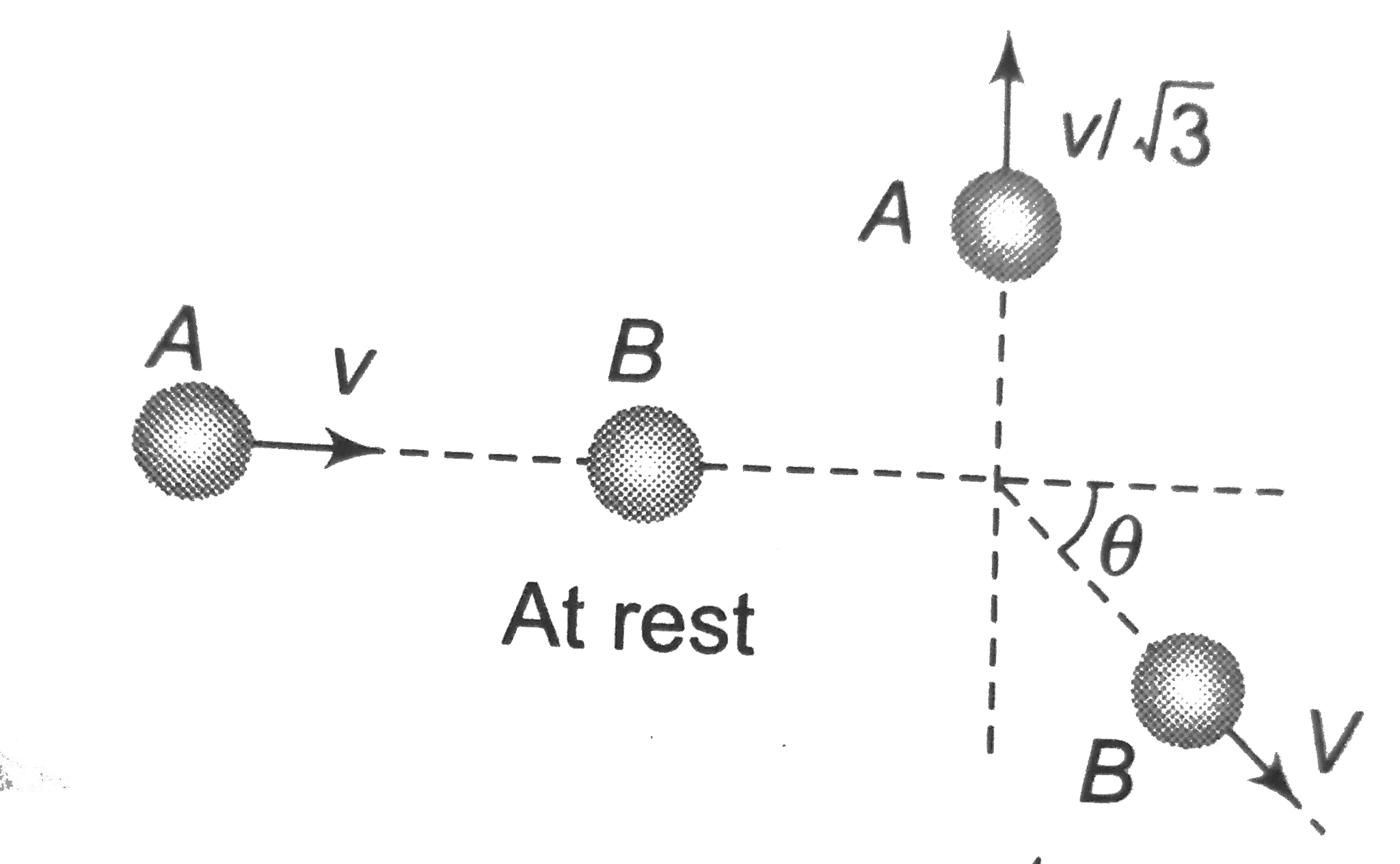
A mass 'm' moves with a velocity 'v' and collides inelastieally with another identical mass . After collision the `1^(st)` mass moves with velocity `v/sqrt3` in a direction perpendicular to the initial direction of motion. Find the speed of the `2^(nd)` mass after collision.
`undersetunderset ((before),(collision))(m)(*rarr) underset(m)* uparrow v//sqrt3 underset((after),(collision):)`

A

`(2)/(sqrt3) v`

B

`(v)/(sqrt3)`

C

`v`

D

`sqrt(3) v`

Text Solution

Verified by Experts

The correct Answer is:
A

Let mass `A` moves with velocity `v` and collides inelastically with mass `B`, which is at rest.

According to problem mass `A` moves in a perpendicular direction and let the mass `B` moves at angle `theta` with the horizontal with velocity `v`.
Initical horizontal momentum of system
(before collision) `= mv` (i)
Final horizontal momentum of system
(after collision) = `mV cos theta` (ii)
From the conservation of horizontal linear momentum
`mv = mV cos theta implies V cos theta` (iii)
Initial vertical momentum of system (bsfore collision) is zero.
Final vertical momentum of system `(mv)/(sqrt3) - mv sin theta`
From the conservation of vertical linear momentum
`(mv)/(sqrt3) - mV sin theta = 0 implies (v)/(sqrt3) = V sin theta` (iv)
By solving (iii) and (iv)
`v^(2) + (v^(2))/(3) = V^(2) (sin^(2) theta + cos^(2) theta)`
`implies (4v^(2))/(3) = V^(2) implies V = (2)/(sqrt3) v`.
Promotional Banner

Topper's Solved these Questions

  • WORK, ENERGY, POWER AND COLLISION

    A2Z|Exercise Problems Based On Mixed Concepts|32 Videos
  • WORK, ENERGY, POWER AND COLLISION

    A2Z|Exercise Assertion Reasoning|17 Videos
  • WORK, ENERGY, POWER AND COLLISION

    A2Z|Exercise Circular Motion In Vertical Plane|21 Videos
  • WAVES AND ACOUSTICS

    A2Z|Exercise Chapter Test|30 Videos

Similar Questions

Explore conceptually related problems

A mass m moves with a velocity v and collides inelastically with another identical mass. After collision the 1st mass moves with velocity v/(sqrt3) in a direction perpendicular to the initial direction of motion. Find the speed of the second mass after collision

A mass ‘m’ moves with a velocity ‘v’ and collides inelastically with another identical mass at rest. After collision the 1st mass moves with velocity (v)/(sqrt(3)) in a direction perpendicular to the initial direction of motion. Find the speed of the 2^(nd) mass after collision :

A sphere of mass m moves with a velocity 2v and collides inelastically with another identical sphere of mass m. After collision the first mass moves with velocity v in a direction perpendicular to the initial direction of motion . Find the speed of the second sphere after collision .

A ball of mass m moving with velocity v collides head on elastically with another identical ball moving with velocity - V. After collision

A particle of mass m moving with velocity u collides elastically head on with a particle of mass 2m at rest. After collision the heavier particle moves with velocity?

A ball of mass M moving with a velocity v collides perfectly inelastically with another ball of same mass but moving with a velocity v in the opposite direction. After collision

A ball of mass m moving with velocity v collides elastically with another ball of identical mass coming from the opposite direction with velocity 2v. Their velocities after collisions are-

A ball of mass m moving with a velocity v undergoes an oblique elastic collision with another ball of the same mass m but at rest. After the collision if the two balls move with the same speeds , the angle between their directions of motion will be:

A2Z-WORK, ENERGY, POWER AND COLLISION-Collision
  1. A body is allowed to fall on the ground from a height h(1). If it is r...

    Text Solution

    |

  2. A ball is let fall from a height h(0). There are n collisions with the...

    Text Solution

    |

  3. A body X with a momentum p collides with another identical stationary ...

    Text Solution

    |

  4. A pendulum consists of a wooden bob of mass m and of length L. A bulle...

    Text Solution

    |

  5. Two pendulum each of length l are initial situated as shown in figure....

    Text Solution

    |

  6. A mass 'm' moves with a velocity 'v' and collides inelastieally with a...

    Text Solution

    |

  7. A ball is projected vertically down with an initial velocity from a h...

    Text Solution

    |

  8. A partical falls from a height h upon a fixed horizontal plane and re...

    Text Solution

    |

  9. The bob A of a simple pendulum is released when the string makes an a...

    Text Solution

    |

  10. Two particle moving in the same direction with speeds 4 m//s and 2m//s...

    Text Solution

    |

  11. Body A of mass m and B of mass 3m move towards each other with velocit...

    Text Solution

    |

  12. A ball of mass m is moving normally towards a walll of mass M(gt gt m)...

    Text Solution

    |

  13. The velocity vector of a sphere after it hits a vertical wall which i...

    Text Solution

    |

  14. A partical of mass m(1) collides head on with a stationary partical o...

    Text Solution

    |

  15. A ball of mass 1 kg strikes a heavy platform, elastically, moving upwa...

    Text Solution

    |

  16. The sphere A of mass m(1) moves with velocity V on a frictionless hori...

    Text Solution

    |

  17. A sphere A of mass m moving with a velocity hits another stationary s...

    Text Solution

    |

  18. A ball strickes a horizontal floor at 45^(@). 25% of its kinetic energ...

    Text Solution

    |

  19. N identical balls are placed on a smooth horizontal surface. An anothe...

    Text Solution

    |

  20. A plank of mass m moving with a velocity v along a frictionless horizo...

    Text Solution

    |

